



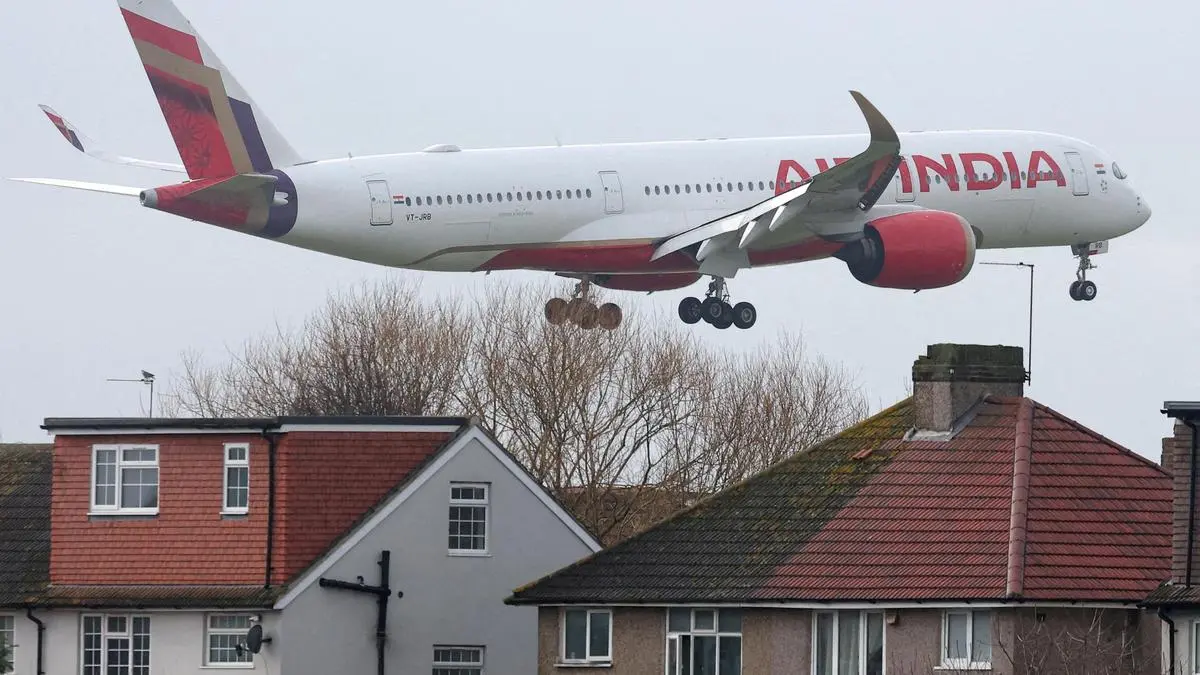
FILE PHOTO: An Air India passenger plane flies near houses as it makes its landing approach to Heathrow Airport in west London, Britain, January 28, 2025. REUTERS/Toby Melville/File Photo | Photo Credit: TOBY MELVILLE
Tata Group-promoted Air India has reduced flight frequencies across several key international routes for May, with reductions of 5 per cent on some routes and up to 25 per cent on others, industry sources told businessline.
The move comes as the Oil Marketing Companies (OMCs) on May 1 decided to increase the price of jet fuel sold for international flights by 5 per cent, adding further cost pressure on airlines already grappling with elevated operational expenses.
Air India did not respond to queries sent by businessline.
North America operations for May have been curtailed by about 20 per cent, with about 40 out of 200 flights it had previously scheduled to operate throughout May having been cancelled.
On European routes, the airline has reduced its weekly frequency on Paris, Copenhagen, and Zurich routes, cancelling close to 20 flights through the month from over 450 flights it had planned to operate.
Australia, another key long-haul market for Air India, sees two out of seven weekly flights cancelled on both the Melbourne and Sydney routes.
Meanwhile, Southeast Asia frequencies have been reduced by 10 per cent for the month.
As per sources, the recalibration reflects ongoing network optimisation in response to demand moderation, rising fuel costs, and evolving operational conditions across international markets.
Industry observers said the combination of higher international jet fuel prices, regulatory cost adjustments, and geopolitical disruptions has intensified pressure on long-haul operations, prompting airlines to reassess capacity deployment across key international routes.
In a recent communication to employees, Air India CEO and Managing Director Campbell Wilson acknowledged the impact of the prevailing geopolitical situation, particularly developments in West Asia, which have affected jet fuel prices, currency exchange rates, and airspace availability.
Wilson noted that many international flights have become unprofitable due to higher jet fuel costs and longer flying routes caused by airspace closures.
He added that while domestic operations have also been affected, the impact remains lower due to government intervention limiting domestic fuel price increases.
According to Wilson, the airline has already reduced select flying for April and May in response to cost escalation pressures, with further schedule adjustments for June and July amid continued challenges in the operating environment.
However, Air India has not yet curtailed its operations for June and July.
Industry sources pointed out that IndiGo is maintaining a wait-and-watch stance and has so far kept its international capacity intact in May compared to April levels.
Nonetheless, on a year-on-year basis, the airline has reduced operations by around 10 per cent, mostly in the Gulf region due to the ongoing conflict.
IndiGo too did not respond to questions in this regard.
Globally, foreign carriers have made similar capacity cuts. Lufthansa recently announced cancelling 20,000 flights between May and October. Qantas has reduced its flights to India at least until October.
Published on May 5, 2026
此内容由惯性聚合(RSS阅读器)自动聚合整理,仅供阅读参考。 原文来自 — 版权归原作者所有。