







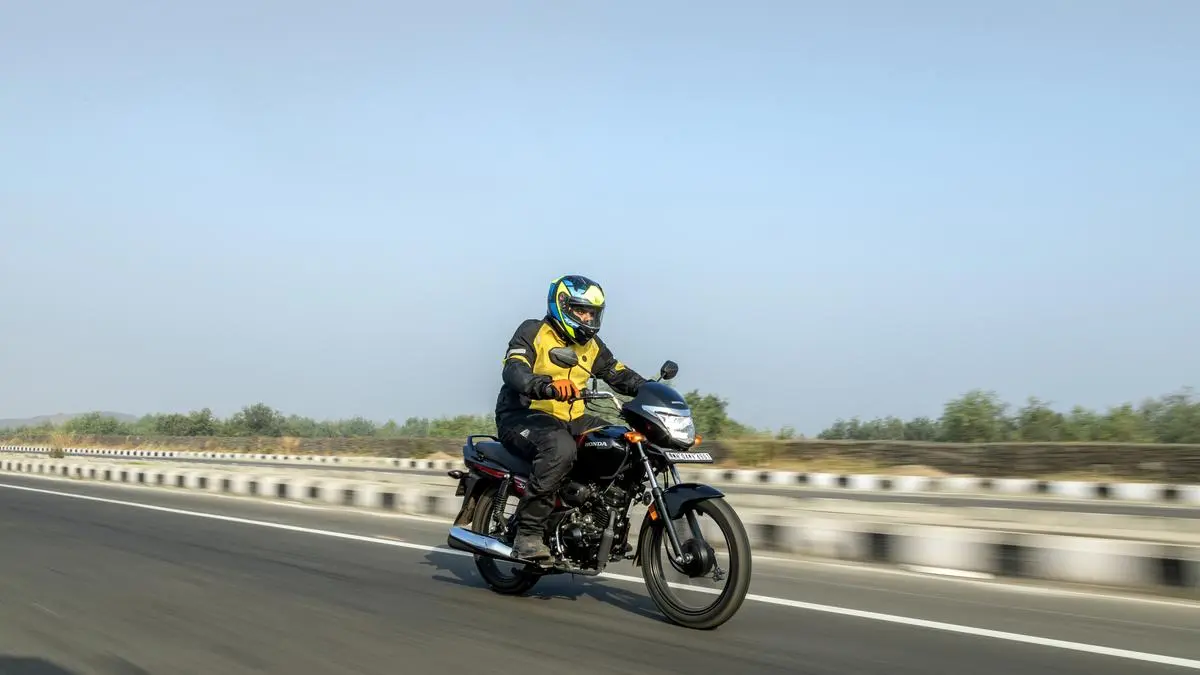
ESSENTIAL SERVICES. The Shine 100 DX keeps its features list crisp. Digital instrumentation is comprehensive, featuring a distance-to-empty readout and easy readability | Photo Credit: Yash Gawde
This is the toughest class of motorcycle to crack. Fuel-efficiency dominates the conversation equalled by an intimidatingly high degree of price sensitivity. Honda’s newest addition to this class (an eternal Hero MotoCorp Splendor monopoly) is well aware of this reality. And it’s done its homework.
Honda appears to have arrived at the Shine 100 DX having taken a deep breath and reassessed the 100cc segment. The cat-and-mouse spreadsheet-clout-chasing approach that typically plagues this class (and also some higher segments) has evidently been avoided, and that should explain why the Shine 100 DX is, despite being the newest in this league, the least powerful, at 7.2 bhp. Given how critical cracking this class of motorcycles is to Honda and others, this output figure must have been arrived at through a data-driven approach. It seems plausible that commuters find little utility in the marginally extra power its rivals offer.

ESSENTIAL SERVICES. The Shine 100 DX keeps its features list crisp. Digital instrumentation is comprehensive, featuring a distance-to-empty readout and easy readability | Photo Credit: Yash Gawde
Instead, Honda has chosen to make the Shine the lightest motorcycle in its class, with a kerb weight of 103 kg. The Hero Splendor, for instance, is 9 kg heavier and the Bajaj Platina, 14 kg heavier! You feel this in an instant, dismounting it from its centre stand and certainly on the move. It’s a delightfully easy motorcycle to shift through tight traffic on, aided by its 17-inch alloy wheels wrapped with MRF NyloGrip Zapper-C tubeless tyres. In the 180 km I rode the Shine, it felt tireless, nimble and just very easygoing. Perhaps, 18-inch wheels would add a stronger sense of stability and composure, although that’s not to say the Shine is lacking in this regard.

The 98.9cc single-cylinder engine is, of course, the heart of the matter and is able to develop its peak torque of 0.8 kg-m earlier than any of its rivals — at 5000 rpm, as compared to the Platina’s 5500 rpm and Splendor’s 6000 rpm. This sets the tone for the kind of rideability you can expect from the Shine, indeed allowing you to crawl comfortably at even 30 kph in fourth gear, while being able to cleanly pull away towards the top end of its performance without downshifting. Beyond 70 kph, though, the Shine begins to feel strained (acceptable, in context of the class) with a buzz incrementally emerging through its footpegs.

The 98.9cc single-cylinder engine is able to develop its peak torque of 0.8 kg-m earlier than any of its rivals | Photo Credit: Yash Gawde
What feels enjoyable is really low-speed urban riding, where the engine’s refinement and especially the gearshift quality shines. It sure doesn’t offer the buttery smoothness of a 125, but on its own, it’s a really pleasant motorcycle to run errands on. As long as you ride it in an ‘efficiency’ frame of mind, you’ll struggle to find fault with it. What I didn’t enjoy as much were the brakes. The front drum is prone to fading under aggressive usage, requiring the rear brake to chip in. I also wished for a firmer seat (not what the masses want, apparently); an hour of riding later, I did begin to experience tailbone discomfort. Fortunately, the Shine on the whole is an ergonomically generous motorcycle, so at no point did I feel cramped or too large for it, even if I am!

Is the Shine 100 DX a no-brainer, given that its ₹71,743 (ex-showroom, Mumbai) price tag undercuts the Splendor by a little over ₹3,000? That, mind you, is roughly two months’ worth of fuel expenses, if you commute 40 km a day and extract 60 kpl (easy; can go higher, too) from it. The answer is ‘yes’ if a light, effortless motorcycle is your idea of an ideal commuter. And if you have a thing against monopolies.
@The MotorGram
Published on March 6, 2026
此内容由惯性聚合(RSS阅读器)自动聚合整理,仅供阅读参考。 原文来自 — 版权归原作者所有。