









The upcoming Volvo EX30 is bound to make owning a Volvo EV even easier. To be positioned below the existing C40 and EX40 Recharge, the EX30 is bound to be the smallest Volvo SUV yet. Does that mean it’ll be devoid of character, or that it’ll look boring? The answer to that is a reassuring ‘no’. This is Volvo’s first ground-up EV, built on the company’s Sustainable Experience Architecture (SEA) platform. We drove the car ahead of its launch to see what Volvo has in store for the buyer.
We start with the looks, and a mere glance will tell you that this is no half-baked project. The front-end styling is clean, devoid of a conventional grille, but has character thanks to Volvo’s Thor’s Hammer DRLs and sleek LED headlights. The squatting stance makes the EX30 more appealing, complemented by 19-inch aero-optimised wheels, nearly no overhangs, and a wide track. At the back, a new split taillight is a distinct move away from Volvo’s oft-copied design. On the whole, the EX30 is a great mix of familiar and new, something Volvo desperately needed in its design. Unfortunately, the bold colours shown at the car’s global unveil won’t make it to India. That’s a shame because the EX30’s overall design suits bright paints.
package deal
The EX30 seems quite likeable on the inside, too, with a great mix of minimalist design and high-quality materials, all in a smaller package. Despite that, the cabin feels airy, and the fixed panoramic sunroof furthers that. The use of recycled materials ups the environment-friendly quotient while the granite-like inserts on both the dashboard and doors lend some added character to the interior design. The dual-tone grey-and-black theme works well, and the highlight of the dashboard has to be the 12.3-inch touchscreen system. The infotainment unit has a portrait orientation and runs on Google’s suite, with embedded services such as Maps, Play Store, and Assistant. There’s also wireless Apple CarPlay and a 9-speaker Harman Kardon audio system, which is placed in a unique sound-bar-like form on the dashboard.
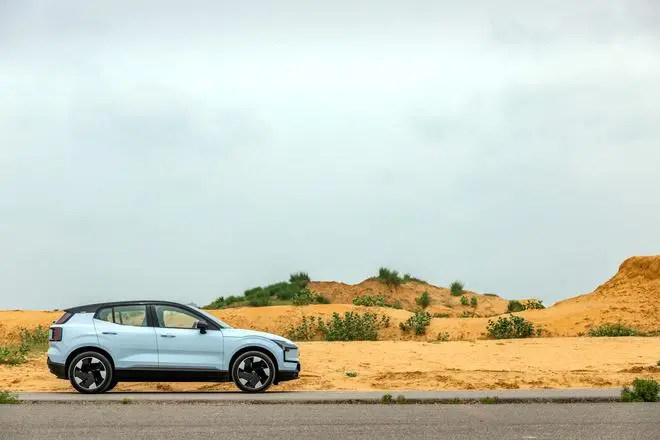
The EX30’s steering is light but precise, making the SUV an excellent tool for urban driving | Photo Credit: Kaizad Adil Darukhanawala
Clever packaging like that opens up more space in the door cards. Other features are a dual-zone climate control, wireless phone charging, air purifier, NFC card key, powered front seats, seven airbags, 360-degree camera, TPMS, blind-spot monitoring, hill start and descent, and even a full ADAS suite, among others.
It’s going to be the smallest Volvo SUV, and the rear seat space is a clear giveaway. The EX30 can still accommodate two adults at the back, but the upright backrest and low lumbar support mean it’s unlikely to be an ideal long-trip companion. The seats at the front are more supportive, but we wouldn’t mind a bit of extra padding. The floor is flat and the boot space is quite generous (for the EX30’s size). What will take some time getting used to is the lack of a driver’s instrument cluster. This also means that in addition to every function being handled by the infotainment system, you will need to look at the central (and only) screen for speed and navigation.
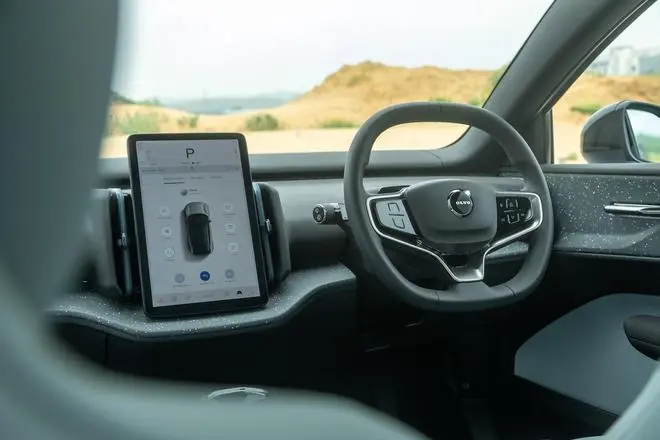
The dual-tone grey-and-black theme works well, and the highlight of the dashboard has to be the 12.3-inch touchscreen system | Photo Credit: Kaizad Adil Darukhanawala
The single-motor, rear-wheel drive model destined to be available in India is powered by a 268-bhp, 34.97-kg-m setup. While a dual-motor version would’ve possibly been more appealing, these are quite decent numbers. The company claims the EX30 can hit 100 km/h from a standstill in under 6 seconds, which, while devoid of noise or drama, is pretty much in the performance-hatch territory. It feels effortlessly quick, with its power delivery being immediate but linear and manageable.
The EX30’s steering is light but precise, making the SUV an excellent tool for urban driving. It’s not exactly engaging, which is a bit disappointing, though. The suspension, on the other hand, feels firm at low speeds, but it’s otherwise comfortable and absorbs road undulations surprisingly well. At highway speeds, the EX30 is planted, despite its small footprint. It’s clear that Volvo has chosen comfort and ease over driving fun, but that doesn’t make the EX30 a slouch in the corners. On the practical side, the SUV’s 69 kWh battery is claimed to reach up to 480 km on a full charge. We think about 400 km should be doable, although we’ll need to spend some more time behind the wheel to understand how true that claim is.
The timing for the EX30 couldn’t have been better. It offers great premium, all-electric motoring without being too difficult to live with in the modern urban environment. From the little time we spent with the car, it became quite clear that this is more than just another EV from Volvo. As the entry point to Volvo’s range of products, the EX30’s young shoulders a fairly big responsibility. It fares well for the most part, especially in the way the car has been put together, how nothing ever feels like a compromise, and most importantly, the freshness the car brings along with it.
It has the potential to be a brilliant everyday premium EV, especially with great manoeuvrability and presence. It doesn’t shout for attention but there’s no way you’ll be able to ignore it, either. Some more focus on interior comfort would’ve definitely made the EX30 a more rounded product, but right now, everything depends on how Volvo prices this. If the company can get the car in the ₹40-45 lakh bracket, the EX30 has the potential to be a game-changer in the premium EV space.
© Motoring World
Published on August 22, 2025