


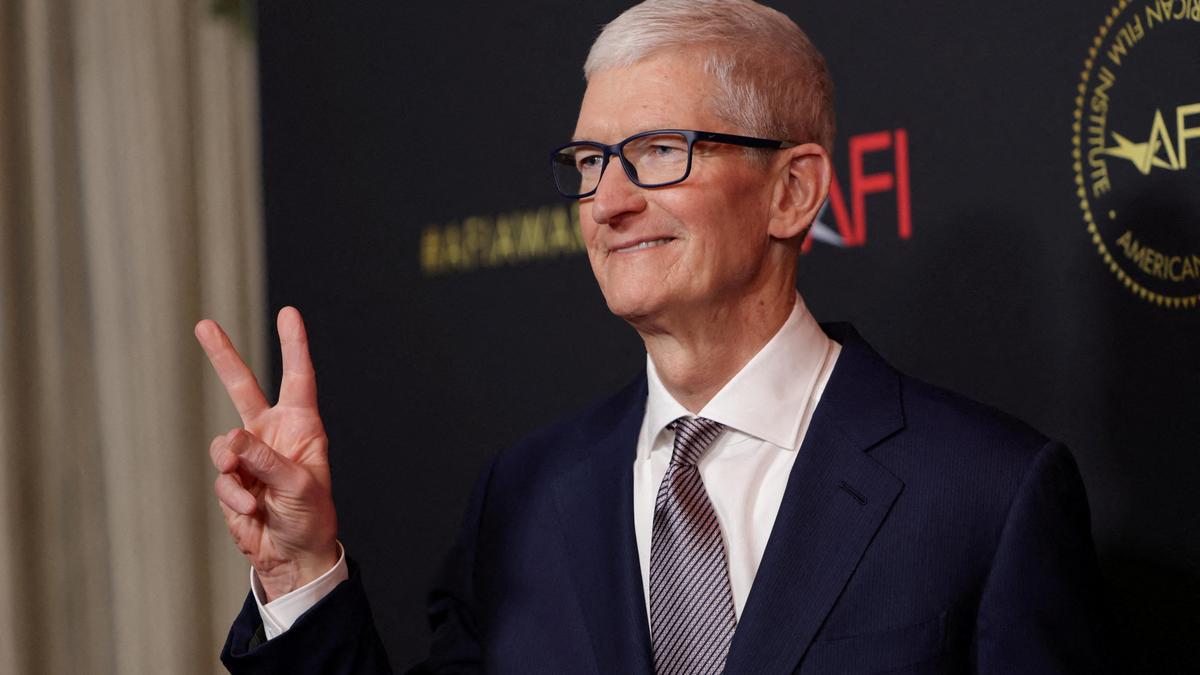
Tim Cook’s era at Apple was defined by operational excellence and ecosystem expansion | Photo Credit: MARIO ANZUONI
Tim Cook’s legacy at Apple is best understood not in comparison to Steve Jobs, but as a redefinition of what leadership after a founder leaves looks like. He did not replicate Jobs’ product genius. Instead, he built one of the most formidable corporate machines in history. Under Cook, Apple transformed itself from a company dependent on breakthrough hits into a highly predictable, cash-generating ecosystem. Revenues multiplied, margins strengthened, and the company’s market value climbed into the trillions.
Yet the critique of Cook is equally consistent. Apple, many argue, became more disciplined but less daring. There was no single product moment to rival the iPhone. Innovations such as the Watch, AirPods, and Apple Silicon deepened the ecosystem, rather than redefine it. Big bets like the Apple Car never materialised, and in emerging areas such as artificial intelligence, the tech major has appeared cautious, even slow, compared to rivals like Google and Microsoft. Nowhere is Cook’s long-game strategy clearer than in India. Once a marginal market, India has, under his tenure, become central to Apple’s future. The company has steadily built a premium consumer base, even as its overall market share remains modest. More significantly, India has emerged as a critical manufacturing hub, reflecting Apple’s effort to diversify beyond China and de-risk its supply chain. Retail expansion, local production, and a growing installed base together signal a structural shift: Apple is embedding itself within India’s economic trajectory.
The transition to the new CEO, John Ternus, a hardware-focused insider, marks a subtle but important pivot. If Cook’s era was defined by operational excellence and ecosystem expansion, the next phase will likely revive Steve Jobs’ era with a strong emphasis on product reinvention. The challenge for Apple under Ternus will be to find its “next iPhone moment” in a world already saturated with devices. At the same time, it must navigate geopolitical tensions, supply chain shifts, and rising regulatory scrutiny.
Apple’s relative restraint in the AI race, often seen as a weakness, could yet prove strategic. Unlike competitors whose business models depend on data extraction and advertising, Apple has the structural advantage of prioritising user privacy. Its emphasis on on-device processing and tightly integrated hardware–software systems positions it to develop AI that is less intrusive and more user-controlled. But leadership in what might be called “AI for good” will require more than branding. It will demand verifiable privacy standards, data minimisation, transparent systems, and a willingness to prioritise trust over rapid monetisation. This may come at the cost of being first or even best in raw capability. Yet, as regulatory pressures mount and public awareness grows, trust could become the defining currency of the AI era. Cook’s tenure, in hindsight, may come to be seen not as an era of missed invention, but as one of strategic preparation.
Published on April 24, 2026
此内容由惯性聚合(RSS阅读器)自动聚合整理,仅供阅读参考。 原文来自 — 版权归原作者所有。