
惯性聚合 高效追踪和阅读你感兴趣的博客、新闻、科技资讯
阅读原文 在惯性聚合中打开

推荐订阅源

Security Archives - TechRepublic
T
The Exploit Database - CXSecurity.com
P
Proofpoint News Feed
Scott Helme
Scott Helme
NISL@THU
NISL@THU
Cisco Talos Blog
Cisco Talos Blog
C
Cybersecurity and Infrastructure Security Agency CISA
AWS News Blog
AWS News Blog
V
Vulnerabilities – Threatpost
J
Java Code Geeks
U
Unit 42
The GitHub Blog
The GitHub Blog
H
Help Net Security
T
Tenable Blog
aimingoo的专栏
aimingoo的专栏
Jina AI
Jina AI
Spread Privacy
Spread Privacy
Apple Machine Learning Research
人人都是产品经理
人人都是产品经理
L
Lohrmann on Cybersecurity
T
Threatpost
让小产品的独立变现更简单 - ezindie.com
Engineering at Meta
Engineering at Meta
A
About on SuperTechFans
I
InfoQ
Microsoft Azure Blog
B
Blog
L
LINUX DO - 最新话题
K
Kaspersky official blog
cs.CV updates on arXiv.org
T
Threat Research - Cisco Blogs
C
Check Point Blog
T
The Blog of Author Tim Ferriss
有赞技术团队
有赞技术团队
宝玉的分享
宝玉的分享
Help Net Security
Help Net Security
Google DeepMind News
A
Arctic Wolf
Y
Y Combinator Blog
N
News | PayPal Newsroom
M
MIT News - Artificial intelligence
Latest news
Latest news
H
Hacker News: Front Page
Blog — PlanetScale
Blog — PlanetScale
腾讯CDC
I
Intezer
爱范儿
爱范儿
F
Fortinet All Blogs
P
Palo Alto Networks Blog
C
CERT Recently Published Vulnerability Notes

BusinessLine Editorial Opinion & Analyses | The HinduBusinessLine

Fund of options No marks Net ambiguity Crushing problem Fiscal dividend Editorial. Power equation Editorial. Reforming schools Editorial. Taking charge Editorial. Coal comfort Editorial. Future shock Editorial. Beyond the ballot Editorial. Halfway house Precious saving Failing the test Poison in the food Editorial. Austere times Bond truths Editorial. Creditable step Editorial. Stardom to statecraft Editorial. Worthy proposal Editorial. Gold rush Editorial. Power shift Editorial. Costly remedy Bad policy The real turnout Challenge of Mythos Fuel for thought Anchoring trade Cover point Editorial. Job well done Editorial. Misreading markets Editorial. Major undercurrents Labour pangs Editorial. Snooping around Prepare the ground Clear the smoke SIP with caution Cyber insecurity Pressure point Plastic concerns Editorial. Fair deal Editorial. Wait and watch Cease and desist Editorial. Nuclear milestone Editorial. Freebies unplugged Editorial. Sweeping powers Editorial. Knotty regulations Up in the air Challenging year Existential crisis Bond blues Editorial. Hard choices Editorial. Commercial pitch Editorial. Weighty matter Editorial. Micro management Editorial. Selling strategy Editorial. Plane truths Demographic fixation Editorial. Resignation and after Feedstock facts Course correction Scenario planning Electric kitchens Editorial. Tariff war 2.0 Editorial. Dry run Editorial. China positive Editorial. Ethanol drive Editorial. Safety Net Editorial. Ides of March Stress management Editorial. Reforms vindicated Editorial. Hard times Categorisation challenges Optimal bandwidth Strong base Editorial. Fresh pain REIT moves Editorial. Last mile finance Editorial. Rhetoric to reality Editorial. Critical alliance Intelligent summit Tricky pitch Capital move Spectrum redefined Realty check Hefty penalty needed for mis-selling financial products TCS, Infosys, HCL Tech, Wipro: IT’s opaque Editorial. InvIT with care Rafale buy a watershed in defence upgrade efforts Creditable move Freedom from toxicity India Inc. manages to overcome adversity in Q3 Editorial. At a crossroads Trade reset Editorial. Staying the course CPI overhaul will result in contemporary inflation numbers Tariff cheer 16th Finance panel formula awards ‘efficient’ States Better options ahead Editorial. Change and continuity
Editorial. Process deficit
2026-04-19 · via BusinessLine Editorial Opinion & Analyses | The HinduBusinessLine
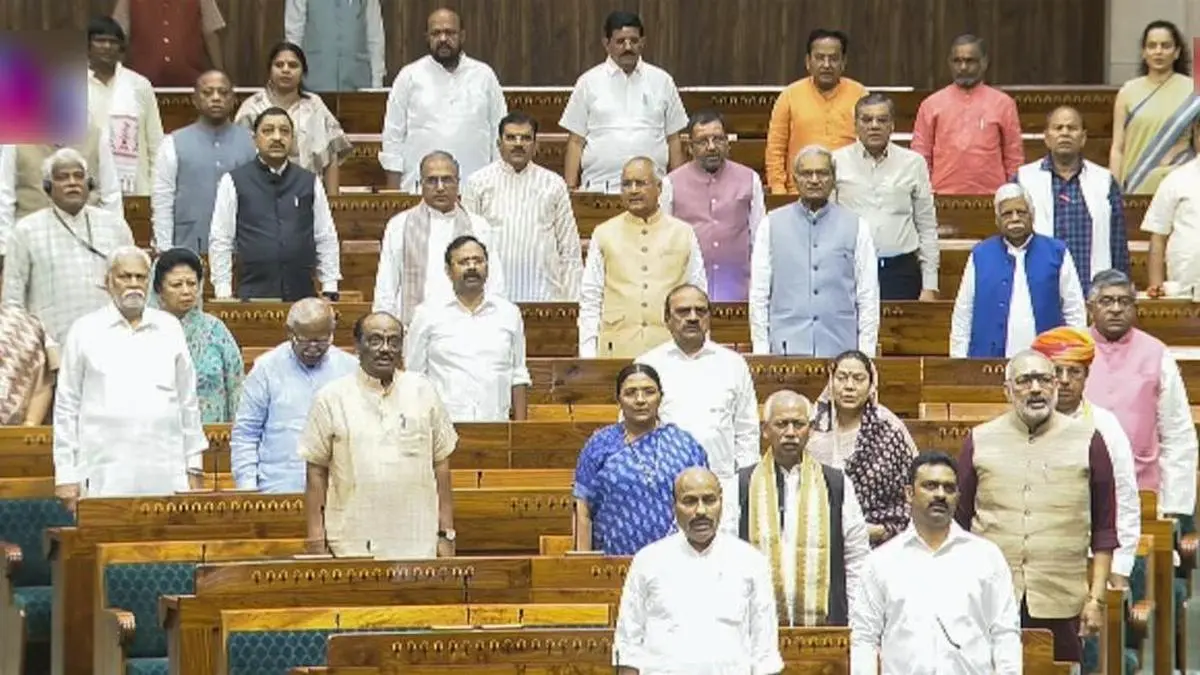
MPs stand for Vande Matram before the adjournment of Lok Sabha on the last day of the Budget Session (2026-27) of Parliament, in New Delhi on Saturday (file photo).

MPs stand for Vande Matram before the adjournment of Lok Sabha on the last day of the Budget Session (2026-27) of Parliament, in New Delhi on Saturday (file photo). | Photo Credit: ANI

The defeat of the Constitution (One Hundred and Thirty-First Amendment) Bill, 2026 in the Lok Sabha raises questions about why a special session of Parliament was convened in the midst of Assembly elections to hastily pass a highly contentious Constitutional amendment. Given the sensitivity of the issue, it should’ve been obvious that such a Bill would not pass the Lok Sabha amidst elections in a couple of the very States that would be undercut by its provisions. Yet, political calculations seem to have been behind the move as seen by how Prime Minister Narendra Modi immediately launched into the Opposition for what he called “female foeticide”.

The fallen Bill was a radical departure from the existing Constitutional scheme freezing the number of seats in the Lok Sabha and State Assemblies based on the 1971 census. No increase in the total number of seats can occur until the first census after 2026 is published. The 2026 Bill proposed to omit the provisions in Articles 82 and 170 that enforce this freeze. Most significantly, it proposed redefining “population” on the basis of the “population figures of the latest published census”. This would have allowed the government to use 2011 census data to increase the seats immediately. It simultaneously proposed an expansion in the number of Lok Sabha seats to 850 (815 from States and 35 from Union Territories). It then sought to amend the existing Nari Shakti Vandan Adhiniyam — which granted 33 per cent reservation for women but explicitly stated that it would come into effect only after a delimitation exercise following the “first census taken after 2023” has been completed, a provision that pushed implementation of women’s reservation to after 2029.

One cannot argue against the Constitutional principle enshrined in Article 81(2)(a) guaranteeing “one person, one vote, one value”, which necessarily involves seat expansion on the basis of population. But there is a reason why successive governments — the last being the one led by the late Atal Bihari Vajpayee — ensured that the number of Lok Sabha seats that each State has remained frozen. It prevented the representation of five southern States from falling from 24.3 per cent to 20.7 per cent and put a stop to increase in representation of northern States by 5 per cent. The related amendments in the Constitution dictated that this arrangement would be valid until the first census after 2026. The Nari Shakti Vandan Adhiniyam in 2023 inserted Article 334A into the Constitution, linking the implementation of women’s reservation to the first census and delimitation taken after this legislation was enacted.

The government now sought to accelerate implementation by tethering women’s reservation to the 2011 Census. While constituency size needs to be adjusted for population, anxieties of southern States must be addressed. This process has to be a masterclass in trust-building. It cannot be achieved by forcing Constitutional amendments amidst an active election cycle.

Published on April 19, 2026