






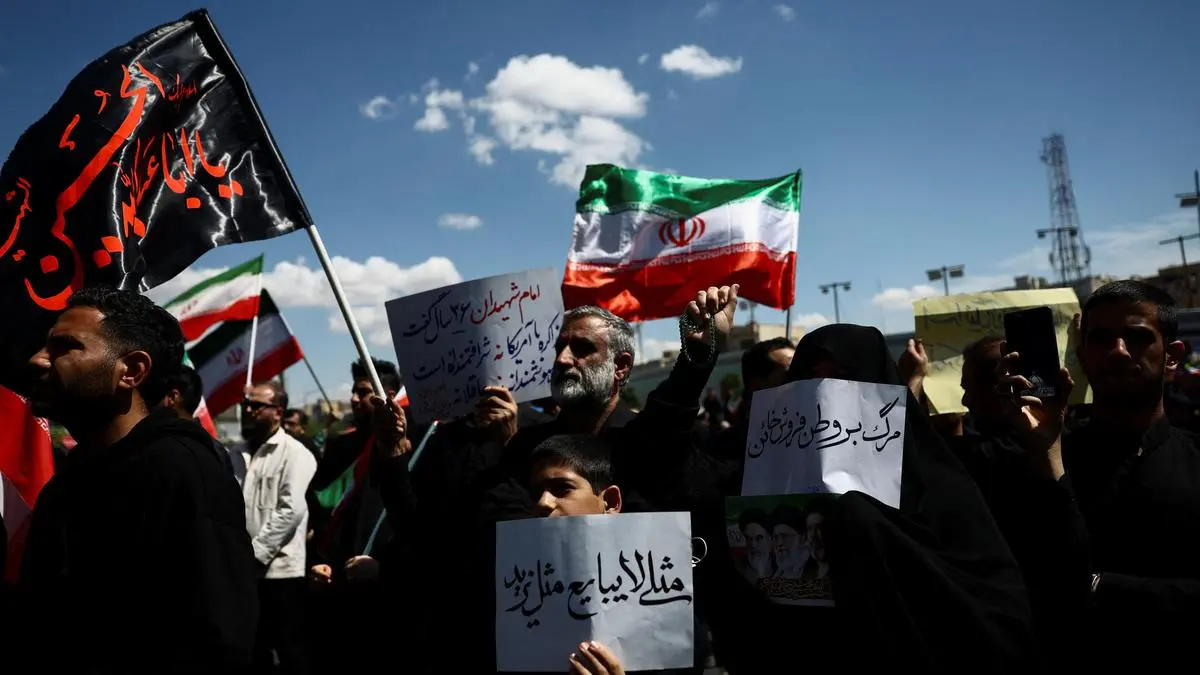
The power play is intriguingly poised, with Iran possibly having an edge | Photo Credit: MAJID ASGARIPOUR
After 40 days of utter mayhem, the US and Iran have agreed to a two-week ceasefire — on a war that the US should not have begun in the first place. Markets have responded with a huge sense of relief, with Brent crude diving below $100 a barrel, and Sensex/Nifty posting near 4 per cent gains. The rupee gained 0.5 per cent over Tuesday’s close on Wednesday, ending at 92.58 to the dollar. Coming just hours after US President Donald Trump’s threats to blow up Iran, the ceasefire comes as a welcome anti-climax.
Now, both sides are expected to conduct talks on the basis of an ambitious set of proposals. While it is anyone’s guess whether this truce endures, major economies and businesses have been pushed to the wall by dizzying levels of disruption and uncertainty — and that includes the US. The Trump administration is facing an economic, political and possibly global blowback. It is being increasingly perceived that China, the world’s second largest economy and the main buyer of Iranian oil, is behind the mediation efforts, even as talks are being held in Pakistan.
So far, it is apparent that Iran has had the upper hand in the conflict, despite its terrain and towns being battered. One fact alone bears this out: Iran blocked the Strait of Hormuz, open to free international access before the war, and effectively shut off 20 per cent of global oil supplies. It has eased access in recent days on its terms, but not before driving up oil prices by about $50 a barrel over a month. Now, a somewhat defensive Trump says that the ceasefire is predicated on Iran ensuring a “complete, immediate and safe opening” of the Strait of Hormuz — which, absurdly enough, was the state of play before US and Israel wrecked it. Iran has said that the straits, for now, will be opened under military supervision, but that it cannot be restored to the pre-war position. These are negotiating postures — just as Iran has demanded war reparations, lifting of economic sanctions, an end to attacks, the release of frozen assets and a UN security resolution making a deal binding, as part of its 10 demands. The US has pushed for the dismantling of Iran’s nuclear programme as part of its 15-point agenda.
The power play is intriguingly poised, with Iran possibly having an edge. If Trump considers Iran’s proposals “workable”, it perhaps suggests that he is looking for an “off ramp” to end a war that has not achieved any of the stated objectives. This included regime change in Iran, destruction of its military, dismantling of its nuclear programme and controlling the Strait. Ironically, what was once a freely navigable strait could well turn into a tolled one if Iran has its way and that’s a definite loss of face for the US. Both, US and Israel do not seem to have reckoned with Iran’s capacity to make a success of ‘asymmetric warfare’. Going forward, the most desirable outcome of the mediated talks would be to ensure that the Strait is safe and open. Meanwhile, we can expect a geopolitical reset, to US’ detriment. India’s position vis-a-vis the US and China looks complicated now, with Pakistan’s involvement — but the economy will hopefully ease up.
Published on April 8, 2026
此内容由惯性聚合(RSS阅读器)自动聚合整理,仅供阅读参考。 原文来自 — 版权归原作者所有。