


‘Nothing lasts forever, even cold November rain’ – a hard-hitting song on the temporary/ephemeral nature of any phase in life — good or bad. Unfortunately, this profound law of nature was lost on some in the IT services sector and the analyst community. Things were so good for such a long time that it was assumed the decent growth would last forever without any investments, akin to a perpetual motion machine that science actually deems as impossible.
At bl.portfolio, in recent years we have been consistently flagging through our numerous articles the sheer unsustainability of elevated stock prices/valuations that investors in the sector were ignoring and recommending them to stay away given business and macro risks. Now, as stakeholders across the board wake up to the slowdown, which—this time it is not your garden-variety cyclical slowdown—and only got drilled harder by TCS’ major job cut announcement last week, it’s time to ponder on ‘who moved my IT sector cheese?’
Here is a lowdown on what ails the IT services industry. But first, what has led to the current situation?
In 2014, the global broking firm UBS published a report titled – Did IBM Succumb to the “Dumbest Idea in the World”? This was after a white paper was published by the leading investment management firm which became famous for staying clear of the dotcom bubble – GMO LLC, endorsing through its research on Jack Welch’s comment ‘shareholder value is the dumbest idea in the world’.
According to the paper, shareholder value maximisation has been an unmitigated failure, and contributed to some very undesirable economic outcomes. The paper traces the evolution of IBM from the 1970s till 2014. In the 1970s under Tom Watson (son of the founder), IBM’s mission statement was outlined by three principles - Respect for individual employees; a commitment to customer service; and achieving excellence. However, as mentioned in the white paper, under IBM’s Roadmap 2010 under Sam Palmisano, ‘the goal shifted to the primary aim of doubling earnings per share in five years.’
Now, here are some facts to consider. In 2000, IBM was a $150-billion market cap company. In 2010, it was $180 billion. Today, it stands at $233 billion ($241 billion including market cap of hived-off business —Kyndryl Holdings). Hardly any meaningful returns for long-term shareholders even when dividends are included.
Between 2010 and now, its net income has actually declined! In being aggressively focused on SVM, spending much of its annual cash inflows on dividends and buybacks , IBM, which was one of the greatest technology companies of the previous century, mostly missed out on the technology boom of the last two decades.
The white paper makes a very important observation: ‘The obsession with returning cash to shareholders under the rubric of SVM has led to a squeeze on investment (and hence lower growth), and a potentially dangerous leveraging of the corporate sector’.
This is not to say that all companies that invested made it big, but then one can say at least they tried. And neither has not trying and focussing on SVM benefited a key stakeholder – shareholders in these companies.
American philosopher Edward Freeman’s stakeholder theory talks of balancing the interests of all stakeholders – shareholders, customers, employees, suppliers and community. Today while customers of Indian IT services firms may still be happy, it is another matter with all other stakeholders. Poor stock performance is now impacting shareholders, meagre salary hikes have led to dissatisfied employees and on-and-off hiring policies are now hurting the economy as well.
Amongst stakeholders mentioned above, shareholders are the most diverse and volatile of the lot. There are long-term investors, short-term traders, arbitrage players, wild speculators etc. SVM decisions can impact each differently. For example a buyback can benefit either a long term shareholder or an arbitrage player depending on the context. So this begets the question towards whom is SVM focused on?
It’s time for introspection!
Worst growth phase
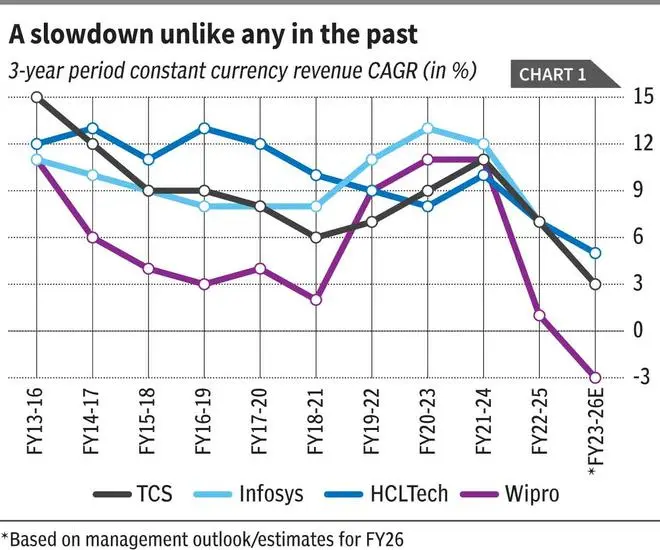
The three-year period from FY24 to FY26 is turning out to be the worst phase in the history of the major IT services companies. Neither during the dotcom bust nor the global financial crisis did they endure a slowdown as bad as in the current phase. For companies like TCS and Infosys, the FY23-26E revenue CAGR (at 3%) is witnessing a greater than 50 per cent drop. Even more stark in the case of Wipro. (see chart 1)
Alarming gap
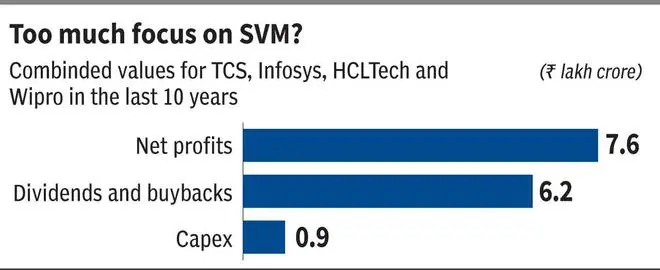
In the last decade, TCS, Infosys, HCLTech and Wipro have invested a mere ₹90,000 crore in capex. Meanwhile, nearly seven times this amount — around ₹6.2 lakh crore — has been returned to shareholders as dividends and buybacks.
Corporate history has examples of all kinds — companies that used surplus cash flows to make reckless diversifications as well as those that used it to reduce dependency on a single core business and invest in emerging businesses. Global Big Techs such as Microsoft, Meta Platforms, Alphabet and Amazon are successful examples of the latter.
Nearly 40 per cent of Microsoft’s revenue today comes from its cloud business. In its June quarter results reported last week, this business grew a stunning 26 per cent. Fifteen years ago, this segment barely existed. Similarly, over 50 per cent of Amazon’s operating profits and its market cap comes from AWS – a business totally unconnected to its original e-commerce business.
Amazon made investments in AWS when its then core e-commerce business was booming and raking in huge cash flows. It could have chosen to return 80-90 per cent of that in the form of buybacks or dividends by focussing on SVM, but rather chose to seed and grow the AWS business, which has created significant value for shareholders. Instagram, which Facebook bought for $1 billion in 2012 and YouTube, which Google purchased for $1.65 billion, are other examples of some risky bets using surplus cash that have created significant value for shareholders.
To avoid reckless diversification, a judicious mix between capital investments/M&A and shareholder returns cannot hurt much. When it comes to technology companies, a good way to measure this is by looking at capex as a percentage of revenue. Since their business are asset light in general, a higher percentage indicates efforts to seed new businesses/revenue streams.
In the last 10 years, Indian Big Techs have invested a mere 1-4 per cent of revenue in capex versus significantly higher levels for Global Big Techs.
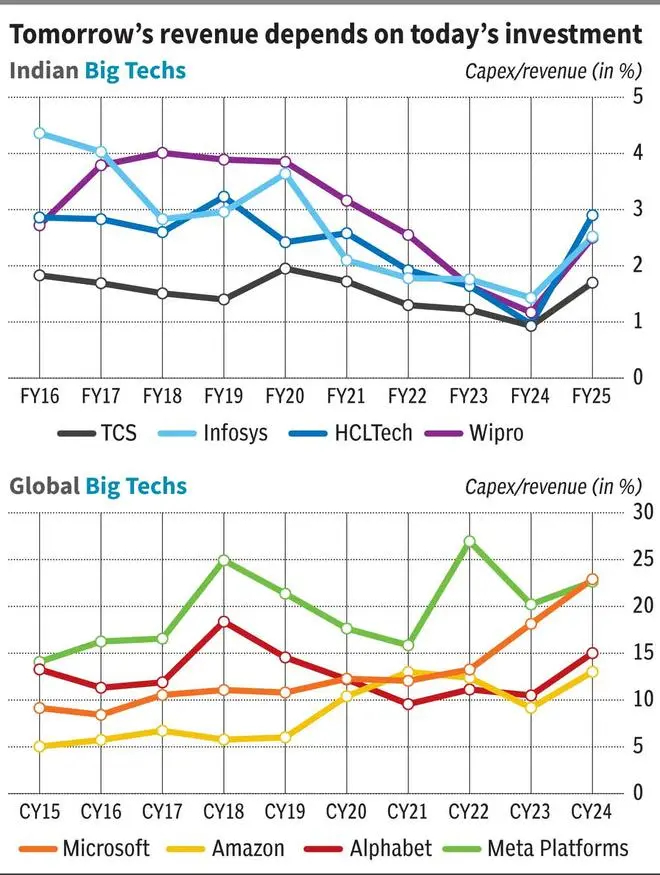
An argument could be made here that most of the Global Big Techs have higher operating margins/profitability, which means more profits per dollar of revenue, and hence can invest more in capex. But this can be countered with example of Amazon, whose profit margins are far inferior to that of Indian Big Techs, yet has significantly higher capex/revenue.
Make hay while the sun shines – the best time to take risks is when the going is so good, that even if you make the worst blunders you will still be in a position to brush it off and move forward. Microsoft or Meta Platforms serve as the best examples here too. Under Steve Balmer, Microsoft made reckless acquisitions — aQuantive, mobile phone business of Nokia, and Skype, all of which had to be written off, burning to dust well over $20 billion of Microsoft’s cash. But none of this hardly harmed Microsoft, as given the annual cash its businesses were raking in, it could comfortably absorb it. So is the case with Meta Platforms with the accumulated losses in its Reality Labs business in the last five years exceeding $60 billion. Yet their share prices are trading at all-time highs today.
However for the Indian Big Techs, while balance sheet remains strong with net cash balances, the ability to take risks has diminished relative to the past for some of them as can be seen from chart below, which tracks net cash as a percentage of revenue.
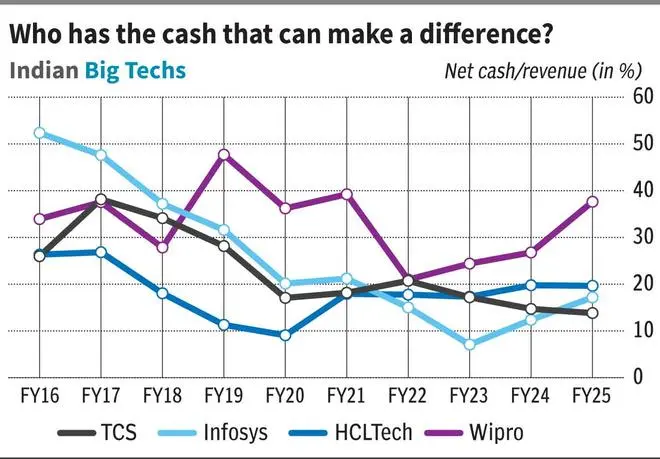
Companies such as TCS and Infosys were better positioned to take risks in FY16/17 when their cash balance as a percentage of revenue was far higher.
In the last 10 years, despite a tight leash on costs, minimal capex, successful transformation of business from legacy to digital services and rupee depreciation, the margins of IT majors have been on a declining trend. Former TCS CEO Rajesh Gopinath had, years ago, set an aspirational target of sustainable EBIT margin band of 26-28 per cent, but that has remained elusive. Vishal Sikka, during his tenure at Infosys, had set an ambitious goal of achieving 30 per cent EBIT margin by 2020, but even in 2025 Infosys’ EBIT margins are way below that at 21 per cent.
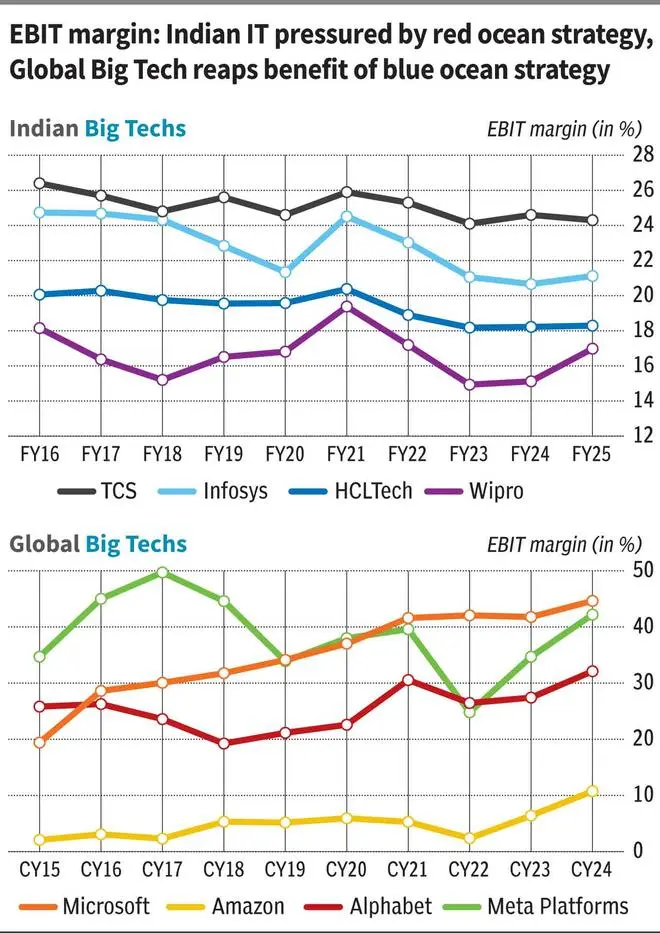
The top four IT services companies have borne the brunt of competition as mid-cap IT players and GCC too compete for a share of the pie and have actually grown much faster in recent years. In the last five years, while the combined USD revenue of top 4 IT players has grown at a CAGR of 7 per cent, that of the top four mid cap IT companies has grown significantly higher at around 18 per cent.
Without a blue ocean strategy, large players are left fighting the red ocean strategy — ‘a business approach where companies compete in existing, established markets, often characterised by intense competition and limited growth opportunities.’
In this context, there is not much hope that margins can get better.
Whether results are strong, average or weak is best deciphered from the quarterly numbers. But then in recent years, there has been a broad-based trend across managements of IT services companies to overload press releases and earnings calls with needless business jargon and amped-up prose.
For example, weak results are sugar-coated with statements like ‘resilient performance amid weak macros’; self-congratulatory statements amid weak numbers like ‘our performance has been robust’; repeating for more than two years amid weak results that ‘we are well positioned for the long term’; talking of AI capabilities without giving any decent detail of how it is contributing to revenue; starting press releases highlighting year-on-year growth when that is not as bad as quarter-on-quarter growth, but in the subsequent quarter without any consistency starting the press release with quarter-on-quarter growth when that is better than year-on-year, and in some cases altogether not mentioning one of them in the press release if it is very bad!
These attempts at managing perception are beginning to fall flat. Eventually, the numbers talk for themselves! One can dig through the last two years of quarterly press releases across different companies in the industry and it would be hard to find any acknowledgement that performance has been weak.
‘Fake it till you make it’ may be a good aphorism, but not a good corporate strategy. If the industry course-corrects on this, it would make for a good beginning.
TCS, Infosys, Wipro have significantly underperformed the Nifty 50 in the last four years. Their valuations, too, have corrected significantly from peak levels. Yet, they don’t appear attractive from a valuation standpoint.
Traditional valuation theory posits that the value of a stock is the net present value of all future cash flows to the shareholder. The future cash flows are discounted by the total of the risk-free rate plus the equity risk premium. By the traditional metrics based on Indian risk-free rate and adding the risk-free premium, the IT services stocks were undoubtedly expensive, yet those valuations sustained during FY21-23. This is where subjective and relative value come into the picture.
Earnings yield or (1/PE) is a rule of thumb measure to assess the relative attractiveness of a stock vs other options. For example, take the 10-year risk-free rate in India, which is at around 6.4 per cent. Today, TCS trades at a PE of around 22 times or earnings yield of 4.5 per cent .Why should an investor go for it when one is assured of 6.4 per cent annual return from a risk-free investment?
The belief here is that TCS’ earnings will grow and over a 10-year period, the growth in earnings will make up for the lower starting point. Ideally, apart from high-growth companies, one must be cautious when buying a stock with earnings yield well below risk-free rate as in the above example. Yet, TCS traded at above 35 times two-three years ago, implying an earning yield of just 2.8 per cent and lower.
Investor speculation apart, this was sustained by the relative attractiveness of the stock not to an Indian investor, but an FII whose alternate option was near-zero risk-free rate in developed economies. With global bond yields surging in the last two years, the relative attractiveness of Indian IT stocks has significantly diminished and poor performance apart, this too is a factor in the significant valuation derating in stocks. And measured by this metric — IT stocks’ earnings yield minus US 10-year bond yield, they are as unattractive as they have been in the last 10 years.
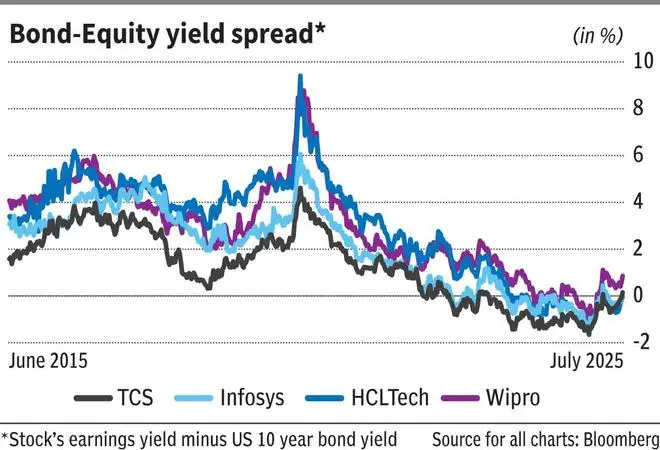
IT stocks have long been a cornerstone of Indian investors’ portfolios, yet these former darlings are increasingly becoming a source of concern. Besides factors detailed above, IT stocks have a few macro headwinds to deal with — a slowing US economy and tariff-related uncertainties that is impacting client decisions. The recent years have proven that without a hedge to cushion slowdown, the companies are at the mercy of the business cycle. So, a key factor to track from a short- to medium-term perspective is how the business cycle trends. If it rebounds, companies can play the cycle well again. But this does not solve the long-term challenges elucidated above. Long-term investors need to assess how these companies address these challenges.
Once a technology company falls behind in innovating, it may, akin to Zeno’s paradox, face an insurmountable challenge in catching up and taking the lead again For long-term investors, this should matter the most.
Published on August 2, 2025
此内容由惯性聚合(RSS阅读器)自动聚合整理,仅供阅读参考。 原文来自 — 版权归原作者所有。