





Even the smartest men in the history of the world – like Isaac Newton or Albert Einstein – have burnt their money in the markets. So it should not be much of a cause for despair if you, too, have lost money in the current market correction. That said, if you have lost money or your investments have underperformed badly like the experience of some investors or fund managers in IT stocks in the last four years, then, maybe, you must introspect how it went wrong. The Nifty 50, despite the severe correction in the last six months, is up 36 per cent in the last three years while Nifty Midcap 150 and Smallcap 250 indices are up by 81 and 70 per cent respectively. But Nifty IT, from its prior peak in 2022 is down by 4 per cent in three years and down 18 per cent from its recent peak in December 2024. Few individual IT stocks are down over 50 per cent over the last 3-4 years.
After all, Einstein also supposedly had said insanity is‘doing the same thing over and over and expecting a different result’. So buying overvalued IT stocks expecting CY21 and CY22 growth rates to sustain and gains to continue was the quintessential folly, as pointed out in the quote. For, since the dotcom boom days it is well understood that buying overvalued IT stocks and overestimating their business growth rates will end in tears. But alas, as George Santayna said, those who forget history are condemned to repeat it.
By mid-2021, if history and some industry insights were sufficient guides, it was getting clear that the IT stocks were reaching extreme overvaluation territory. This was the reason that resulted in bl.portfolio shifting to a cautious stance on the sector and recommending sell/book profits and locking in on the handsome gains in most of the stocks in the sector during CY21 and CY22. The prospect of these stocks outperforming the index or even risk-free FDs appeared improbable to us from a medium-term investing perspective (three-five years). Not only were we cautious throughout the last four years, but also unflinchingly re-iterated multiple times through many articles that investors must refrain from buying most of the stocks in the sector.
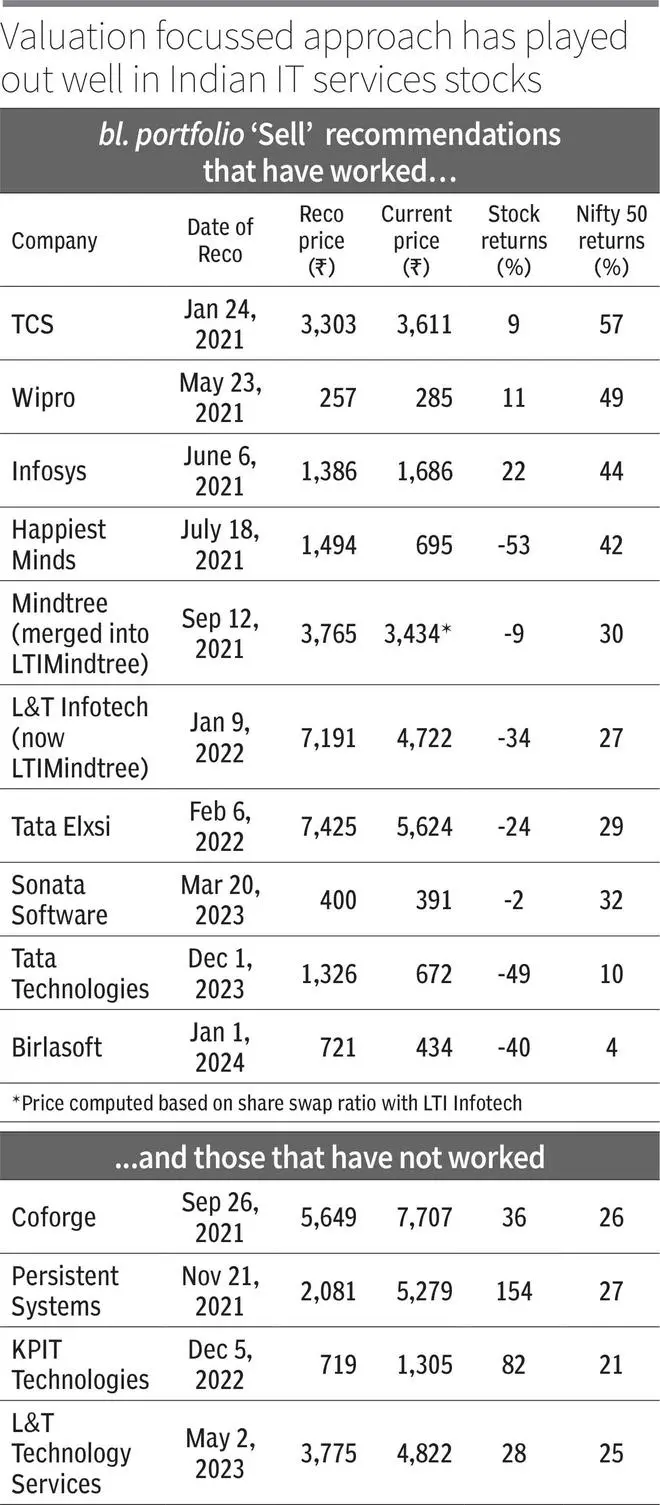
This approach has aged well for bl.portfolio (see table). For instance, the stock of Happiest Minds Technologies is down 54 per cent in the four years since our book profit call, while Nifty 50 is up 42 per cent in the same period. LTIMindtree is down 34 per cent, vs Nifty 50 up 27 per cent. Tata Technologies is down 49 per cent. Even industry leader TCS has underperformed badly since our original book profit recommendation in January 2021. On the other hand, our positive and opportunistic buy/accumulate calls on stocks such as Tech Mahindra, Oracle Financial Services Software, Zensar Technologies, HCL Technologies have yielded handsome returns. Here, too, we recommended investors to book profit/exit and lock in on gains when valuations overshot significantly.
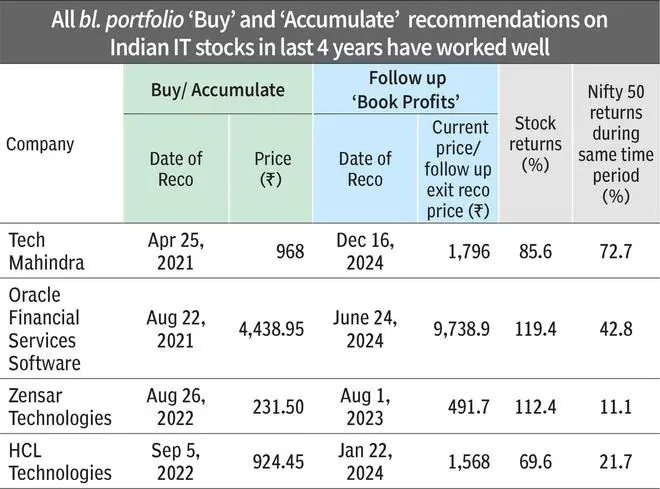
Bottomline,approaching the sector using a simple framework built upon PE and EV/FCF multiples,long-term growth rate assumptions based on history as a guide and global GDP growth expectations has worked well for making investment decisions in the IT sector.
After the last three-four years of absolute/time-wise correction, we wish we could say the sector and stocks are cheap, but they are not. All that can be said is yes, in most cases (not all), the froth has been significantly purged out.
What to expect from here? Before that, it is important to get clear on a few important aspects that will impact the stocks.
Unexciting growth rate
Here is some statistic to crunch upon – the Nifty IT index constituents as a whole, have seen their cash from operations increase around 160 per cent from FY16 to FY25E (data sourced from Bloomberg). During the same time, their combined capex has increased a mere 15 per cent! From a capex to operating cash flow (OCF) ratio of 15 per cent in 2016, it has dwindled to a mere 7 per cent. In simple terms, from investing 15 per cent of the cash they generated from operations in FY16 to creating capacities and intellectual properties to drive long-term growth, the Nifty IT companies today are re-investing only 7 per cent.
Can businesses grow without investing much? Yes, but not for too long as the benefits of large capacities, intellectual property and mining business relationships will taper off. For example, in FY07 and FY08 when businesses were booming, companies like TCS and Infosys had capex to OCF ratioof 30-40 per cent. For CY24, despite all the much-talked about AI opportunity, this has been at a mere 6 per cent.
The declining trend in capex to OCF ratio can be directly correlated with the declining revenue growth trend for companies in the sector. The company managements have sent a clear message: They do not foresee much investment opportunities to drive growth and are happy to return excess cash to its rightful owners — to the shareholders in the form of dividends and buybacks.
There is nothing to fault here. It is not just the Indian IT services companies, but global leader in the IT services and consulting space Accenture, too, has adopted the same strategy and sent the same message. Companies are definitely better off returning cash rather than make a value-destructive investment. However this also means growth will be unexciting, unless companies invest more.
Having said this, while growth is likely to be average, smaller players are growing significantly better compared with the top five players in the industry. Out of the Nifty IT constituents, while the top five players (TCS, Infosys, HCLTech, Wipro and Tech Mahindra) have grown their revenue at a CAGR of 10 per cent during FY19-24, the next five have grown much stronger at CAGR of20 per cent. But the top five players account for 85-90 per cent of the combined revenue of the top 10 players.
Coforge, Persistent Systems,Hexaware and KPIT Technologies have grown much above the industry growth rate. Smaller players are growing faster, driven by a greater revenue share from the higher-growth Engineering, Research &Development (the ER&D) segment, or offering specialised industry-specific expertise, and pricing their offerings competitively. But, at the same time, their margins are much lower than the large-cap players.
Uncertain global economy
Inflation, high interest rates, geopolitical flare-ups... — against these and more, the global economy has shown remarkable resilience since Covid-19. Add DOGE and trade wars to this list, and one can’t help wondering how much more it can take and remain resilient!
Recent inflation data in the US has been a meaningful cause of discomfort and this is only set to get worse with tariff wars, placing the Fed’s rate cut cycle in jeopardy. To top it off, Germany has just announced a massive fiscal spending programme that has sent its bond yields soaring to levels seen in October/November 2023 during the bond market tantrum. This has placed the ECB too on a dilemma on the path ahead from here with regard to interest rates. The rate cut cycle was viewed as one factor that could revive discretionary spending by companies in the US and Europe, which account for 80-90 per cent of revenues for most IT services companies.
The TCS management, in its most recent earnings call, had noted early signs of improvement in discretionary spending in the BFSI vertical (largest vertical for most IT services companies). Just as green shoots are appearing to sprout, tariffs, DOGE and expansionary fiscal policy in Europe pose the risk of weeding them out. Moves by the Trump administration have significantly increased uncertainty for businesses. So as far as CY25/FY26 outlook is concerned, the path may remain rocky and this will weigh in on stock performance.
Accenture’s Feb quarter results that will be released in the second half of this month will provide the first indications of how these can affect the business for IT services.
A report published by Nasscom last month notes that the dollar revenue growth of the Indian tech industry will be around 6 per cent in FY26, following a 5.1 per cent growth in FY25. This also roughly matches the estimated FY25 dollar revenue growth for industry leaders like TCS and Infosys. Based on Nasscom estimates, at best, FY26 can be marginally better than FY25, which would still imply only single-digit dollar revenue growth for large players. However, these estimates are at risk given the revenue of the IT services industry is linked to global economy.
AI – boon or bane?
After entering a bear market in 2022, Nifty IT rebounded strongly piggy-backing on the AI wave in 2023 and H1 of 2024. Interestingly, while businesses at the fulcrum of AI wave like cloud businesses of Amazon and Microsoft, chip businesses of Nvidia, AI hardware business of Dell et al have been booming, Indian IT industry has been on the slowdown lane.
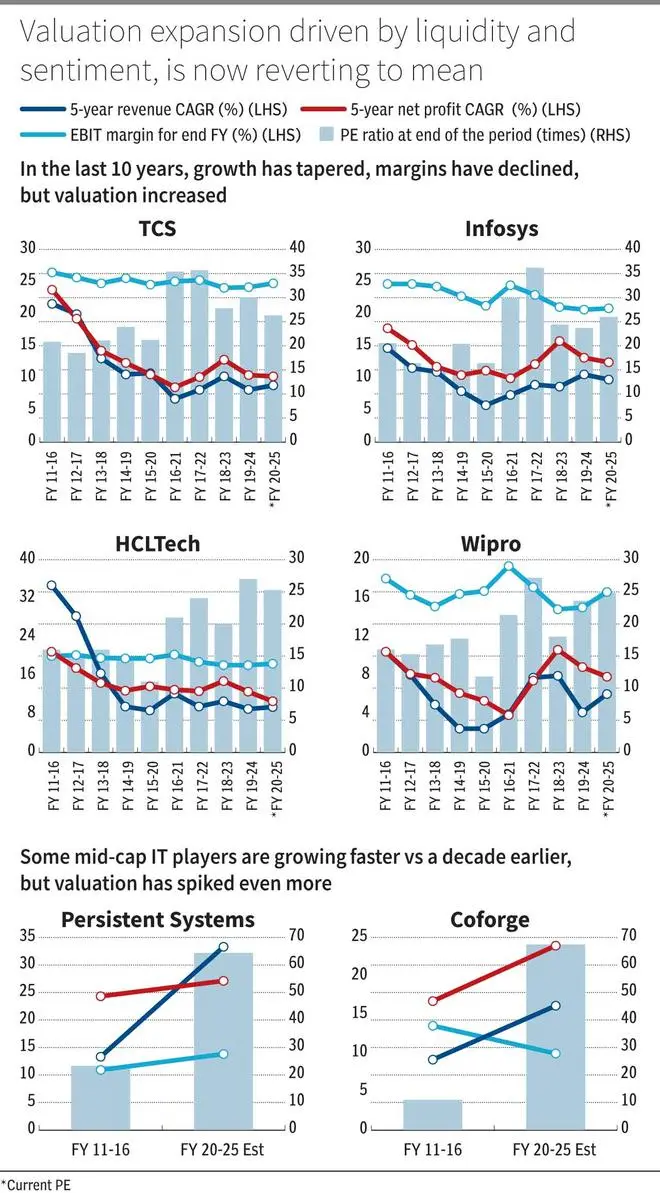
So, it’s clear that AI has not benefited them so far. This is, to some extent, reminiscent of how the digitisation wave played out in the early stages of last decade. Exactly 10 years ago, the IT services industry was witnessing one of its most challenging period after the dotcom bust. The new theme of SMAC (social, mobile, analytics and cloud) was upending their traditional business model. There were few years of uncertainty during CY15-CY17 when IT stocks underperformed meaningfully, but the companies adapted well and by FY18, their digital business was booming. By early part of this decade, digital was the main business. The good news: The companies had successfully moved up the value curve. The bad news: This transition did not, in any way, improve their EBIT margins or accelerate revenue growth, except for the digitisation bump during the Covid-impacted years (see chart). So before concluding AI is a boon for IT services companies, it is important to keep the past decade experience — wherein productivity gains were passed back to clients — in mind.
Mark Zuckerberg has come on record stating that 2025 will be the year when it becomes possible to build an AI engineering agent that has coding and problem-solving abilities of around a mid-level engineer. While timelines on when this will be cheaper than using a human to code is unclear, a huge productivity boom in programming is likely in few years. There is no guarantee that the productivity gains from this will accrue to shareholders of IT services companies as past experience shows.
Given their fantastic execution track-record over two decades, strong client relationships and successful adaption to disruptions in the past, there is a good case to be made that companies will manage well this time as well. But this may not result in outsized gains for shareholders.
Valuation
As we have explained, it is hard to make a case that IT stocks are attractive despite the underperformance over the last three-four years. Compared with the past, companies have lower growth, lower margins and face more challenges from uncertain global economy and AI-related challenges. So, what exactly is the logic of giving the stocks a higher valuation vs pre-Covid years? It is not like investors before 2020 did not know how to value stocks!
To top it off, at least till 2021, global bond yields were low between zero and 2 per cent. This made a strong case for FPIs to buy IT stocks, whose earning yield (1/PE) at 3 per cent or more along with decent growth was a no-brainer. But that is not the case any more. With bond yields having surged globally with US 10-year yields above 4 per cent, IT stocks are completely unattractive to FPIs even at earnings yield of 4 per cent, given they also face currency risk from their investments in Indian markets. The impact of this for Indian investors, too, has not been much appreciated. There is stronger competition from alternative asset classes now. So it’s a reasonable case to make that the surge in shares and spikes in valuations were not just fundamentals, but more of liquidity and sentiment as well. Liquidity and sentiment seem to be reversing now and valuations appear to be on the path of mean reversion.
While nothing is certain, the case for IT stocks to move up to their valuation levels in 2020 and 2021 is not strong. So, as always, it is time to look at opportunities based on valuations rather than how much the stocks have fallen from peak or underperformed over the last three-four years.
Our view has always been that pre-Covid five-year average valuations as well as at the end of CY19 (before Covid-19 struck) serve as good benchmarks. But that is not the gold standard and based on a case-by-case basis, investors need to assess whether there is a rationale for increase or decrease in valuations, depending on how growth and margins have fared.
Overall, stocks will get attractive only post further corrections. But one stock to keep an eye on is TCS. Being the industry leader with wide scale and capabilities, and the best-in-class margins, it is now nearing its end-CY19 valuation. What if stocks take longer to correct and investors feel they may miss out on opportunities? If you are a long-term investor, given the valuations, the probability of getting returns that will be too good to ignore is low. Hence, wait for the Happy Hours; alternatively, there are other asset classes to consider.
Published on March 8, 2025