







Defence upcycle is the buzzword now. With several conflicts underway and security architecture of the world undergoing a shift, India and even Europe are reprioritising defence spending. While Indian defence stocks were in focus earlier as well , post-Operation Sindoor, the battle-tested stocks have found a new vigour. We look at the factors that are underlying the shift in defence stocks.
The companies have large order-books, which is not unusual, but the plans in public domain indicate the momentum will continue to propel ahead either in the form of defence spending or the next wave of technology in discussions. But the largest driver of value was from indigenisation of the supply chain, which boosted self-reliance. The stock prices of defence stocks have been reflecting this. While export potential has structural support, the prospects will remain, for now, a show-me story, the bias is positive on this front also. The valuations though have been cruising at high altitude, supported by growth factors, but investors have to be wary of any shifts in defence cycles.
Here is a low-down on factors driving the sector
Atmanirbhar Bharat is showing results in defence sector. Defence procurement, wherever possible, prioritises Indian design, development and manufacturing (IDDM) under the defence procurement procedures (DPPs). Not only is the product manufactured in India but so should be the design, development and the patent. Global purchase is accorded the least priority, with Make in India (through tech transfer) placed in the middle.
This is reflected in sector financials as Indian defence sector stocks in consideration (10 largest stocks by weight in Nifty India Defence Index) reported an average revenue CAGR of 20 per cent in the period FY20-25. The defence procurement budget ballooned at 10 per cent CAGR post-Covid to ₹1.8 lakh crore with the added benefit in the form of IDDM. Also, as the current geopolitical events have shown, self-reliance is no longer an optionality, but a necessity. Even in the US, General Electric (GE) engines for Mark-1 aircraft were delayed owing to supply chain issues and only recently supplied.
As the capacity-constrained Defence ‘OEMs’ focus on core competency, this has also resulted in a trickledown effect and allowed smaller MSME companies to share the workload. DRDO, Bharat Electronics (BEL), Hindustan Aeronautics (HAL) or Mazagaon Dock, at the top, have allowed smaller companies to bag lucrative orders under their aegis.
BEL’s Akashteer programme now boasts of more than 90 per cent indigenous content that includes contribution from MSMEs and start-ups. BEL itself procures close to 30 per cent from MSMEs. Lower down the supply chain, Zen Technologies should benefit from the counter-drone orders to BEL. Astra Microwave will have a role to play in upcoming missile development including for Bramhos, Project Kusha, Akash and VL-SRSAMs (vertically-launched short-range surface-to-air missile). BEL, which itself is aiming to be a systems integrator (different systems talking to each other), will be complemented by Data Patterns, which has developed significant capabilities in this space.
HAL reports that the engine development for Sukhois may increase indigenisation from the current 57 per cent and LCA (light combat aircraft) Mark-1 will have several domestic companies as suppliers, including wings from L&T, fuselage from VEM, Alpha Tocol and Tata advanced Systems.
But the anchor project for indigenisation will be AMCA (Advanced Medium Combat Aircraft), where even the development of engine is targeted for indigenisation and is under renewed focus. HAL is negotiating with GE for LCA Mark-2 on pricing and the quantum of technology transfer.
In the shipbuilding front, Mazagaon expects the two follow-on submarines (P-75 and P-75(I)) and will have indigenisation more than 60 per cent as negotiated with ThyssenKrupp. The German engineering company will also partner Mazagaon for South Asian orders. To accommodate the expanded shipbuilding mandates, Mazagaon and others (GRSE and Cochin Shipyard) will likely focus on larger orders in-house and outsource smaller orders, providing scope for private shipyards.
Defence sector has orders that should last it for the next four-five years. This is the norm for companies with long gestation-delivery schedules. But the icing on the cake that drove the recent stock rally is the emergency procurement orders that should add ₹40,000 crore to the current year’s defence budget. This will be in addition to the current order-book and not yet reflected in projections.
For HAL, the delivery of one GE engine for LCA Mark-1 will build expectations of 11 more deliveries this year (83 in total) and will be the key part of the order-book along with 240 engines for Sukhoi-30, 156 helicopters - Prachand, 12 Sukhoi-30 aircraft.
Mazagaon is in the last leg of securing two submarines P-75 and P-75(I), which will boost the order-book along with Indian Navy’s order for 17 Bravo frigates. Similarly, Cochin Shipyard order-book comprises 15 defence platforms and close to 13 commercial platforms for exports. GRSE order-book also includes exports to a German client for a multipurpose vessel along with P-17 Alpha frigates and the rest from 16 warships to Indian Navy.
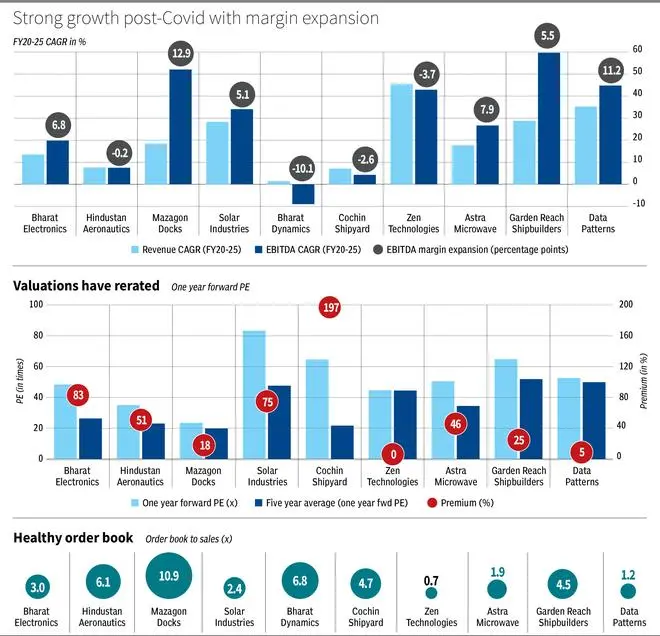
As the Naval and Airforce fleet are flush with orders, the support system will incrementally benefit. The sub-system and systems integrator BEL and Data Patterns; missile, radars, drone and anti-drone manufacturers Bharat Dynamics (BDL), Solar, Zen and Astra Microwave should be similarly occupied.
BEL order-book comprises avionic sub-systems for LCA Mark-1 and electronics for P-75 and P-75(I) submarines apart from air-defence systems Akashteer, Arudhra Radars and electronic warfare systems Himshakti. BDL will be focused on replenishing the surface-to-air missiles of different range and reaction times. Solar Industries’ order-book is supported by ₹6,000-crore order for Pinaka rockets.
The current order-book is factored into valuations. Investors should focus on the prospects of sustaining the momentum which is inferred from the next-generation order pipeline. Apart from next generation of fleet and ammunitions, companies are engaging in new technologies including SDR development (software-defined radios), space and satellite launches in the private sector and integrated electronic warfare and air defence systems.
As mentioned, for HAL, AMCA will be the next milestone along with orders for Dornier aircrafts for Coast Guard, Navy and Air Force. The company is also entering space with a recently-concluded deal to build, own and commercialise SSLV launches, taking the first step to space under the aegis of ISRO. If successful, this could pave the way for future private satellite launches in India, a lucrative market served by ISRO so far. Astra Microwave will benefit from demand for LCA Mark-1 and Sukhoi radar systems. The satellite order to HAL may also provide scope to Astra for the radars.
BEL future initiatives will be thrust from indigenous S-400 called Project Kusha and BEL can play the part of a systems integrator along with sub-system. The order size can be around ₹40,000 crore. The company will be eyeing sub-system contracts for NGC (Next-Generation Corvettes) that will be bagged by shipyards and is shortly expecting to be the production agency for ₹30,000-crore QRSAM (quick reaction SAM).
BDL is supported by the strong order-book comprising Astra MK II, next-generation beyond-visual range SAM. Similarly, Solar Industries will be working on the next versions of Nagastra and Bhargavastra, drone and anti-drone systems. The company is part of the future development of Brahmos and air defence missile programmes, including loitering ammunitions.
Zen Technologies is secure in anti-drone solutions on a standalone basis. But it has also utilised acquisitions to plug gaps and work on the next generation of warfare. This includes naval simulations (Zen is into army simulations), drone component manufacturing and a company in autonomous weapons system. It recently also acquired a company in loitering munitions and UAV (unmanned aerial vehicles). Data Patterns will be focusing on radar, EW suites and radio solutions.
While there is structural support to expect higher exports, the initial traction seems patchy and not significant so far.
On structural support, Europe and NATO commitment to spend 5 per cent of GDP on defence should translate, at least in part, to some outsourcing of manufacturing or technology partnerships in India. Dassault Aviation and Airbus have partnered with Tata Advanced Systems for Rafale jet fuselage and helicopters in India is a prime example and more such collaboration should be expected.
Within shipbuilding, India aims to rank among the top 10 shipbuilders by 2030. This is aided by China +1 sentiment among clients looking to diversify production.
Lastly, the recent battle-tested systems in air defence, systems integration, missile and drone/anti-drone capabilities are a useful thrust to unlocking the export potential as well.
But the two leading companies BEL and HAL do not have a significant export exposure. But shipbuilders have pitched in with expanded capacities. Mazagaon Dock expects to double the capacity in the next three years. The company has recently acquired a Colombo-based dockyard. Cochin Shipyard’s master-ship repair agreement with the US Navy, and an ongoing manufacturing of two vessels for an European client are giving traction to the export front. GRSE expanded from 20 to 28 dry docks in the last two years, partly to accommodate the shipbuilding projections.
But companies with strong export outlook are led by BDL, which has witnessed 7.5 times export revenue growth in FY25 with a portfolio that is now battle-tested, including Akash SAM and Helina/Dhruvastra. Solar Industries, Zen technologies and Data Patterns have export presence and are establishing operations in new geographies as well.
The top 10 stocks reported a revenue growth CAGR of 20.3 per cent in FY20-25. This was aided by indigenising a large defence capital outlay budget that now stands at ₹1.8 lakh crore. The government aims to spend ₹3 lakh crore) on defence capital outlay by 2029 and the creeping indigenisation levels that are north of 50 per cent in most sectors should support continued growth at the top line as it has in the past five years.
The margins, too, have expanded by a significant 330 bps in the last five years as well. While operating efficiencies have improved, the large orders have also aided the expansion with economies of scale.
But investors have to note that defence sector financials are cyclical. In the periods of order delivery, the revenues and margins will be above average and below average in the early stages of the project.
Also, while there are no known headwinds to the current defence upcycle, the current period is marked by three-five active conflict zones. In the hopeful scenario of widespread de-escalation, India or Europe may temper, if not cut back, on defence spending and that is a risk worth noting in defence sector investments.
The primary headwinds are from valuations. The one-year forward PE ratios have increased by an average 55 per cent compared to their last five-year average. Excluding the outlier, Cochin Shipyard, which has nearly tripled, the valuations have still increased 38 per cent.
The scope for growth is strong. The current order-book should hold steady for three-four years, post which the next-generation fleet and systems will enter the order-book, enabling a strong growth. The companies are also expanding their capacities, which should improve the revenue recognised every year. But the margin for error is limited at the current valuations.

Published on June 28, 2025
此内容由惯性聚合(RSS阅读器)自动聚合整理,仅供阅读参考。 原文来自 — 版权归原作者所有。