


India’s love affair with two-wheelers (2Ws) is as old as its post-Independence economy, when the imported Vespas were brought in 1948. From zipping through narrow lanes on a humble scooter to munching miles on highways aboard a sturdy motorcycle, 2Ws have long been the vehicle of choice for millions. Affordable, agile and practical, they aren’t just personal rides, they’re lifelines for millions of college- and office-goers, gig workers, small businesses, families on the move and hence, in many ways, are part of the backbone of the economy. With millions of units on the road, India is the largest 2W market in the world.
While its importance remains undiminished, it is going through a major transition now. The hum of the petrol engine is being joined, and in some cases being taken over by the quiet whirr of electric motors. Today, five out of every 100 2Ws sold is an e-2W. The higher running cost of an ICE (internal combustion engine) 2W, choking air pollution and policy nudges have sparked a shift that now appears could prove to be inevitable.
When the world changes, you have to change along with it. So, how is the 2W world changing and how are all the stakeholders adapting? Here is a lowdown.
The shift from ICE to e-2Ws is a natural evolution for India’s urban commuters. Most daily rides in cities are short, predictable and stop-start, where e-2Ws thrive. The EVs can be charged at home overnight or at office parking lots and thus will make sense for many buyers even in the absence of a public charging network.
For starters, the scooter body style of almost all e-2Ws today is making the adoption simpler. The scooter body style is a perennial favourite in India, thanks to its ample under-seat storage and family-friendly ergonomics, making it the go-to choice for urban mobility. Powertrain-agnostic and early adopters appear to be switching to EVs. EV penetration within the scooter segment is 14.7 per cent (FY24), far higher than the penetration rate in the whole 2W market at 5.1 per cent. As per Crisil Intelligence, EV penetration in the scooter segment could grow to 70-75 per cent by FY31.
Among factors that can drive the shift faster, lower TCO (total cost of ownership) of an e-2W takes pole position. E-2Ws cost 40-50 per cent more than an equivalent ICE vehicle initially. Even insurance cost will be higher for an e-2W. But the real kicker comes in the form of running costs. e-2Ws make up for the differential costs with running costs that tend to be way less than ICE counterparts. The lower service costs associated with e-2Ws is an added advantage.
We ran a comparison between the TCO of two popular models on sale (one EV and a comparable ICE) with real-life numbers. The EV model had a warranty of five years on the battery pack and so we assumed a life of five years for both the EV and the ICE scooter. This way, a like-for-like comparison can be made, without having to factor for the cost of the second battery.
For 6,000 km ridden every year, the lifetime cost (includes the on-road price, running cost and service cost) of owning the e-scooter turned out to be 16.2 per cent less than that of the ICE vehicle. Even when considered without the PM E-DRIVE subsidy of ₹5,000, owning the e-scooter turned out to be beneficial (13.8 per cent difference in TCO). The gap only gets wider in favour of e-2Ws when a higher distance ridden is assumed. Besides, a safe conclusion can be drawn that for fleet purposes, the e-2W will be the more economical option, as the distance run is naturally higher there.
Lower emissions, government policy favouring EVs and a growing public charging network are other advantages.
If it’s an engine and a gearbox for an ICE 2W, it’s a battery pack and a motor for an e-2W. But this apart, two more parts are crucial for an e-2W – the battery management system (BMS) and the motor controller. The battery pack is made up of cells that contain energy-dense chemicals which need to be kept at optimum temperature to ensure longevity. The BMS is an electronic part with computer code inside it that monitors and regulates parameters of the battery such as temperature and voltage. It also keeps track of the state of charge. While the motor converts electrical energy from the battery to mechanical energy, the motor controller takes signals from the throttle and controls the speed of the motor by adjusting the power sent from the battery. The motor controller is also an electronic part that has code in it.
The level of refinement in how the battery pack, BMS and motor controller function in unison determines whether the vehicle can generate consistent and predictable output. This is why e-2W companies tend to invest heavily in in-house design, R&D and assembly, as regards these parts, to ensure quality control.
A perspective on this can be gained from Ather Energy’s recently-published red herring prospectus (RHP). The battery pack (with BMS) costs 29 per cent of the bill of materials (BoM). Electronics, which include motor controller, touchscreen instrument console, wiring harness, etc, cost 34 per cent and all the other mechanical parts such as the motor, the chassis, brakes, wheels, suspension, etc cost the rest .
India’s e-2W industry, what was just a 30,000-unit market in FY19, is now over 10 lakh units strong with the following players being the major stakeholders.
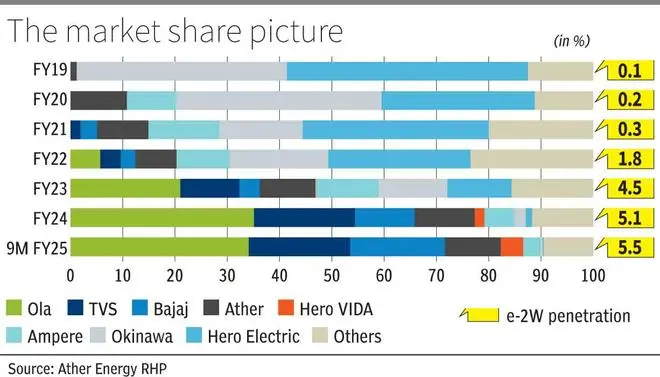
Ather entered the market in FY19 with its ‘450’ scooter. Though it didn’t garner meaningful market share in FY19, it did so in FY20 with the scooter’s speed and acceleration comparable to ICE 2Ws and having introduced novel features such as Internet connectivity. Since FY20, the company has maintained a market share of around 10-11 per cent consistently. It now has two models on sale – the 450 and Rizta.
Ola entered in FY22 and expanded its presence at a rapid pace, with an equally feature-rich scooter – the Ola S1. The very next year, it became the market leader with a 21 per cent share. The only OEM with cell manufacturing capacity, today, claims a market share of 34 per cent. Ola’s offerings include an updated S1 line-up, a couple of e-motorcycles and a pair of low-speed e-2Ws specifically to cater to fleet needs.
In contrast, legacy OEMs TVS and Bajaj have been measured in their approach. TVS stepped into the market in FY20 with its iQube e-scooter. Though it saw low traction in the initial years after launch with low single-digit market share, FY23 was a good year for TVS when its share picked up to 11 per cent. The iQube is the primary product of the company, while there is also another product in ‘X’ priced above ₹2.5 lakh. Today, TVS has the second-largest market share.
Bajaj introduced its Chetak e-scooter towards the end of FY19. Like TVS, the company saw traction build up only later in FY24. Meanwhile, the company had been building capacity in distribution and production. Today, with its updated Chetaks, the company is the third-largest e-2W maker with an 18 per cent share.
Hero MotoCorp’s VIDA e-scooter was launched in FY23 and its 4 per cent share today, deserves a mention. Outside the listed space, the Japanese OEMs Suzuki and Honda have launched their e-Access and e-Activa line-ups recently.
OEMs in this space will have to put up with intense competition and thrive. Per Vahan data, there were over 150 unique OEMs whose e-2Ws were retailed in FY25. While a lot of them were Chinese imports, some of them are Indian start-ups such as Ultraviolette (TVS has a 30 per cent stake), River Mobility, Tork Motors, Oben Electric and Simple Energy, which could scale up and become the Olas and Athers of tomorrow.
Further, legacy OEMs such as Hero VIDA, Honda and Suzuki are relatively new to the market and the impact of their products on the market remains to be seen. These players along with TVS and Bajaj come with distribution clout and cash to splurge and gain market share – something that pure-play OEMs need to contend with.
But where Ola and Ather shine and stand out is when it comes to tech and features on board, which are leaps ahead of the competition. The convenience of such features lures buyers and could turn them loyal towards the brand. However, they cannot put their feet up yet, as their USPs could be emulated by peers over time.
The primary opportunities for EV players arise from the long runway of growth ahead, given current penetration at 5.5 per cent. As per report by Crisil Intelligence, this is expected to increase to 35 per cent by FY31.
But this is not all. EV players score over traditional OEMs from their ability to generate recurring revenue.
First, today’s e-2Ws use copious amounts of software (on-board navigation, integration with phone, etc). The makers charge a premium for the convenience features that such software stacks offer. Ather charges ₹14,000-20,000 per vehicle, Bajaj charges ₹3,000-5,000 and Ola charges close to ₹8,000. From the OEM’s perspective, the direct costs associated with such offerings are largely-sunk R&D costs and hence, as buyers increasingly opt for such subscriptions, the revenue therefrom will flow straight to the EBITDA line.
On the flip side, challenges come in terms of recent speedbumps in scaling up and that most of the benefits from falling cost of cells are behind now. Demand-side subsidies declining also compounds the challenges.
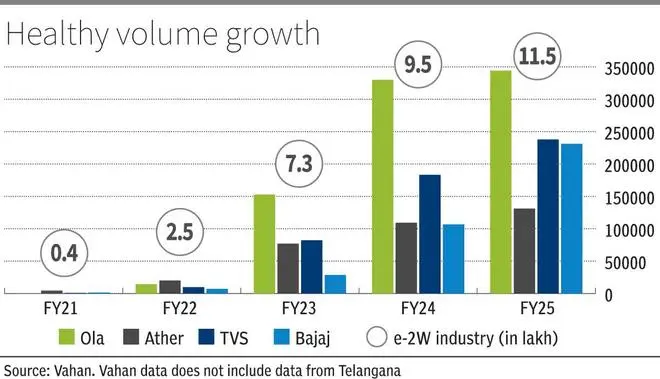
Though the year-on-year growth in volume sold by the players is strong, the EV penetration needle hasn’t moved much (see market share infographic), though there is improvement there. E-2W penetration in FY22 was 1.8 per cent. It went up sharply to 4.5 per cent in FY23 and has shown flattish growth since, moving up only to 5.5 per cent in 9M FY25. This is extremely crucial because pure-play EV OEMs such as Ather and Ola are banking heavily on scaling up to turn EBITDA-positive.
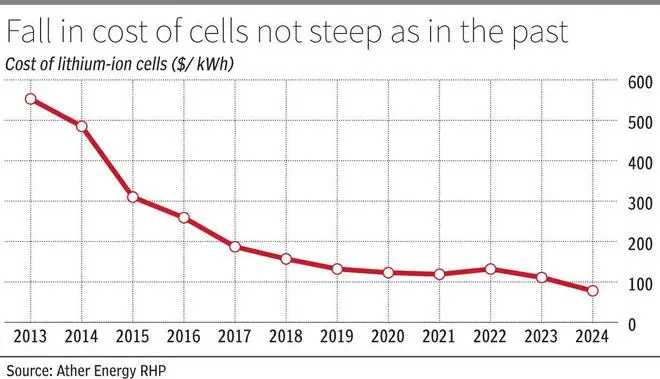
Regarding cells, almost all OEMs import cells, and they cost about $78 per kWh today (per Ather’s RHP). The same took five years to become one-third of what it was in 2013. In the next six years leading up to 2024, the prices only halved from 2018-levels. This is clearly a sign that the drop in prices is slowing down, and a bottom may be nearby. As seen above, the battery pack with the BMS forms about one-third of the BoM.
In-house cell manufacturing is also unlikely to significantly help on the cost side. Cell manufacturing is an extremely capital-intensive business requiring massive scale to make any investment sense. For instance, LG Energy Solutions (Korea) that supplies cells to Ather and Ola, makes a net profit margin of just 4 per cent, though operating on a scale of close to 300 GWh. CATL of China makes a higher margin of 11 per cent on a similar scale, probably supported by State subsidies. Other players with smaller scale make just 1-3 per cent.
Ola has a Gigafactory to make cells and it has also been granted approval under the government’s advanced cell chemistry PLI. Under the scheme, Ola has to achieve sales of 20 GWh by 2028 (with intermittent milestones of 5 GWh and 10 GWh). Not achieving could lead to reduced subsidy payouts, which could be crucial to make financial sense of the investment.
Hence economies of scale, must come from other parts, such as chassis and wheels. Further, any desperate attempt to raise prices of e-2Ws could slow down EV adoption.
As regards subsidies, the quantum of subsidy per vehicle has grown smaller over the years. Under FAME II in June 2021, the subsidy per vehicle was ₹15,000 per kWh, capped at 40 per cent of the vehicle cost. The same was reduced to ₹10,000 per kWh, capped at 15 per cent of the vehicle cost in June 2023. The EMPS (Electric Mobility Promotion Scheme) followed FAME II until September 2024 with a subsidy of ₹5,000 per kWh, capped at ₹10,000 per vehicle. The PM E-DRIVE scheme followed EMPS with the same quantum of subsidy until FY25. For FY26, the subsidy stands slashed to ₹2,500 per kWh, capped at ₹5,000 per vehicle.
Finally, concerns about the true life of a battery and range anxiety linger. The e-2Ws on road today are fairly new and hence there is only limited data on battery longevity, warranty claims honoured and resale value. This may get sorted over time.
However, the same cannot be said about range anxiety, which primarily stems from the absence of a dense public charger network. The network is growing rapidly though, from 11,600 e-2W chargers in FY23 to 18,326 in FY24. Data from Petroleum Planning & Analysis Cell of the Ministry of Petroleum & Natural Gas suggests there are 27,602 EV charging outlets (not just those meant for e-2Ws) as of March 2025. For context, this is roughly 25 per cent of the number of retail fuel stations (including CNG, LPG outlets) in the country. OEMs and other players in the ecosystem must continue the investment in public chargers to accelerate EV adoption.
The market position, prospects, strengths and challenges that each incumbent faces have been discussed in brief above. Information on volume growth, market share and profitability can be inferred from the infographics.
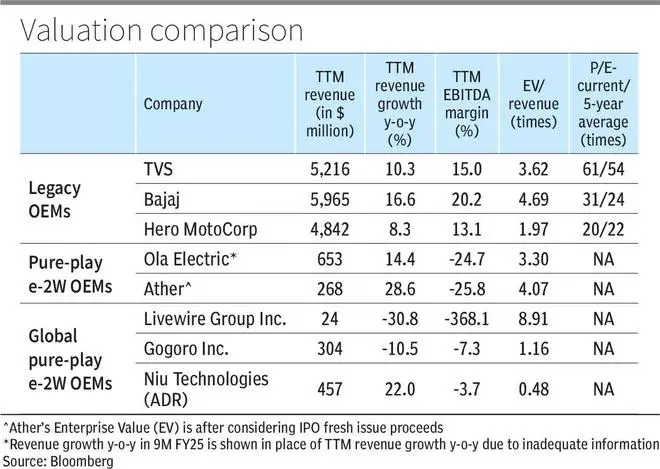
As can be seen in the Valuation infographic, Ola and Ather along with their global pure-play e-2W counterparts are yet to turn profitable. But they trade at richer valuations. Also, given the above challenges, their current valuations appear expensive.
Comparatively, legacy OEMs appear less expensive as they have a profitable business at the consolidated level. Their EV business’ profitability is not ascertainable with publicly-available information. But they come with the baggage of a relatively slow-growing ICE segment. Except for TVS, month-on-month sales of Bajaj and Hero have not been consistently growing. And rightly so, their sub-industry level volume growth in FY25 and their relative valuation to TVS mirror the same. On the other hand, having posted healthy growth, TVS is trading at a significant premium to BSE Auto index’s P/E of 23.4x and the stock’s own five-year average P/E of 54x.
There are a lot of moving parts with respect to the future of India’s e-2W market, and right now, it’s anyone’s guess which player might come to dominate it. Hence long-term investors interested in riding the electrification wave in 2Ws are better off waiting out for now, till the valuation signal turns green. The potential is high, but stocks appear priced perfectly for now. Investors need to keep track of fundamentals and be on the look for opportunities during the next bout of market correction.
Published on May 17, 2025
此内容由惯性聚合(RSS阅读器)自动聚合整理,仅供阅读参考。 原文来自 — 版权归原作者所有。