








The Unified Pension Scheme (UPS), which guarantees pension to Central government employees, has been launched from April 1. Government employees enrolled in the National Pension System (NPS) have been given an option to switch to this scheme before June 30. New employees joining the government can also opt for the UPS within 30 days of their joining service. Reports suggest that the initial response to UPS has been tepid. But for most employees, it does make sense to switch to UPS.
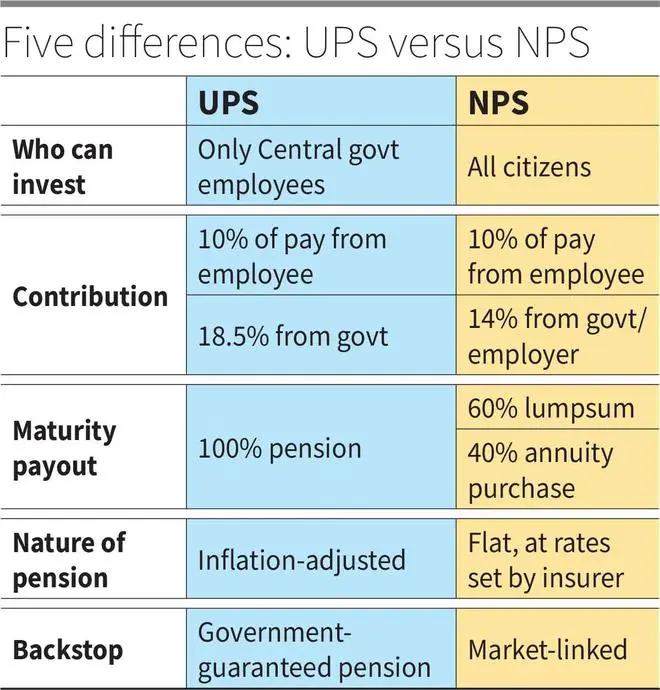
There are four main points of difference between the NPS for government employees and UPS.
Contributions: Under NPS, you contribute 10 per cent of your basic pay plus dearness allowance to the NPS Tier 1 account every month. This sum is automatically deducted from your salary. The Central government also contributes 14 per cent of your basic pay plus DA into your NPS Tier 1 account. These contributions grow over time to fund your pension. Under UPS, your contribution will remain at 10 per cent, but the government’s contribution will be 18.5 per cent. However, only 10 per cent of the government contribution will be paid into your NPS account, with the remaining 8.5 per cent going into a common pool. This 8.5 per cent will not be paid to you at maturity.
Investment options: Under NPS, you are free to choose how your contributions will be invested. You can allocate your entire contribution to debt instruments or opt for the two lifecycle funds which allocate 25-50 per cent to equities and the rest in debt. But under the UPS, the government assumes that default asset allocation, which currently invests about 85 per cent of contributions in debt and 15 per cent in equities. While employees opting for UPS can deviate from the default option, the calculations assume that contributions are invested in the default option. If the employee opts for a different allocation and the corpus fails to match the default option, the employee will need to fill the gap to get assured pension. If the corpus exceeds the default option, the excess will be paid to the employee. This makes the default option the safe choice for government employees seeking guaranteed pension under UPS.
Lumpsum at maturity: NPS allows subscribers to withdraw 60 per cent of their maturity proceeds as a lumpsum while using the remaining 40 per cent to buy a pension plan from approved insurers. But with UPS, you can convert 100 per cent of the maturity amount to get a guaranteed pension at 50 per cent of your last-drawn pay. This pension will be continued lifelong, with 60 per cent of it paid to your spouse after you. UPS does offer the option of a partial lumpsum payout at retirement. But in this case, your pension (of 50 per cent of last-drawn pay) will be reduced proportionately.
In addition, at retirement, UPS pays a lumpsum equal to 10 per cent of your monthly pay for each completed year of service. So, if you serve 25 years, you will get 2.5 month’s salary at the time of retirement in addition to the pension. This is non-contributory and entirely borne by the exchequer. (It does not come from the common pool either.) .
Pension payout: The NPS does not guarantee any pension to subscribers. From the corpus they accumulate during their working life, employees are required to invest 40 per cent in approved annuity schemes from insurers at the time of retirement to get a pension. The pension quantum from NPS is, therefore, based on market returns on your contributions and the annuity rates offered by insurers when you retire. Insurers provide fixed pension payouts which are not adjusted for inflation. In the UPS, 100 per cent of employee contributions in the scheme (under the default pattern) is transferred to the government, which then promises to pay a lifelong pension at 50 per cent of the employee’s last-drawn pay. The pension will be periodically adjusted for inflation.
The 50 per cent pension is linked to an employee completing 25 years of service with the government. If service is lower, the pension will be reduced proportionately. Employees need to have a minimum 10-year service to be eligible for pension under UPS.
There are three reasons why switching to UPS makes sense for most government employees who plan no career changes.
One, the UPS allows them to get an inflation-adjusted pension at 50 per cent of their last-drawn pay, by contributing just 10 per cent of their basic pay plus DA through their working years. Calculations show that managing an inflation-adjusted pension on your own could call for much higher contributions. For instance, the NISM retirement calculator shows that a 35-year-old with monthly expenses of ₹1 lakh today, may need to invest at least ₹30,513 per month over the next 25 years to get to the retirement corpus of ₹5.73 crore that could see him through retirement. This calculation is based on some assumptions — a post-tax return of 12 per cent on your retirement savings over the next 25 years, a post-tax return of 7 per cent post retirement, an inflation rate of 6 per cent throughout and a longevity of 85 years. An adverse change in any of these numbers could further inflate your savings needs.
The accompanying table, using the NISM calculator , shows the monthly sums that will need to be invested (at a 12 per cent return) to get to an inflation-adjusted pension after retirement. The numbers clearly show the proportion of income you will have to invest towards retirement escalates sharply based on your age. Therefore, the closer you are to retirement, the more sense it makes to opt for UPS. You can run your own numbers in the calculator to know your investment targets.

Two, while handing over 100 per cent of your retirement corpus to the government at retirement may seem daunting, the government is compensating for this by contributing 8.5 per cent of your basic pay into a common pool, to meet any shortfall in your pension at retirement. As you are required to contribute only 10 per cent of your basic pay to UPS, you will have room to use your savings beyond this, to invest towards other goals or supplement your pension. You can invest this excess in the NPS Tier 2 account or in mutual funds to accumulate a lumpsum independent of the NPS/UPS.
Three, while those starting early (in their 20s or early 30s) do have a good shot at getting to the target retirement corpus, this requires regular savings and being disciplined about your retirement accumulation plan over the next 35 or 40 years of your working life. The assumptions underlying retirement planning, such as the 12 per cent return assumption, the 6 per cent inflation assumption and longevity of 85 years, can all be subject to change. Periodic bouts of correction in stock and bond markets can also pose a behavioural challenge to staying the course. This will call for periodic review and alteration of your investment plans. Only folks who are both disciplined and passionate about investing may manage it.
Four, under NPS your pension at retirement will be decided not just by your accumulated corpus but by the annuity rates offered by insurers. These have historically tended to be below fixed deposit rates and do not offer inflation adjustment. With UPS, the onus of giving you a monthly pension at 50 per cent of your last-drawn pay and adjusting it for inflation, falls on the government. This relieves you of the worry of tracking rates and managing reinvestment risks after retirement.
Overall, the only folks who need to think twice about opting for UPS are investment-savvy employees in their 20s and employees who don’t plan to stick with government service for over 10 years.
Private sector employees in India aren’t fortunate enough to have access to a government-guaranteed, inflation-adjusted pension. But the UPS design has lessons for them too.
For one, the design of the UPS shows that to set up a pension at 50 per cent of their pay, government employees along with their employer are required to save 28.5 per cent of their pay over their working life (the employee’s 10 per cent contribution plus the government’s 18.5 per cent contribution). Private sector employers may not be willing to chip in with 18.5 per cent of the employee’s pay towards their retirement. This is especially true if you already have an EPF account where the employer contributes 10 or 12 per cent. Therefore, it may be up to you to ensure that you step up your retirement savings.
Two, UPS guarantees pension at 50 per cent of last-drawn pay only if the employee contributes for 25 or more years. This underlines the need for an early start on your own retirement plans, if you are a private sector employee or are self-employed.
Three, UPS proposes to invest contributions in market-linked instruments which are a mix of debt and equity. Currently, the default option of NPS invests 85 per cent in government and corporate bonds and 15 per cent in equities. Even with this, the Centre doesn’t rule out a shortfall in the retirement corpus, which is why it is setting aside 8.5 per cent of its contribution in a common pool. As a private employee, this shows that you cannot rely on the debt-oriented EPF alone to build up your retirement corpus. You need equity exposure. You can build up this exposure through index funds (Nifty100, Nifty Midcap 150) or highly-rated active large-cap and mid-cap funds. Alternatively, you can use the NPS Tier 2 account to gain an equity plus debt exposure similar to the UPS. By having a higher equity allocation of, say, 30-40 per cent, you can make do with a lower monthly contribution than the 28.5 per cent envisaged by UPS.
Overall, UPS is a wake-up call that if you are looking to fund a comfortable retirement and keep up with inflation in your retirement years, then starting as early as you can and saving 25 per cent plus of your income is your best bet.
Published on May 10, 2025
此内容由惯性聚合(RSS阅读器)自动聚合整理,仅供阅读参考。 原文来自 — 版权归原作者所有。