



惯性聚合 高效追踪和阅读你感兴趣的博客、新闻、科技资讯
阅读原文 在惯性聚合中打开

推荐订阅源

D
Docker
爱范儿
爱范儿
人人都是产品经理
人人都是产品经理
博客园 - 司徒正美
cs.AI updates on arXiv.org
量子位
罗磊的独立博客
cs.CL updates on arXiv.org
小众软件
小众软件
C
Cybersecurity and Infrastructure Security Agency CISA
Cyberwarzone
Cyberwarzone
大猫的无限游戏
大猫的无限游戏
Threat Intelligence Blog | Flashpoint
雷峰网
雷峰网
Simon Willison's Weblog
The Cloudflare Blog
博客园 - 三生石上(FineUI控件)
D
Darknet – Hacking Tools, Hacker News & Cyber Security
C
Cyber Attacks, Cyber Crime and Cyber Security
博客园_首页
博客园 - 叶小钗
V
Vulnerabilities – Threatpost
T
The Exploit Database - CXSecurity.com
T
Tailwind CSS Blog
IT之家
IT之家
博客园 - 聂微东
Spread Privacy
Spread Privacy
V2EX - 技术
V2EX - 技术
S
Security Affairs
宝玉的分享
宝玉的分享
V
V2EX
C
Cisco Blogs
博客园 - Franky
美团技术团队
酷 壳 – CoolShell
酷 壳 – CoolShell
月光博客
月光博客
S
Securelist
J
Java Code Geeks
Webroot Blog
Webroot Blog
让小产品的独立变现更简单 - ezindie.com
P
Proofpoint News Feed
Last Week in AI
Last Week in AI
L
LINUX DO - 热门话题
NISL@THU
NISL@THU
WordPress大学
WordPress大学
W
WeLiveSecurity
T
Threatpost
freeCodeCamp Programming Tutorials: Python, JavaScript, Git & More
腾讯CDC
阮一峰的网络日志
阮一峰的网络日志

Opinion, Editorial, Views, Columnists, Columns | The HinduBusinessLine

Rupee can’t be defended from just one side Railways’ performance Why not have a women-only party? Labour pangs Pak’s peculiar comeback on the global stage Letters to Editor India has jobs, but it needs better ones Cross-border insolvency laws and trade A major health challenge Editorial. Snooping around Letters to the Editor dated April 20, 2026 Real-time metric for factory output All you want to know about the women’s reservation and delimitation bills fiasco Editorial. Process deficit Letters to the Editor dated April 19, 2026 WPI effect on new GDP series The tragic reality of police brutality India’s AI value paradox Prepare the ground India-Korea economic ties poised to strengthen Nari Shakti Bill — a missed opportunity Natural farming should become mainstream policy Insights from new GDP data Strategies to enhance fertilizer security Pathway to maritime insurance sovereignty Why the GoP’s jittery Clear the smoke Aiding piped gas push Stocks are the least over-priced asset in India Is TCS harassment case tip of the iceberg? SIP with caution Global gold ETFs post worst-ever $12 billion monthly outflow: WGC How India is funding Silicon Valley’s rise Cyber insecurity Continuity via status quo Iran war, a boon for the BRICS Assessing the easing of provisioning norms by RBI Iran war, a test for India’s economic resilience Iran war’s impact on India’s farm output and food inflation Economic competence in judiciary Pressure point India moving up the pharma value chain NFRA’s statutory leap Finance capital in time of war How West-Asia war could reshape the AI race When signals diverge: Reading the Nifty-Gold ratio Mohali’s miracle boys Plastic concerns Nice countries come last Lawyers matter more than ever for corporates Odisha central to our aluminium ambitions Editorial. Fair deal Editorial. Wait and watch Letters to the Editor dated April 10, 2026 Unfortunate fallout of cyber crime investigations Letters to the Editor dated April 9, 2026 Will the uneasy truce hold? Charting an intellectually honest way of forecasting RBI plumps for caution amidst uncertainty Large corporates and the sustainability transition of MSMEs MPC positive, despite strong headwinds Cease and desist Together, let us empower our Nari Shakti An AI model that’s too risky NPS funds consistency check: what 10-year rolling returns reveal Editorial. Nuclear milestone Letters to the Editor dated April 7, 2026 Packaging woes China’s perennial industrial policy Sensex has fallen on account of global forces India’s strategic defiance at the WTO meet Close the backdoor in tobacco FDI policy Is EU’s CBAM discriminatory? Editorial. Freebies unplugged Letters to the Editor dated April 6, 2026 Projecting growth is not easy Improving safety in Indian aviation Amendments to FCRA India’s outreach to Angola will contain energy risk Oil shocks and the rupee: The tricky 100s Sensex at 40: Secrets behind long-term wealth in markets Editorial. Sweeping powers India’s next social protection is care, not cash In West Asia, it is advantage China Is awarding Trump a Nobel Prize the best bet for peace? Editorial. Knotty regulations Letters to the Editor dated April 3, 2026 Time to push for rupee internationalisation Up in the air Time for industry to lead economic resilience Allied healthcare needs attention What holds back investor participation? Still no endgame in sight Challenging year What happens when CAD rises Reorienting farm research Telecom infra must rest on strong fibre network A severe test for monetary policy India’s chance in supply chain reset Bengaluru’s housing market is growing but affordability is shrinking
Freebies will hit Tamil Nadu’s fiscal health
2026-04-07 · via Opinion, Editorial, Views, Columnists, Columns | The HinduBusinessLine
DMK President and Tamil Nadu Chief Minister MK Stalin, left, party leader Kanimozhi Karunanidhi, right, with others during the release of the party's manifesto for the upcoming state Assembly elections, at Anna Arivalayam, in Chennai (file photo)

DMK President and Tamil Nadu Chief Minister MK Stalin, left, party leader Kanimozhi Karunanidhi, right, with others during the release of the party's manifesto for the upcoming state Assembly elections, at Anna Arivalayam, in Chennai (file photo) | Photo Credit: -

Three political parties in Tamil Nadu have released their manifestos. The debt levels seem set to be self-spiralling even under optimistic assumptions.

The main impact is from the ‘monthly assistance’ to women which can claim ₹54,000 crore — 16.28 per cent of TN’s revenue receipts of 2025-26, if one strictly follows the language of the manifestos. The yearly of all promises by DMK and AIADMK come to ₹48,500-51,000 crore if we limit all women-focused give outs to only those who are already receiving the ₹1,000 assistance, despite several complaints of unfair exclusion but including the additional days under VBGRAMG ).

If all are enrolled this figure balloons to about ₹64,000 crore a year in both cases. One time appliance related payout is ₹18,000 crore and ₹29,700 crore.

Fiscal impact

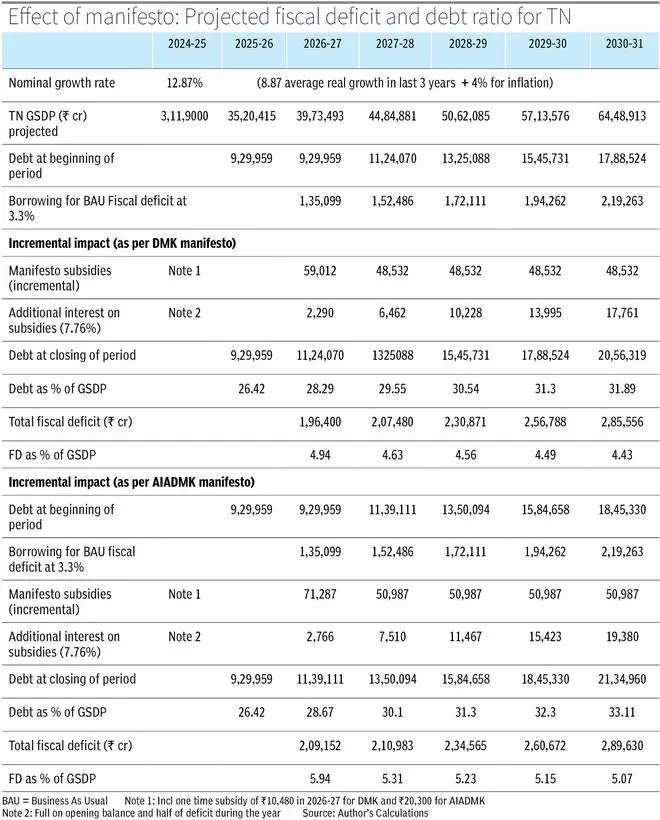
The table analyses Tamil Nadu’s financial health in the backdrop of the subsidies promised by the rival political combines. The State’s nominal GSDP is projected to grow at its last three years average (real) plus 4 per cent inflation which is the target set for RBI, i.e. 12.87 per cent. The borrowing for financing the incremental deficit is taken at the going yields for TN securities (7.76 per cent). GSDP is assumed to grow at Nominal terms while subsidies have been frozen at same levels throughout.

The 16th Finance Commission has advised a limit of 3 per cent fiscal deficit. At the peak it is 4.94 per cent for DMK and 5.94 per cent for AIADMK.

What is alarming is the persistence of growth of debt-GSDP ratio over the 30 per cent considered the danger mark at the State level. The proposed subsidies may violate almost all prudential norms – RBI’s regarding borrowing limits, Finance Commission norms, FRBMs and Supreme Court’s ‘observations’ and ‘advice’ regarding provisions and disclosure of sources. Surely Tamil Nadu’s credit rating is bound to take a hard hit.
The 8th Pay Commission when implemented would further worsen the situation.

Development hit

The biggest casualty is the abandoning of the developmental path relentlessly pursued by Tamil Nadu. While free markets won’t alone solve all society’s economic problems, subsidies should also not be designed to kill or dilute private initiative.

Subsidies should be limited to merit goods. Education and healthcare are prime examples. Free gas and appliances can in no way be called a merit goods.

As documented in several studies, full loan write-offs have adverse behavioural impact and encourage future defaults. The state could at best, shoulder a part of the debt burden, leaving the balance to be paid by the beneficiaries.

Even these should be based on defined stresses and shocks, which will largely preserve private optimisation instinct to play its role.

It would be desirable if the fiscal deficit goes largely towards capital expenditure and capacity creation instead of filling revenue deficit. Sadly, there is not much talk on employment but only assistance. The most appropriate way would be to accelerate development projects, create employment opportunities, and control unemployment to enhance incomes. That requires massive training and capacity building and creation of infrastructure to make India cost competitive.

If this is the situation in Tamil Nadu — one of the better performing States, one wonders what the situation would be if all other States start imitating TN. Surely some serious legislative or judicial clamp downs seem necessary to preserve States’ fiscal health.

The writer is the author of Making Growth Happen in India

Published on April 7, 2026