





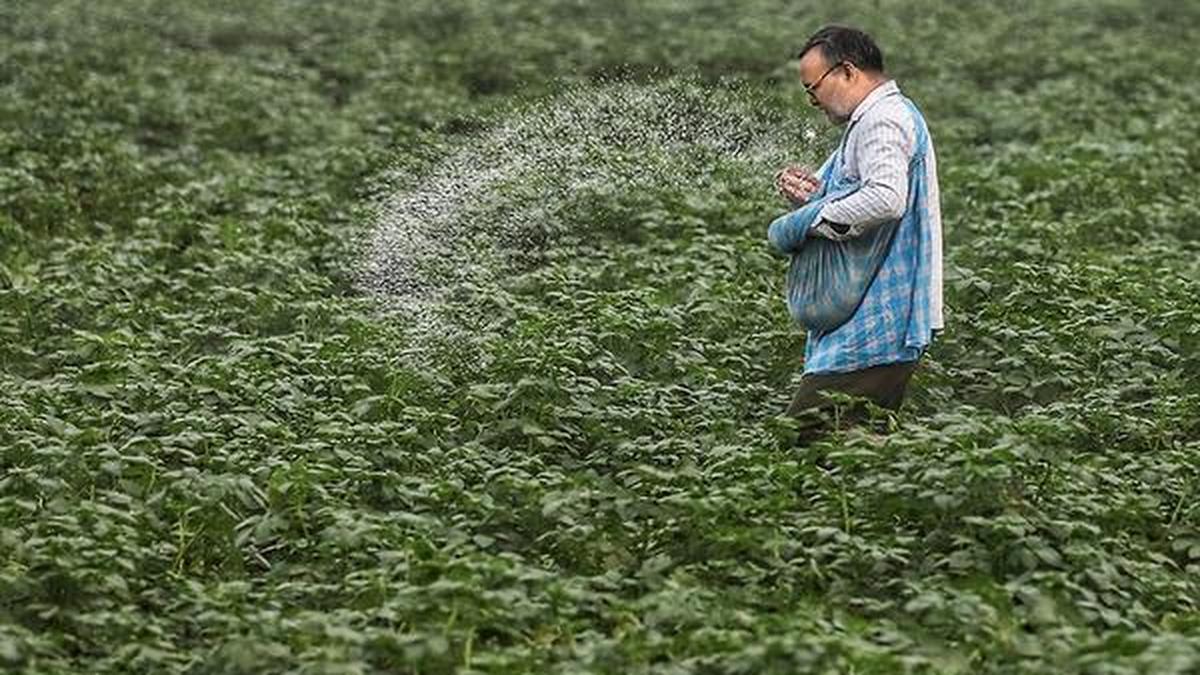
A war-induced fertilizer shock | Photo Credit: ANI
Fertilizer shortage looms large in the wake of the West Asia war, given our heavily reliance on the region for fertilizer and feedstock. This leads to the issue of addressing scarcity in the upcoming kharif season.
The legacy of the Green Revolution has been the manifold increase in our reliance on chemical fertilizers, propelling India as the second-largest consumer of these nutrients in the world. The scale of this transition is staggering. Total fertilizer (NPK) consumption surged to 32.93 million tonnes (mt) in 2024-25, a massive leap from a mere 0.295 mt in 1960-61. On a per-hectare basis, the consumption has skyrocketed from 1.92 kg to 150.11 kg, an increase of over 78 times (see Chart).

While domestic production has followed a positive trajectory, reaching an all-time high of 21.95 mt in 2023-24, our dependence on the Gulf region remains a critical vulnerability. Gulf countries together account for approximately 30 per cent of India’s imports of both urea and di-ammonium phosphate (DAP). Further, about 50 per cent of our Liquefied Natural Gas (LNG) is sourced from this region. Since LNG is the primary feedstock for urea production, any disruption in the Gulf region directly affects Indian agriculture.
Following the disruption, the daily production of urea reportedly plummeted by 30,000-35,000 tonnes from its normal level of 80,000 tonnes. Recognising the situation, the government has taken steps to help boost daily production to 67,000 tonnes. However, this recovery has come at a high cost, as it relies on expensive spot-market gas purchases to bridge the supply gap.
The timing is particularly crucial as we approach the kharif season. During 2025, total fertilizer sales reached 36.1 mt, comprising 19.32 mt of urea, 4.63 mt of DAP, 1.1 mt of MOP, 8.15 mt of complex fertilizers and others. For 2026, the demand is projected at 39 mt. This demand could increase further if the country receives a normal monsoon and paddy area expands beyond last year’s level. While the government is making every effort to bolster production, the risk of panic buying before the onset of the season in June is a real concern that must be seriously addressed.
Reports suggest that the damage to production units of key feedstock in the Gulf region is extensive, implying that supply chains will not normalise immediately. In this context, several remedial measures are essential to safeguard our farmers and ensure food security.
Foremost, farmers must be advised to use fertilizers judiciously across all crops. Currently, paddy and wheat together consume about 56 per cent of the total urea supply. Encouraging a shift towards pulses and oilseeds, which require significantly less fertilizer, could alleviate the pressure on nitrogenous supplies. To facilitate this transition, the government should consider providing short-term incentives on per hectare basis to farmers who move away from fertilizer-intensive paddy and wheat cultivation. To address the anticipated fertilizer shortage, the government has reportedly issued advisories to States recommending SSP (single superphosphate) and TSP (triple superphosphate) as effective substitutes for DAP. These alternatives must now be proactively promoted to farmers particularly in Punjab, Haryana, Tamil Nadu, Andhra Pradesh and Telangana, where the intensity of fertilizer consumption is high.
The current application of nutrients is deeply skewed. Instead of the scientifically recommended NPK ratio of 4:2:1, the actual ratio followed by farmers in 2023-24 was 11.6:4.6:1. This excessive use of urea not only leads to diminishing returns in soil fertility but also triggers widespread micro-nutrient deficiencies. Fixing this imbalance through the area-based rationing of fertilizer supply may reduce the scarcity of urea.
Furthermore, the promotion of nano-urea is no longer an option but a necessity. Nano-urea increases nutrient efficiency while significantly reducing the fiscal burden on the state and the logistics of transport. Moving towards more efficient delivery systems, alongside an aggressive promotion of organic farming and Zero Budget Natural Farming will help reduce our long-term dependency on chemical imports.
The writer is an economist and former full-time Member (Official), Commission for Agricultural Costs and Prices, New Delhi. Views expressed are personal
Published on April 20, 2026
此内容由惯性聚合(RSS阅读器)自动聚合整理,仅供阅读参考。 原文来自 — 版权归原作者所有。