
惯性聚合 高效追踪和阅读你感兴趣的博客、新闻、科技资讯
阅读原文 在惯性聚合中打开

推荐订阅源

Spread Privacy
Spread Privacy
P
Palo Alto Networks Blog
P
Proofpoint News Feed
AI
AI
Help Net Security
Help Net Security
S
Securelist
T
Troy Hunt's Blog
K
KPMG report finds enterprise disconnect between AI and its ROI | CIO
C
Cisco Blogs
Scott Helme
Scott Helme
Hacker News - Newest:
Hacker News - Newest: "LLM"
Vercel News
Vercel News
Exploit-DB.com RSS Feed
CTFtime.org: upcoming CTF events
B
Blog
GbyAI
GbyAI
Recent Commits to openclaw:main
D
Darknet – Hacking Tools, Hacker News & Cyber Security
P
Proofpoint News Feed
S
Security Affairs
Cisco Talos Blog
Cisco Talos Blog
AWS News Blog
AWS News Blog
T
Tenable Blog
H
Help Net Security
NISL@THU
NISL@THU
F
Fortinet All Blogs
博客园_首页
G
GRAHAM CLULEY
L
LINUX DO - 最新话题
P
Privacy International News Feed
G
Google Developers Blog
博客园 - Franky
Cyber Security Advisories - MS-ISAC
cs.CL updates on arXiv.org
Security Archives - TechRepublic
The Register - Security
L
LangChain Blog
aimingoo的专栏
aimingoo的专栏
T
Tor Project blog
P
Privacy & Cybersecurity Law Blog
量子位
C
Cyber Attacks, Cyber Crime and Cyber Security
Forbes - Security
Forbes - Security
S
Secure Thoughts
Simon Willison's Weblog
D
Docker
Recorded Future
Recorded Future
博客园 - 三生石上(FineUI控件)
L
Lohrmann on Cybersecurity
T
Tailwind CSS Blog

Opinion, Editorial, Views, Columnists, Columns | The HinduBusinessLine

Rupee can’t be defended from just one side Railways’ performance Why not have a women-only party? Labour pangs Pak’s peculiar comeback on the global stage Letters to Editor India has jobs, but it needs better ones Cross-border insolvency laws and trade A major health challenge Editorial. Snooping around Letters to the Editor dated April 20, 2026 Real-time metric for factory output All you want to know about the women’s reservation and delimitation bills fiasco Editorial. Process deficit Letters to the Editor dated April 19, 2026 WPI effect on new GDP series The tragic reality of police brutality India’s AI value paradox Prepare the ground India-Korea economic ties poised to strengthen Nari Shakti Bill — a missed opportunity Natural farming should become mainstream policy Insights from new GDP data Strategies to enhance fertilizer security Pathway to maritime insurance sovereignty Why the GoP’s jittery Clear the smoke Aiding piped gas push Stocks are the least over-priced asset in India Is TCS harassment case tip of the iceberg? SIP with caution Global gold ETFs post worst-ever $12 billion monthly outflow: WGC How India is funding Silicon Valley’s rise Cyber insecurity Continuity via status quo Iran war, a boon for the BRICS Assessing the easing of provisioning norms by RBI Iran war, a test for India’s economic resilience Iran war’s impact on India’s farm output and food inflation Economic competence in judiciary Pressure point India moving up the pharma value chain NFRA’s statutory leap Finance capital in time of war How West-Asia war could reshape the AI race When signals diverge: Reading the Nifty-Gold ratio Mohali’s miracle boys Plastic concerns Nice countries come last Lawyers matter more than ever for corporates Odisha central to our aluminium ambitions Editorial. Fair deal Editorial. Wait and watch Letters to the Editor dated April 10, 2026 Unfortunate fallout of cyber crime investigations Letters to the Editor dated April 9, 2026 Will the uneasy truce hold? Charting an intellectually honest way of forecasting RBI plumps for caution amidst uncertainty Large corporates and the sustainability transition of MSMEs MPC positive, despite strong headwinds Cease and desist Together, let us empower our Nari Shakti An AI model that’s too risky NPS funds consistency check: what 10-year rolling returns reveal Editorial. Nuclear milestone Letters to the Editor dated April 7, 2026 Packaging woes China’s perennial industrial policy Sensex has fallen on account of global forces India’s strategic defiance at the WTO meet Freebies will hit Tamil Nadu’s fiscal health Close the backdoor in tobacco FDI policy Is EU’s CBAM discriminatory? Editorial. Freebies unplugged Letters to the Editor dated April 6, 2026 Projecting growth is not easy Improving safety in Indian aviation Amendments to FCRA India’s outreach to Angola will contain energy risk Oil shocks and the rupee: The tricky 100s Editorial. Sweeping powers India’s next social protection is care, not cash In West Asia, it is advantage China Is awarding Trump a Nobel Prize the best bet for peace? Editorial. Knotty regulations Letters to the Editor dated April 3, 2026 Time to push for rupee internationalisation Up in the air Time for industry to lead economic resilience Allied healthcare needs attention What holds back investor participation? Still no endgame in sight Challenging year What happens when CAD rises Reorienting farm research Telecom infra must rest on strong fibre network A severe test for monetary policy India’s chance in supply chain reset Bengaluru’s housing market is growing but affordability is shrinking
Sensex at 40: Secrets behind long-term wealth in markets
2026-04-06 · via Opinion, Editorial, Views, Columnists, Columns | The HinduBusinessLine

Markets are often narrated through headlines. In one phase, liquidity becomes the defining explanation. In another, it is reform momentum, geopolitical uncertainty, interest rates, or foreign flows. Bull runs are celebrated as a triumph of confidence; weak phases are blamed on anxiety and indecision.

Yet, when one steps back and looks at the Sensex over the last 40 years, a quieter and more durable truth becomes evident. Markets, over the long run, are driven less by stories and more by arithmetic.

That arithmetic is uncomplicated. Equity returns over time broadly reflect earnings growth (Sensex basket of companies), with changes in valuation adding or subtracting from returns only temporarily. Put simply, investors ultimately earn what corporate India delivers in profits. Excitement, pessimism, and market mood may influence prices in the short term, but over a decade or more, earnings do the heavy lifting.

This is an unfashionable conclusion in an era increasingly drawn to index milestones, target levels, and dramatic market calls. But it is the most useful lesson that the Sensex offers as it completes four decades of existence.

Earnings do the heavy lifting

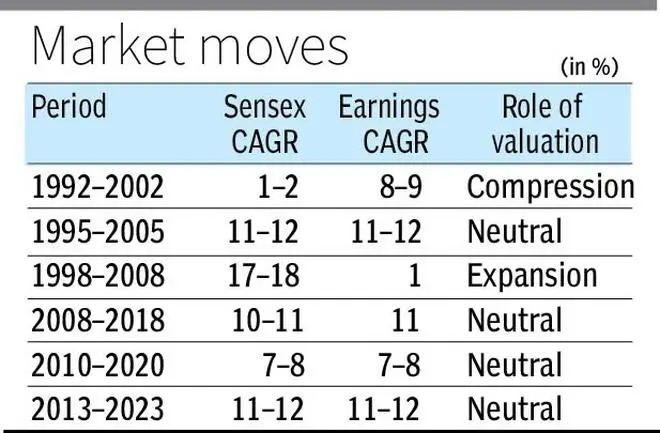
A long view of market history shows that over most rolling 10-year periods, Sensex returns have broadly tracked earnings growth. On average, both have stayed in the vicinity of 10-11 per cent. There have been periods when returns have moved well above this band, but those episodes were typically driven by a combination of strong earnings growth and a sharp expansion in valuation multiples. They were exceptions, not the rule.

The years from the late 1990s to 2008 remain the most striking example. That period combined rapid profit growth with a powerful re-rating of the market. Earnings growth moved into the mid-teens, while price-to-earnings multiples expanded significantly. The result was a phase of unusually strong equity returns that still shapes investor memory today. But that memory can also be misleading. Exceptional periods tend to become the standard against which normal market behaviour is judged, and that often distorts expectations.
Myth of extraordinary returns

The post-global financial crisis period offers a useful counterpoint. Market returns in many of those years were far more restrained and largely mirrored earnings growth, with little help from re-rating. This underlines a critical point: valuation expansion can amplify returns for a while, but it rarely sustains wealth creation on its own. Unless earnings keep growing, markets eventually run out of momentum. This is why investors often misread long phases of subdued market performance. Range-bound or moderate-return periods are frequently seen as signs of stagnation or disappointment.

In reality, they are often phases of adjustment, when earnings continue to rise but valuations remain stable or contract. Such stretches are not signs of market failure. They are part of the natural process through which markets reconnect prices with fundamentals.

Realistic reading

This has direct relevance for the present market environment. India’s equity market today appears to be in an earnings-led phase rather than a valuation-led one. Earnings growth remains reasonably healthy, but valuations are already demanding, and the interest-rate backdrop does not offer the kind of broad support that typically fuels a dramatic re-rating.

Under such conditions, expecting returns to remain broadly aligned with earnings growth may be more realistic than hoping for another prolonged phase of outsized gains. That is not a pessimistic view. It is a disciplined one.

The problem with equity investing is rarely that long-term returns are inadequate. The problem is that investors often expect them to be spectacular all the time.

The enduring lesson

The larger lesson from 40 years of the Sensex is therefore both simple and humbling. Corporate earnings grow over time. Market returns, over long periods, broadly follow that growth. Valuation cycles can create temporary bursts of exuberance or phases of disappointment, but they do not rewrite the long-term equation.

The arithmetic of markets may not be dramatic. But it has proved more reliable than the stories told around them.

Saravanan is Professor of Finance, IIM Tiruchirappalli; and Manas is Associate Professor of Finance, Goa Institute of Management, Goa

More Like This

Towards a community based approach to social care

Published on April 6, 2026