


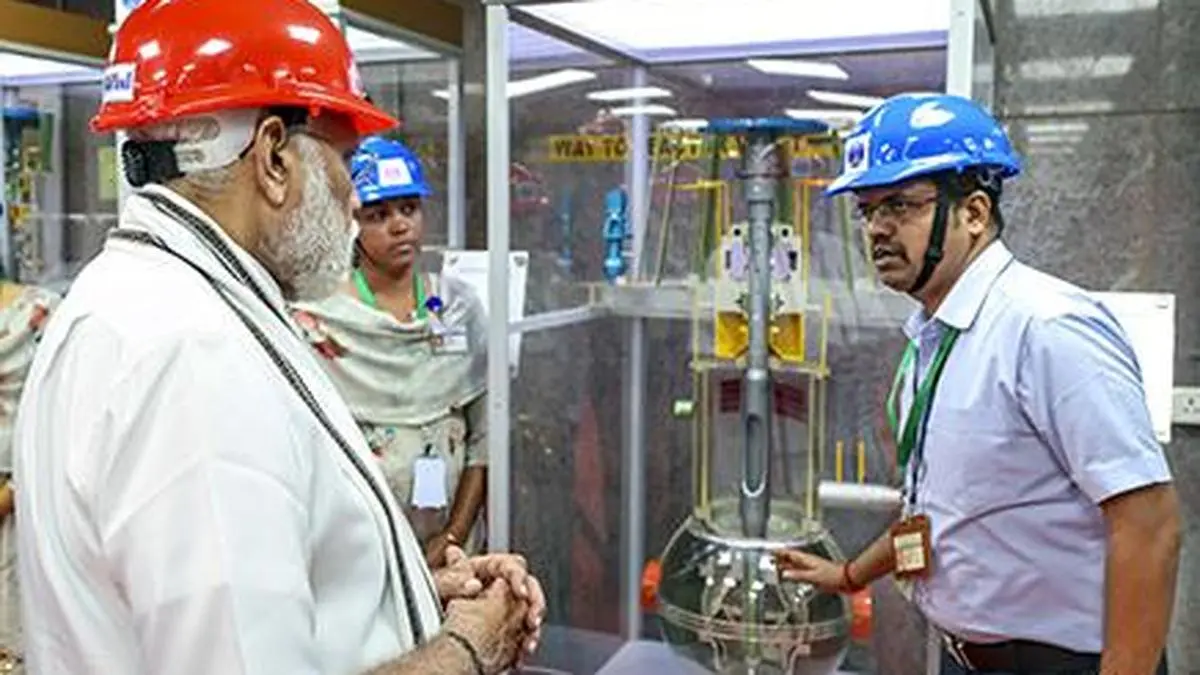
Prime Minister Narendra Modi witnesses initiation of core loading of India’s indigenous Prototype Fast Breeder Reactor, at Kalpakkam in Tamil Nadu on March 4 (File photo) | Photo Credit: Sanal M Sudevan _11657@Chennai
The 500 MW Prototype Fast Breeder Reactor (PFBR) at the Kalpakkam nuclear energy complex near Chennai has gone critical — meaning, a sustained nuclear chain reaction has begun inside the reactor, a prelude to electricity generation. It is a heartening milestone, even if the PFBR suffered a 15-year delay and cost ₹8,181 crore, against the originally estimated ₹3,492 crore. The time and cost overruns seem unconscionably high, but they deserve condonation because building fast breeder reactors is technically very challenging.
Only Russia operates them commercially; France and Japan abandoned their efforts after finding the technical challenge unnecessary, while the US stepped back largely on economic considerations. China’s CFR-600 is in its early stage of operation. Thus, India is on the cusp of becoming only the third country in the world to have a commercial fast breeder reactor. It will be 12-18 months before the PFBR starts supplying electricity to the grid, after tests and turbine synchronisation. It is important for the various arms of the Department of Atomic Energy to ensure that all projects — those under implementation and planned — are fast-tracked. BHAVINI, the government company set up to build and operate breeder reactors, should lose no time in implementing the plan to build two more breeder reactors at the same site, and four more elsewhere.
The PFBR is fuelled by a mixture of oxides of plutonium-239 and uranium-238, both of which come from the conventional pressurized heavy water reactors that India runs. The PFBR is a ‘breeder’ — it produces more Pu-239 than it consumes, by converting U-238 into more Pu-239. Hopefully, the next two breeder reactors will use metallic fuel — a mixture of pure Pu-239 and U-238 rather than their oxides — to increase the breeding ratio so that more Pu-239 is produced. Metallic fuels are the holy grail of fast breeder reactors; India should make the shift to metallic fuels, however tough, a high priority. Once sufficient inventory of Pu-239 is built, India can move to the thorium cycle.
Fast breeder reactors can also convert thorium — which India has in plenty — into another fissile material, uranium-233. However, producing U-233 from thorium comes at the cost of Pu-239 production. While India should prioritise Pu-239, it should explore other ways of converting thorium into U-233. There are several options. This includes an ‘accelerator-driven subcritical system’ (ADSS) — a method of irradiating thorium to produce U-233. The ADSS project has been on the anvil at the Bhabha Atomic Research Centre since 2001 and should be fast-tracked. Further, the DAE should take up construction of the 300 MW Advanced Heavy Water Reactor thorium reactor, for which the design is ready. Alongside, the government should address the delays that continue to dog several other projects under the Department of Atomic Energy — such as the ₹9,859-crore fast reactor fuel cycle facility.
Published on April 7, 2026
此内容由惯性聚合(RSS阅读器)自动聚合整理,仅供阅读参考。 原文来自 — 版权归原作者所有。