







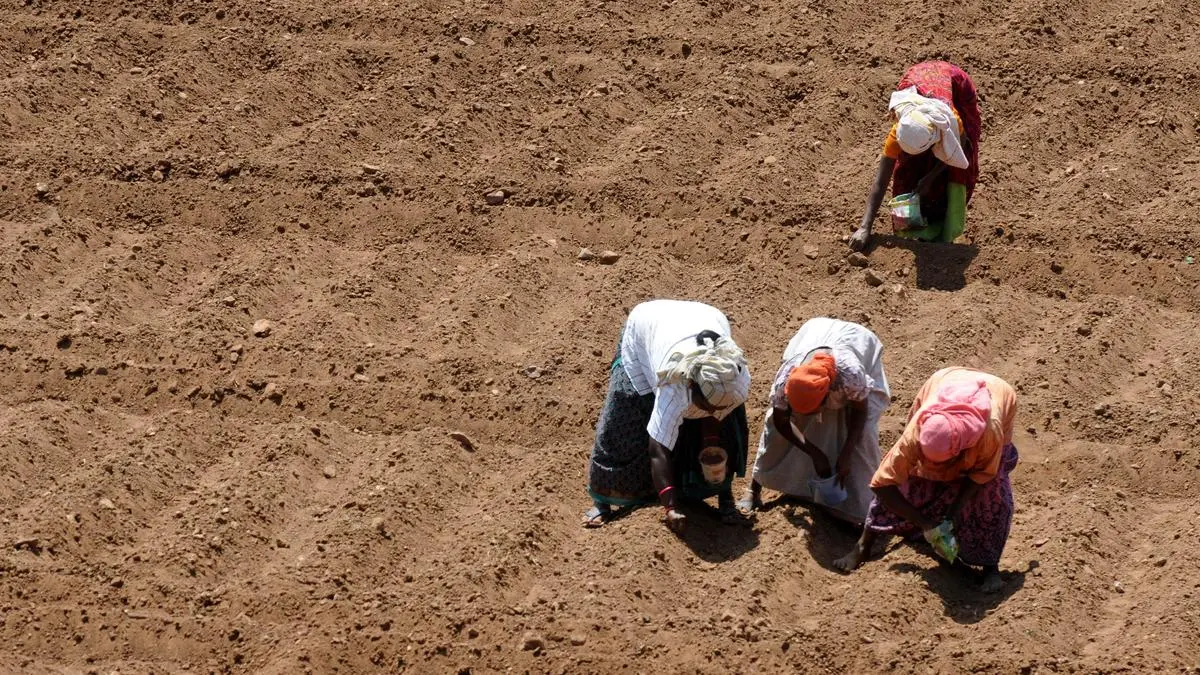
Over 100 million women are now enrolled in the scheme | Photo Credit: MUSTAFAH KK
If one were to traverse the length and breadth of India, from the high plains of Jammu and Kashmir to the paddy fields of Tamil Nadu, one image recurs: women at work. Over 400 million such multi-taskers manage fields, run small businesses and tend to livestock, while continuing to care for their families and households. There is no question that rural communities would not function without them. Nobody, however, thought to ask what they wanted for themselves.
The National Rural Livelihoods Mission decided to ask that question. Fifteen years ago, it made a wager — to see women not just as “caregivers” or “doing household work” or attending to livelihood activities but also as entrepreneurs, institution-builders, and citizens with agency.
What no one dared to claim at the outset was the degree to which organising poor women around thrift and credit would reorganise everything else. The Mission has changed how rural women see themselves, how their families see them and how they engage with the world outside their homes.
Started as one of the world’s largest poverty alleviation programmes, the NRLM had clear targets: enrol women into self-help groups (SHGs), link them to credit, build institutions that could last. On measurable goals, the NRLM has performed remarkably. Over 100 million women are now enrolled in the scheme, empowered through a network of nine million SHGs, 500,000 village organisations (VOs) and 32,400 cluster-level federations (CLFs). It has saturated rural areas of all the States, Union Territories and districts. Thirty-five million women have been provided financial literacy to navigate through banking intricacies. On the livelihoods front the scheme has enrolled and oriented over 4.6 crore women farmers for improved and sustainable farming livelihoods and supported the establishment of over 5.25 lakh non-farm enterprises.
Yet the real story of the Mission lies beyond these numbers. Impact assessments have shown that SHG members were more likely to attend Gram Sabha and Mahila Sabha, more aware of grass-root-level functionaries, travel alone, and to be involved in decision-making on a range of variables from personal to political. Elected women representatives from SHG backgrounds actively involved SHGs in community governance and rejected proxy representation by husbands. Women who had always been defined by their relationships to the male members of their family, are now being known for what they do and build. Thus, giving them greater agency and confidence to hold identities independent of their domestic relations.
Perhaps most tellingly, women are now emerging as an independent political constituency and contestant. Across States, direct cash transfer schemes targeting women have delivered electoral returns, proving that SHG members, who account for roughly 60 per cent of women voters, constitute an attractive constituency to be nurtured. On the other hand, the programme has proven that greater participation in public spheres prepares women for public roles. In Jharkhand’s Godda district, 86 SHG members were chosen as Elected Representatives (ERs) of PRIs in the 2015 elections. Additionally, community institutions created under NRLM are breaking the patron-client relations typical of public service delivery and emerging as a convergence platform for the delivery of many economic, social, and developmental services.
Today, the Mission stands at a threshold, 15 years old and at an inflection point. So, what should NRLM 2.0 look like? In my view, it must accomplish four things the first phase did not fully resolve.
First, it must complete the unfinished work of inclusion of ultra-poor, PVTGs, persons with disabilities and the elderly through special outreach and tailored support.
Second, it must begin the deliberate transfer of programme stewardship to the CLFs themselves. For this to actually happen, State Rural Livelihoods Missions (SRLMs) need to develop exit plans, transferring functions currently performed by SRLM staff to CLFs and their federations while strengthening those bodies organisationally and financially.
Third, it must make a serious, time-bound commitment to livelihood creation at scale. Currently, only about 10 per cent of enrolled households have crossed the Lakhpati threshold. I propose 2030 as a target year and upgrading the income goal to ₹200,000 per household annually. This demands systematic livelihood planning matched to district-level potential, supported by assetisation, skilling, credit, market linkages, and value chain development in farm and non-farm sectors.
Fourth, NRLM must negotiate minimum HR standards with States. Being one of the largest employers in the development sector with over 40,000 development professionals across SRLMs it is time for market-linked compensation, clear career paths, and reskilling in emerging areas like livelihoods, value chains, and e-commerce. Additionally, deeper coordination between Rural Development, Panchayati Raj ministries, and PRI and SHG leadership is what will ensure that all 100 million SHG members are linked with key entitlements. Similarly, there is a need for a lot of research and innovation in the functioning of the various components of the programme, as well as their impact on the lives of SHG constituents.
In short, the path ahead for the mission is equally profound and daunting, but given the NRLM’s track record of renewal and reinvention, I am confident that the programme will rise to it. We must also remember that a Viksit Bharat will not be built from its cities alone. It will be built from its villages, by its women and through exactly the kind of grounded institution-building that the mission has spent 15 years perfecting. Happily for all of us, through initiatives like Mission Lakhpati or SHE-MART or Rural Prosperity and Resilience Programmes, all announced during the last three years help advance the agenda forward, yet, it would require “all hands on the deck” approach, sensitive, participatory and multi-stakeholder approach to accomplish the task ahead.
The writer is former Secretary, Ministry of Rural Development, Government of India
Published on April 20, 2026
此内容由惯性聚合(RSS阅读器)自动聚合整理,仅供阅读参考。 原文来自 — 版权归原作者所有。