

惯性聚合 高效追踪和阅读你感兴趣的博客、新闻、科技资讯
阅读原文 在惯性聚合中打开

推荐订阅源

OSCHINA 社区最新新闻
OSCHINA 社区最新新闻
月光博客
月光博客
爱范儿
爱范儿
The Cloudflare Blog
Y
Y Combinator Blog
B
Blog RSS Feed
Stack Overflow Blog
Stack Overflow Blog
博客园 - 叶小钗
G
Google Developers Blog
J
Java Code Geeks
P
Proofpoint News Feed
美团技术团队
Engineering at Meta
Engineering at Meta
腾讯CDC
Cyber Security Advisories - MS-ISAC
博客园_首页
WordPress大学
WordPress大学
博客园 - 聂微东
雷峰网
雷峰网
有赞技术团队
有赞技术团队
L
LangChain Blog
N
Netflix TechBlog - Medium
让小产品的独立变现更简单 - ezindie.com
博客园 - 【当耐特】

Economy News, Latest Economic News Today | The HinduBusinessLine

GE, HAL clinch tech deal on joint jet engine plan India rejects USTR allegations, seeks termination of Section 301 probe Indian automobile sales record highest-ever sales in FY26, first time after FY19: SIAM Madhya Pradesh CM says basmati rice from the State is exported to 47 nations 63 Moons’ cybersecurity arm pilots GPS-spoofing solution at Indian airports Highways ministry notifies amendment to streamline fee for overloaded vehicles on NHs Global aviation crisis deepens as fuel shortage, Iran conflict hit airlines TRI launches agri-voltaic project to help farmers earn double income Hotel industry to hit $31 billion in 2029; listed hotel firms set to add 70k rooms by 2030: CBRE Temperatures may trend up over North-West, Central India until weekend Reduction in airport tariff credit neutral, minimal impact on revenue: Ind-Ra Global coffee prices rise as fertiliser costs and West Asia tensions threaten supply Bluspring Enterprises to acquire LSG Sky Chefs India, enters aviation catering sector China says policy to improve relations with India remains unchanged amid Arunachal naming row Research firms divided over impact of below normal monsoon on food inflation Unnat Krishi Mahotsav concludes, farmers to emerge as energy, fuel & hydrogen providers, says Gadkari Airlines may get ₹5,000 crore credit support under proposed ECLGS variant How kashmir’s breakthrough is making Gucchi mushroom farming possible Centre not taking away State’s power on bonus for agri produces, says FM Sitharaman Carriers cut flights on cost pressures, uncertain demand GE Aerospace scales AI from pilots to production; India anchors global capability West Asia crisis may push India’s current account deficit to 2% of GDP: Crisil Tax Dept to resume Tiger Global reassessment, says GAAR relief won’t alter SC ruling Ceasefire talks fail to restore vessel movement in Strait of Hormuz, fate of 599 ships remain inconclusive DMRC launches mid-life refurbishment of Blue Line trains to enhance safety and passenger experience Retail inflation likely rose 3.5-4% in March India-UK free trade pact may come into force from second week of May: Official 'West Asia war a good opportunity for energy reforms, lower costs for industry' India’s marine exports surge to ₹62,408 crore in 2024-25, Govt sets ₹1 lakh crore target PM Modi to inaugurate Dehradun-Delhi Expressway on April 14
Industries urge GST Council to allow inverted duty refund...
2026-04-17 · via Economy News, Latest Economic News Today | The HinduBusinessLine
Experts feel that absence of such a mechanism creates structural disadvantage for manufacturers

Experts feel that absence of such a mechanism creates structural disadvantage for manufacturers | Photo Credit: Shutthiphong Chandaeng

Ahead of the next GST Council meeting, industry leaders are pushing for a significant policy shift: allowing input tax credit (ITC) refunds on input services under the inverted duty structure (IDS). Currently, manufacturers can often only claim refunds on raw materials (inputs), leaving tax paid on services (like legal, consulting, or logistics) trapped as a cost.

Experts feel that absence of such a mechanism creates structural disadvantage for manufacturers.

Basic problems

IDS refers to a system where tax on inputs is higher while that on output is lower. This results in two basic problems. First, it could result in accumulated ITC and blocked working capital. Though there is provision of refund, it is is available only for input goods and not for input services. Second, IDS pushes the production cost making affecting competitiveness of domestic manufacturer and thus makes imported goods cheaper.

In a representation to Central Board of Indirect Taxes (CBIC), the Bengal Chamber of Commerce & Industry (BCCI) said: “While the rate reduction in GST 2.0 has helped trade and industry too by supporting the output supply part, yet for manufacturers it has deepened the inverted duty structure and hence increased the cost.” It may be noted that with effect from September 22, GST rates were restructured with two basic rate slab (5 per cent and 18 per cent) along with 40 per cent rate slab for demerit and high-end goods.

Key issues

The chamber especially highlighted problem of FMCG (fast moving consumer goods) manufactures. As a part of rate revision, GST on many such goods lowered to 5 per cent from 18 per cent. “As a consequence of this downward revision, the rate of tax applicable to outward supplies were reduced by 13 per cent; however, the rate of tax applicable for input services remained as 18 per cent,” it said. This deepened the IDS on account of input services to a large extent.
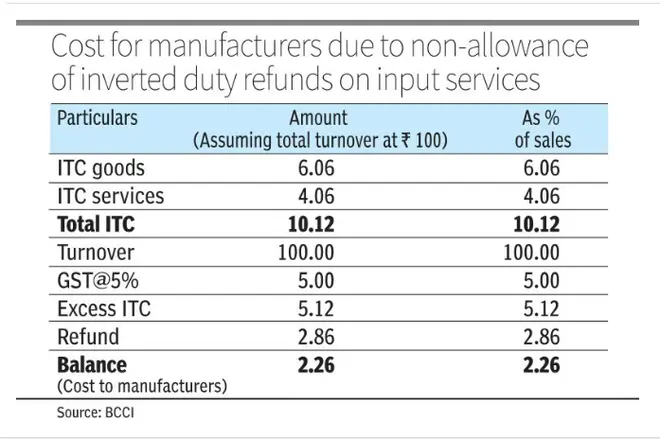
Further, due to the legal provisions under section 54 of CGST/ SGST Act and Rule 89 and as confirmed by the courts also, inverted duty refunds are not eligible on input services. This leaves the ITC earned on input services as a wasteful asset in the balance sheet and a resultant cost to the manufacturers. “This also goes against the very object of GST to eliminate ‘cascading impact of tax,” the chamber said while making the plea for appropriate recommendations for the amendment of the statutory provisions for correcting this anomaly.

According to Rahul Shekhar, Parter at Nangia Global, in practice, manufacturers incur substantial input services costs such as information technology, rentals, advertising, royalty/ technical fees on acquisition of technology, management cost if it is a subsidiary of global MNC etc, which form an integral part of their overall cost structure. The exclusion of input services from the refund mechanism results in the accumulation of unutilised ITC, thereby blocking working capital and increasing the cost of operations. “This creates a structural disadvantage for manufacturers operating under an inverted duty regime, ultimately affecting liquidity and business efficiency,” he said.

Published on April 17, 2026