








The ₹5 biscuit pack has survived demonetisation, GST, Covid, and three commodity price spikes over the past decade. Now, with crude above $100 a barrel, palm oil supplies tightening, and polymer prices rising sharply, it will survive this one, too.
It will just weigh less.
India’s FMCG companies are in the middle of a fresh cost squeeze. Nuvama Institutional Equities has warned that the current commodity basket could shave off 100–250 basis points from gross margins if companies do not act. EY India’s Angshuman Bhattacharya, Partner and National Leader, Consumer Products and Retail, describes it as a “system-wide cost surge” likely to translate into higher MRPs or grammage cuts.
Dhairyashil Patil, National President, All India Consumer Products Distributors Federation (AICPDF), told BusinessLine that FMCG companies’ grammage reduction strategy is a “silent killer” — protecting margins while quietly eroding consumer value, as buyers chasing ₹5 and ₹10 price points often do not realise they are getting less for the same money. He pointed to biscuits, where a ₹10 pack of Good Day has reduced from 100 grams to around 90 grams, and said the trend is even sharper in soaps, among the most palm oil-sensitive categories, with global palm oil derivative prices at a 24-month high in early 2026. Entry-level ₹10 packs of Lifebuoy and Lux have been trimmed by 8–12 grams, with bars that were earlier 55 grams now closer to 46–48 grams, while Dettol’s ₹10 bar has reduced from 45 grams to about 40 grams. Even cleaning products have not been spared, with the ₹5 Vim ‘Chhotu’ bar cut by 5–7 grams, making it visibly thinner even as the price remains unchanged, he added.
Companies don’t want to disturb customers’ safe consideration zone
But the sanctity of the ₹5 and ₹10 price points will not change. These entry-level packs will not disappear, nor will ₹10 become ₹12, because they anchor rural India’s consumption economy, where purchases are often daily: a ₹5 note from a morning’s wage or a ₹10 coin from a small transaction. Even a marginal hike risks pushing consumers out of the category altogether.
“Companies like Parle and Dabur are considering price increases or smaller packs,” Anand Rathi Research said, but the emphasis, tellingly, is on the smaller packs.
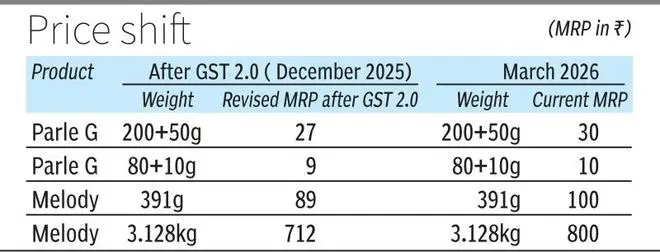
Parle Products has trimmed grammage in select Parle-G packs to retain ₹5 and ₹10 price points rather than raise them. Varun Beverages has introduced ultra-small ₹10 packs of Pepsi and Slice. Emami is doubling down on BoroPlus and Navratna sachets, holding prices and adjusting quantities.
Dabur has introduced smaller packs of Dabur Honey, Real juices, and Vatika hair care while taking selective price hikes only where demand elasticity allows, according to Anand Rathi Research.
Nuvama notes Britannia and Nestlé are being “surgical” — trimming grammage in high-volume packs of Good Day, Marie Gold, and Maggi while protecting premium segments. Packaging alone accounts for 15–20% of total costs for companies like Parle, and crude-linked polymer inflation has further sharpened the pressure.
The bridge pack fills the middle
Companies are also building “bridge packs”, formats between the ₹5 sachet and the larger family pack, designed to retain consumers within the brand franchise without forcing a sharp jump in spending. HUL’s Lifebuoy is the textbook example: a ₹16 bar sitting between the ₹10 entry and the ₹36 format, with Surf Excel, Rin, and Clinic Plus following similar logic.
Adani Wilmar is pushing smaller Fortune refined oil packs to keep households in branded oil, even as the larger tin has become a significant purchase. The consumer who stays with Fortune today is worth far more than one who drifts to loose oil.
The urban consumer sees through it
The rural consumer accepts the lighter pack. The urban consumer resents down-trading to unbranded alternatives or bulk buying when branded packs deliver less. HUL runs the inverse play simultaneously: Dove in compact bottles, TRESemmé in trial sizes, Indulekha in smaller packs.
This is not shrinkflation but access plays, keeping aspirational brands within reach of a budget-conscious urban buyer. Two strategies, both small packs, pointing in opposite directions.
A ratchet that only turns one way
Each commodity spike prompts a reduction in grammage. When costs ease, pack sizes never recover. The baseline resets lower every cycle. “The transmission from input costs to pricing and eventually to demand is already underway,” Bhattacharya of EY noted, and that transmission is asymmetric. It flows downward. It does not reverse.
“Such pricing actions could weigh on the nascent demand recovery,” Anand Rathi Research cautioned. The middle path of shrinkflation carries its own demand cost, compounding quietly across cycles.
The ₹5 pack will survive; it’s too embedded in rural India’s daily cash-flow economics, in the kirana store’s logic, in every FMCG company’s brand calculus to be abandoned by either side.
The Parle-G of FY27 will be lighter than the one from 2017. The Fortune pouch is smaller. The Maggi block lighter. The pricing on the pack is unchanged.
It will just keep getting lighter.
Published on April 10, 2026