







From corporate corridors to curdled milk, India’s artisanal cheese movement is being shaped by two very different journeys — one emerging from Mumbai’s start-up kitchens and the other from Ladakh’s nomadic pastures.
While Mausam Narang left a corporate career at Capgemini to build Eleftheria Cheese in Mumbai, another story was unfolding nearly 3,000 km away in the high-altitude cold deserts of Ladakh, where Thenlay Nurboo was quietly redefining yak milk into an artisanal product rooted in tradition.
The two were among India’s standout winners at the Mundial do Queijo do Brasil 2026, where Indian entries won four medals across categories, marking a notable debut on the global cheese stage.
Home kitchen
For Narang, the journey began in a home kitchen after returning from abroad with a simple craving for better cheese. Over weekends, she experimented with milk sourced from farmers in Maharashtra, gradually building Eleftheria into a full-fledged artisanal brand.
Today, the company partners with multiple family-run farms and produces a range of cheeses that blend European techniques with Indian ingredients and geography.
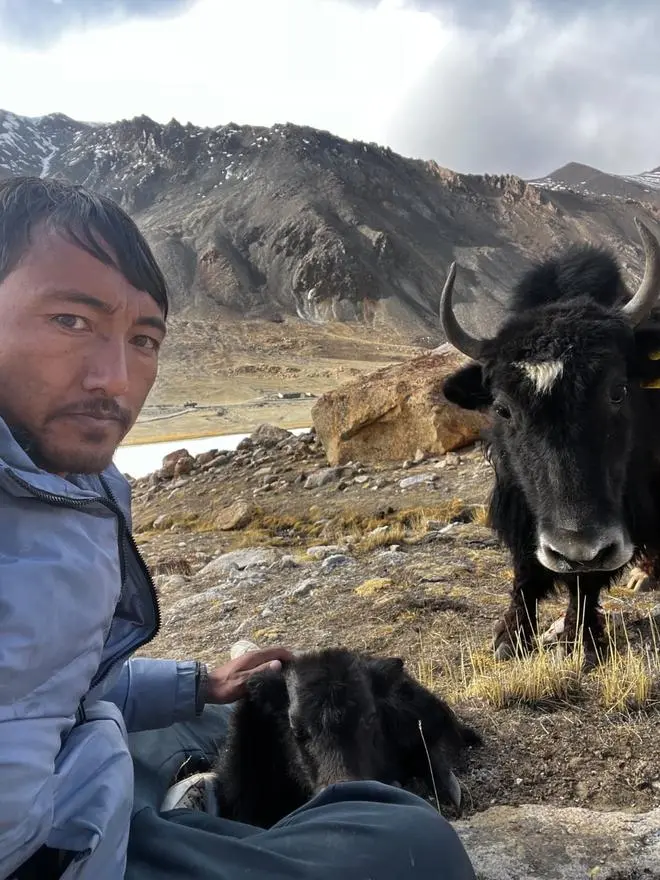
Thenlay Nurboo
In contrast, Nurboo’s story is anchored in scale and terrain rather than urban experimentation. Working from his ‘Nomadic farm’ in Durbuk, he produces just 8-9 kilograms of cheese at a time, relying entirely on yak milk sourced from his herd of around 150 animals. “This Yak Churpi is made from yak milk and is not available anywhere else in India other than Ladakh,” he said, adding that while similar variants exist in Sikkim and Arunachal Pradesh, Ladakh’s version is distinct in texture and process.
Unlike many modern dairy systems, Nurboo’s method requires no machinery or advanced technology. Yak Churpi is already a staple in Ladakh’s food culture, widely consumed in noodle shops and as instant food, reflecting its deep integration into local diets rather than niche gourmet positioning.
His path to cheesemaking, however, was not linear. Having learned the craft from his parents nearly a decade ago, Nurboo initially experimented with recreating cheese from other regions, even travelling to Nepal to study different varieties.
Traditional forms
Eventually, he shifted focus back to indigenous production, choosing to work with yak milk in its most traditional forms. Alongside Churpi, he now produces butter, lassi, ghee and whey — extending value addition across the animal’s full output.
Together, the Mumbai-based urban brand and the Ladakh nomadic producer represent two ends of India’s emerging artisanal dairy spectrum where one is driven by structured branding and market expansion, the other rooted is in heritage, subsistence and minimal intervention.
At the Brazil competition, both narratives converged on a global platform, where blind tastings judged cheeses purely on texture, flavour and craftsmanship.
Narang’s Gulmarg (Brie-style) won Super Gold, while Nurboo’s Yak Churpi earned Gold recognition — placing India firmly on the map of a category long dominated by European producers.
The international recognition has also drawn attention at the highest levels.
Prime Minister Narendra Modi, in a public message, said India had “made an impressive debut” at the Brazil competition, adding that such successes strengthen the country’s artisanal dairy sector on the global stage.
Nurboo said that he had sent his product to the Brazil-based competition through the National Dairy Development Board (NDDB). Churpi is known for its long shelf life and unique texture. In Ladakh, it is inseparable from the pastoral lifestyle, where yak milk — richer and more resilient than cow’s milk — is turned into butter, curd and cheese to sustain communities through long winters. “For communities in remote areas, these products are not only a dietary staple but also a means of preserving milk for long winters,” said Dr Satnazin Rabgais, Chief Animal Husbandry Officer, Leh, pointing to the cultural and practical value of such foods.
For Narang, the recognition of winning three awards is both validation and a reflection of how far the category has come.
“The cheeses are judged based on their visual appeal, flavour and texture. It is a blind-tasting event, so nobody knows the origin of the cheese,” she said. “Artisanal cheese is still at a nascent stage in India, so to win at this level is encouraging.”
Her approach stands in contrast to the processed cheese that has long dominated Indian consumption.
Craftsmanship
“We all grew up eating cheese cubes and slices. Much of that is processed, with emulsifiers, preservatives and additives. Artisanal cheese is about craftsmanship — it is 100 per cent dairy, made from good quality milk and fermented over time,” she explained.
That focus begins at the source. Eleftheria partners with four family-run farms across Maharashtra, working with both cow and goat milk. Maintaining quality requires close coordination with farmers, including ensuring the right feed and conditions to achieve the desired pH and temperature.
“It was important for us to pay a premium and incentivise farmers to consistently deliver the right quality of milk,” Narang said.
Over time, the company has also built a distinct identity by blending European techniques with Indian context. Initially using familiar European names, it gradually shifted to Indian ones as acceptance grew.
“Gulmarg, for instance, is named for its snow-like rind, while Konark resembles the wheels of the Sun Temple,” she noted, adding that while techniques may be inspired globally, the raw materials and expression remain rooted in India.
The business itself has evolved alongside the category. Starting as a B2B supplier to hotels and restaurants, Eleftheria pivoted during the pandemic to build a direct-to-consumer channel.
Today, about 40 per cent of its revenue comes from D2C sales across cities such as Mumbai, Delhi, Bengaluru and Ahmedabad, contributing to an overall growth rate of around 30 per cent annually.
(INPUTS From GULZAR BHAT in Srinagar)
Published on April 23, 2026