


惯性聚合 高效追踪和阅读你感兴趣的博客、新闻、科技资讯
阅读原文 在惯性聚合中打开

推荐订阅源

博客园 - 三生石上(FineUI控件)
月光博客
月光博客
人人都是产品经理
人人都是产品经理
Google DeepMind News
M
MIT News - Artificial intelligence
Vercel News
Vercel News
MyScale Blog
MyScale Blog
爱范儿
爱范儿
博客园 - 司徒正美
OSCHINA 社区最新新闻
OSCHINA 社区最新新闻
IT之家
IT之家
H
Help Net Security
Last Week in AI
Last Week in AI
阮一峰的网络日志
阮一峰的网络日志
酷 壳 – CoolShell
酷 壳 – CoolShell
L
LangChain Blog
罗磊的独立博客
Stack Overflow Blog
Stack Overflow Blog
宝玉的分享
宝玉的分享
博客园 - 聂微东
云风的 BLOG
云风的 BLOG
J
Java Code Geeks
博客园 - 叶小钗
D
Docker

Economy News, Latest Economic News Today | The HinduBusinessLine

GE, HAL clinch tech deal on joint jet engine plan India rejects USTR allegations, seeks termination of Section 301 probe Indian automobile sales record highest-ever sales in FY26, first time after FY19: SIAM Madhya Pradesh CM says basmati rice from the State is exported to 47 nations 63 Moons’ cybersecurity arm pilots GPS-spoofing solution at Indian airports Highways ministry notifies amendment to streamline fee for overloaded vehicles on NHs Global aviation crisis deepens as fuel shortage, Iran conflict hit airlines TRI launches agri-voltaic project to help farmers earn double income Hotel industry to hit $31 billion in 2029; listed hotel firms set to add 70k rooms by 2030: CBRE Temperatures may trend up over North-West, Central India until weekend Reduction in airport tariff credit neutral, minimal impact on revenue: Ind-Ra Global coffee prices rise as fertiliser costs and West Asia tensions threaten supply Bluspring Enterprises to acquire LSG Sky Chefs India, enters aviation catering sector China says policy to improve relations with India remains unchanged amid Arunachal naming row Research firms divided over impact of below normal monsoon on food inflation Unnat Krishi Mahotsav concludes, farmers to emerge as energy, fuel & hydrogen providers, says Gadkari Airlines may get ₹5,000 crore credit support under proposed ECLGS variant How kashmir’s breakthrough is making Gucchi mushroom farming possible Centre not taking away State’s power on bonus for agri produces, says FM Sitharaman Carriers cut flights on cost pressures, uncertain demand GE Aerospace scales AI from pilots to production; India anchors global capability West Asia crisis may push India’s current account deficit to 2% of GDP: Crisil Tax Dept to resume Tiger Global reassessment, says GAAR relief won’t alter SC ruling Ceasefire talks fail to restore vessel movement in Strait of Hormuz, fate of 599 ships remain inconclusive DMRC launches mid-life refurbishment of Blue Line trains to enhance safety and passenger experience Retail inflation likely rose 3.5-4% in March India-UK free trade pact may come into force from second week of May: Official 'West Asia war a good opportunity for energy reforms, lower costs for industry' India’s marine exports surge to ₹62,408 crore in 2024-25, Govt sets ₹1 lakh crore target PM Modi to inaugurate Dehradun-Delhi Expressway on April 14
Nearly half of population now covered by health insurance...
Shishir Sinha · 2026-04-21 · via Economy News, Latest Economic News Today | The HinduBusinessLine
While insurance coverage has expanded, now accounting for 38% of the market and reaching over 50 crore people, these gains have not curbed OOPE, which still dominates health spending.

While insurance coverage has expanded, now accounting for 38% of the market and reaching over 50 crore people, these gains have not curbed OOPE, which still dominates health spending.

Nearly half of India’s population is now covered by health insurance, finds a survey report released on Monday by the Statistics Ministry. However, the average out-of-pocket expenses (OOPE) per hospitalisation continue to remain high, topping ₹34,000 in private and charitable healthcare facilities.

The findings are based on responses from about 1.4 lakh households surveyed between January and December 2025 as part of the 80th round of the National Sample Survey (NSS).

Health insurance coverage has risen sharply, the report noted. In 2017-18, during the previous NSS health survey, only 14.1 per cent of rural residents and 19.1 per cent of urban residents were insured.

By 2025, the coverage had increased to 47.4 per cent in rural and 44.3 per cent in urban areas. This expansion coincided with the reduction of GST on individual and family health insurance premiums to zero from 18 per cent, effective September 22, 2025.
Govt schemes

Coverage under government-sponsored schemes grew even faster, rising from 13 per cent in rural areas and 9 per cent in urban areas in 2017-18 to 45.5 per cent and 31.8 per cent, respectively, in 2025. The Ayushman Bharat-Pradhan Mantri Jan Arogya Yojana (AB-PMJAY), launched in September 2018, offers annual health cover of up to ₹5 lakh per eligible household and has enrolled nearly 12 crore families.

Experts, however, offered a nuanced assessment of this expansion. “The increase is driven largely by government-funded health assurance schemes such as Ayushman Bharat PM-JAY rather than direct private insurance,” said Indranil of OP Jindal University. Mohan Rao, a former professor at the Centre of Social Medicine and Community Health, Jawaharlal Nehru University, added that the scheme has effectively subsidised private healthcare provision at the cost of strengthening public health infrastructure.

Out-of-pocket spend

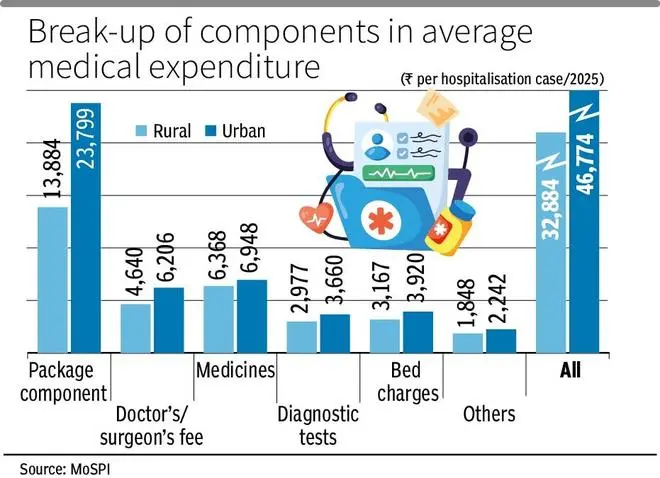
Despite the wider coverage, cost disparities remain stark. The average OOPE per hospitalisation stood at ₹6,631 in government or public facilities, but jumped to ₹39,530 in charitable or NGO-run hospitals and ₹50,508 in private hospitals, including those empanelled under government schemes.

The 2017-18 NSS did not provide comparable OOPE estimates. However, a study by Indranil, which deflated costs to 2014 prices, estimated outpatient OOPE at ₹16,128 in rural and ₹20,814 in urban areas during that period.

Other key findings

About 13.1 per cent of persons reported illness in the 15 days before the survey, with urban areas (14.9 per cent) slightly higher than rural (12.2 per cent). The average hospitalization rate was 2.9 instances per 100 persons over the preceding 365 days.

While insurance coverage has expanded, now accounting for 38 per cent of the market and reaching over 50 crore people, these gains have not curbed OOPE, which still dominates health spending.

With private premiums rising (a 25 per cent jump for 52 per cent of policyholders in the last year) and schemes like AB-PMJAY focusing on inpatient empanelments, households continue facing catastrophic costs, as evidenced by studies like Reshmi et al (BMJ 2021) and Samir Garg et al (EPW, April 2024).

Published on April 20, 2026