








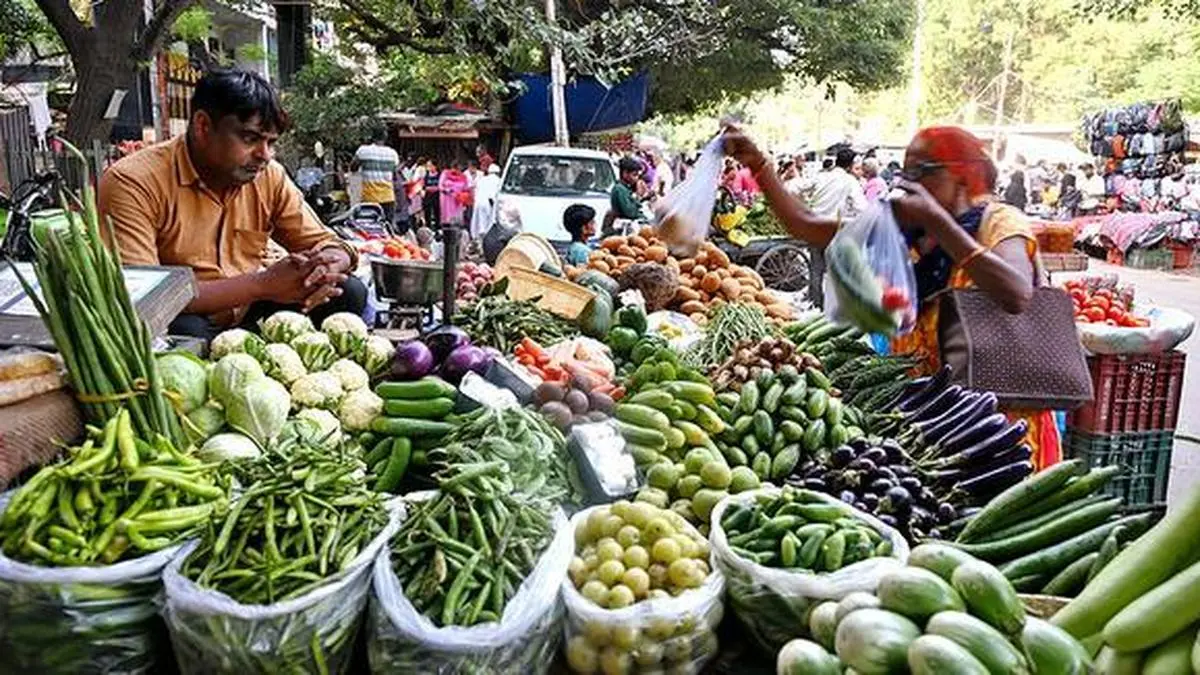
It is expected that food inflation is likely to be benign, while decline in gold prices will have some impact on core inflation | Photo Credit: SUSHIL KUMAR VERMA
With higher fuel prices, retail inflation based on Consumer Price Index (CPI) is likely to have surged between 3.5 and 4 per cent in March. It was 3.2 per cent in February.
Statistics Ministry will officially release the data for March on Monday.
Though pump prices of petrol and diesel are unchanged, prices of domestic and LPG cylinder increased with effect from March 07. While the cost of 14.2 kg domestic LPG cylinders rose by ₹60, that of a 19 kg commercial LPG cylinder went up by ₹115 on the same date, impacting businesses including hotels, restaurants and small commercial establishments. Following that, many businesses have passed on the rise in retail prices to the consumers and that could be seen in the headline inflation number.
However, there is still comfort in prices of food (mainly vegetables) and precious metals. Accordingly, it is expected that food inflation is likely to be benign, while decline in gold prices will have some impact on core inflation (headline inflation minus food and fuel inflation). Still, core inflation will see some increase on account of rise in cost of some services.
In a note, Dipanwita Mazumdar, Economist, at the Bank of Baroda said: “We expect CPI in March, 26 to be at 3.7 per cent.” The arrival statistics of TOP vegetables (Tomato, Onion and Potato) have shown a 53.8 decline in March, 26 over March, 25. Other than that, edible oil prices are elevated. Hence monitoring is required on food inflation front, albeit it is softer. “The increase in LPG (1.98 per cent) prices in March 26 by 7 per cent is also expected to push the housing and utility component of the new series higher. The subsidized Kerosene prices (weight in CPI: 0.01 per cent) in metro cities have also increased. Thus, the fuel component of CPI is expected to be higher in March 26,” she said.
According to her, news reports have also underlined that FMCG, consumer durable companies, are already weighing in input price risks. The gap between retail and wholesale prices for TOP vegetables (Tomato, Onion and Potato) is also falling, thus pass-through to retail prices is expected to be visible soon.
Meanwhile, economists at HDFC Bank estimated retail inflation to rise to 4 per cent in March. This assumes a sequential rise of 0.8 per cent month-on-month in March compared to 0.1 per cent rise in February. The risk in this forecast is tilted towards the upside. The pick-up is primarily estimated to come from higher fuel inflation.
For core inflation, “we estimate a more moderate increase at this stage (to 3.5 per cent in March from 3.4 per cent earlier) as the pass-through to retail inflation (given second round effects of the rise in commodity prices) is likely to be gradual initially. Moreover, the continued fall in gold and silver prices could partially offset any increase in other categories within the core basket,” the note by HDFC Bank said.
The April 6-9 Reuters poll of 45 economists have forecast inflation at 3.48 per cent in March.
Published on April 12, 2026
此内容由惯性聚合(RSS阅读器)自动聚合整理,仅供阅读参考。 原文来自 — 版权归原作者所有。