
惯性聚合 高效追踪和阅读你感兴趣的博客、新闻、科技资讯
阅读原文 在惯性聚合中打开

推荐订阅源

aimingoo的专栏
aimingoo的专栏
Google DeepMind News
S
SegmentFault 最新的问题
Project Zero
Project Zero
D
DataBreaches.Net
I
InfoQ
L
Lohrmann on Cybersecurity
OSCHINA 社区最新新闻
OSCHINA 社区最新新闻
酷 壳 – CoolShell
酷 壳 – CoolShell
Stack Overflow Blog
Stack Overflow Blog
The Register - Security
Recorded Future
Recorded Future
Vercel News
Vercel News
博客园 - 司徒正美
freeCodeCamp Programming Tutorials: Python, JavaScript, Git & More
I
Intezer
The Hacker News
The Hacker News
F
Fortinet All Blogs
Microsoft Azure Blog
P
Proofpoint News Feed
Help Net Security
Help Net Security
cs.CV updates on arXiv.org
Application and Cybersecurity Blog
Scott Helme
Scott Helme
T
Threatpost
爱范儿
爱范儿
N
Netflix TechBlog - Medium
D
Docker
云风的 BLOG
云风的 BLOG
C
Cisco Blogs
K
Kaspersky official blog
H
Help Net Security
S
Secure Thoughts
T
Threat Research - Cisco Blogs
钛媒体:引领未来商业与生活新知
钛媒体:引领未来商业与生活新知
S
Security @ Cisco Blogs
Cyberwarzone
Cyberwarzone
N
News and Events Feed by Topic
G
Google Developers Blog
Forbes - Security
Forbes - Security
博客园 - 三生石上(FineUI控件)
博客园 - 叶小钗
B
Blog
Google DeepMind News
Recent Announcements
Simon Willison's Weblog
S
Securelist
P
Privacy International News Feed
Spread Privacy
Spread Privacy
The Last Watchdog
The Last Watchdog

Threat Intelligence Blog | Flashpoint

Understanding Illicit Ecosystems: How Dark Web Forums Structure Cybercrime AI, Trust, and the Future of Threat Intelligence Remus Stealer: A New, Not-So-New Infostealer America250 Fourth of July Threat Assessment Unmasking the Digital Trail: Essential Techniques for Vetting AI-Generated Content The Shift to Threat-Informed Prioritization: Operationalizing CISA BOD 26-04 Identity Is the New Attack Surface: How Infostealers Are Reshaping Enterprise Risk Understanding Illicit Ecosystems: Weaponizing Mainstream Apps and Social Infrastructure Connecting Vulnerability Intelligence to Real-World Exposure With Flashpoint EASM Understanding Illicit Ecosystems: XSS and the Current State of the Russian-Speaking Underground How to Align and Measure Threat Intelligence Operations: Flashpoint Priority Intelligence Requirements The Mini Shai-Hulud Worm and the New Era of CI/CD Exploitation Understanding Illicit Ecosystems: The Hybrid Threat of “The Com” AI Threat Report: How Artificial Intelligence Is Used Across Illicit Communities How Mergers and Acquisitions Expand Your Attack Surface Overnight The Evolution of the Geotag: How AI is Bridging the Gap in Location-Based OSINT Navigating the Threat Landscape of the 2026 FIFA World Cup Inside the 2026 Cyber Threat Landscape: Data-Driven Security Priorities Flashpoint MCP Server: Operationalizing Cyber Threat Data for Agentic AI Security Workflows 2026 Gartner® Magic Quadrant™ for Cyber Threat Intelligence: Key Takeaways for Security Leaders Escalation in the Middle East: Tracking “Operation Epic Fury” Across Military and Cyber Domains How to Build and Operationalize Priority Intelligence Requirements National Vulnerability Database (NVD) Shifts to Selective Enrichment as CVE Volume Surges Flashpoint Surpasses Cataloging 7,000 Known Exploited Vulnerabilities as Disclosure Volume Accelerates Why Intelligence Requirements Fall Flat and How to Fix Them with a Practical Priority Intelligence Requirements Framework Tax Refund Fraud in 2026: How Threat Actors Exploit Identity, Verification, and Cash-Out Channels The Language of Emojis in Threat Intelligence: How Adversaries Signal, Obfuscate, and Coordinate Online What the NVD ‘Slowdown’ Means For You: How to Stay Ahead in Vulnerability Management Forrester Threat Intelligence Landscape: Key Takeaways for Security Leaders Connecting Threat Intelligence to Decision-Making: How Flashpoint Is Operationalizing Intelligence in 2026 Iran-Aligned Militias Signal Expanded Regional Risk Amid US–Israel–Iran Conflict Destructive Activity Targeting Stryker Highlights Emerging Supply Chain Risks Navigating 2026’s Converged Threats: Insights from Flashpoint’s Global Threat Intelligence Report What to Know About the Notepad++ Supply-Chain Attack Cyber Threat Intelligence Index: Q3 2023 Edition Beyond Hamas: Militant and Terrorist Groups Involved in the October 7 Attack on Israel The First 72 Hours of the Israel-Hamas War: Hamas and PIJ Activity on Telegram About Us Qakbot Takedown: A Brief Victory in the Fight Against Resilient Malware Unmasking the Attacker and Decoding Threat Actor Patterns The Flashpoint Firehose: 5 Questions With Michael Raypold, VP of Engineering The Seven Phases of a Ransomware Attack: A Step-by-Step Breakdown of the Attack Lifecycle Lost in Transition: A Timeline of Failed Successors to Breach and Raid Forums Days of Chaos: How OSINT Helps Us Understand the Putin-Prigozhin Schism Lessons From Clop: Combating Ransomware and Cyber Extortion Events How to Combat Check Fraud: Leveraging Intelligence to Prevent Financial Loss Beyond Gates and Alarms: The Scope and Impact of Physical Security Intelligence Why We Built Flashpoint Ignite: Unity, Power, and Performance The Risk-Reducing Power of Flashpoint Video Search Card Shop Threat Landscape: BidenCash Dumps 2.1M Stolen Credit Cards Flashpoint in 2023: A Note From Our CEO 5 Reasons Taiwan Is a Growing Source of US-China Tension Why We Acquired Echosec Systems: The OSINT Revolution Open Source Intelligence
The Phishing-as-a-Service Pipeline: How a Scalable Fraud Ecosystem Is Driving Global Attacks
2026-04-10 · via Threat Intelligence Blog | Flashpoint

Phishing is no longer a standalone tactic. It has matured into a service-based ecosystem where specialized actors provide each component of an attack lifecycle, from infrastructure and delivery to credential harvesting and cash-out.

Flashpoint analysts, working with partner financial institutions, have observed a growing number of PhaaS operations operating with a level of coordination and specialization more commonly associated with legitimate software platforms. These ecosystems bring together phishing kit developers, infrastructure providers, spam delivery services, and financially motivated actors into a single, scalable pipeline for fraud.

This shift has significantly lowered the barrier to entry for cybercriminals while increasing the scale, efficiency, and success rate of phishing campaigns.

From Phishing Kits to a Service-Based Fraud Economy

PhaaS emerged from early phishing kits into a full cybercrime-as-a-service model built on commercialization, modular tooling, and operational scalability.

Early phishing activity relied on standalone kits — basic login pages and scripts that allowed attackers to collect credentials. Over time, operators began centralizing these capabilities into subscription-based platforms offering hosting, domain management, campaign tooling, and ongoing support.

Modern PhaaS platforms now operate similarly to legitimate SaaS providers:

  • Subscription-based pricing models
  • Prebuilt templates for major brands and services
  • Integrated delivery mechanisms (email, SMS, QR phishing)
  • Real-time dashboards for campaign tracking and credential harvesting

This model has made sophisticated phishing accessible to low-skill actors. Kits can cost as little as US$10, while full platforms enable large-scale campaigns for relatively modest monthly fees.

MFA Bypass and AI Are Reshaping Phishing Capabilities

As organizations adopted multifactor authentication (MFA), PhaaS operators adapted.

Modern platforms increasingly rely on adversary-in-the-middle (AiTM) techniques, using reverse proxy infrastructure to intercept login sessions in real time. This allows attackers to capture not only credentials, but also MFA tokens and session cookies, effectively bypassing traditional authentication controls.

At the same time, AI is accelerating the scale and effectiveness of phishing campaigns.

Threat actors are using AI to:

  • Generate convincing, localized phishing lures
  • Clone brand interfaces with high fidelity
  • Optimize campaigns through automated testing and iteration

This combination of MFA bypass and AI-driven automation has transformed phishing from a volume-based tactic into a precision-driven access vector.

The PhaaS Pipeline: How the Ecosystem Operates

What distinguishes modern phishing operations is not just tooling, but coordination.

A typical PhaaS campaign follows a structured lifecycle:
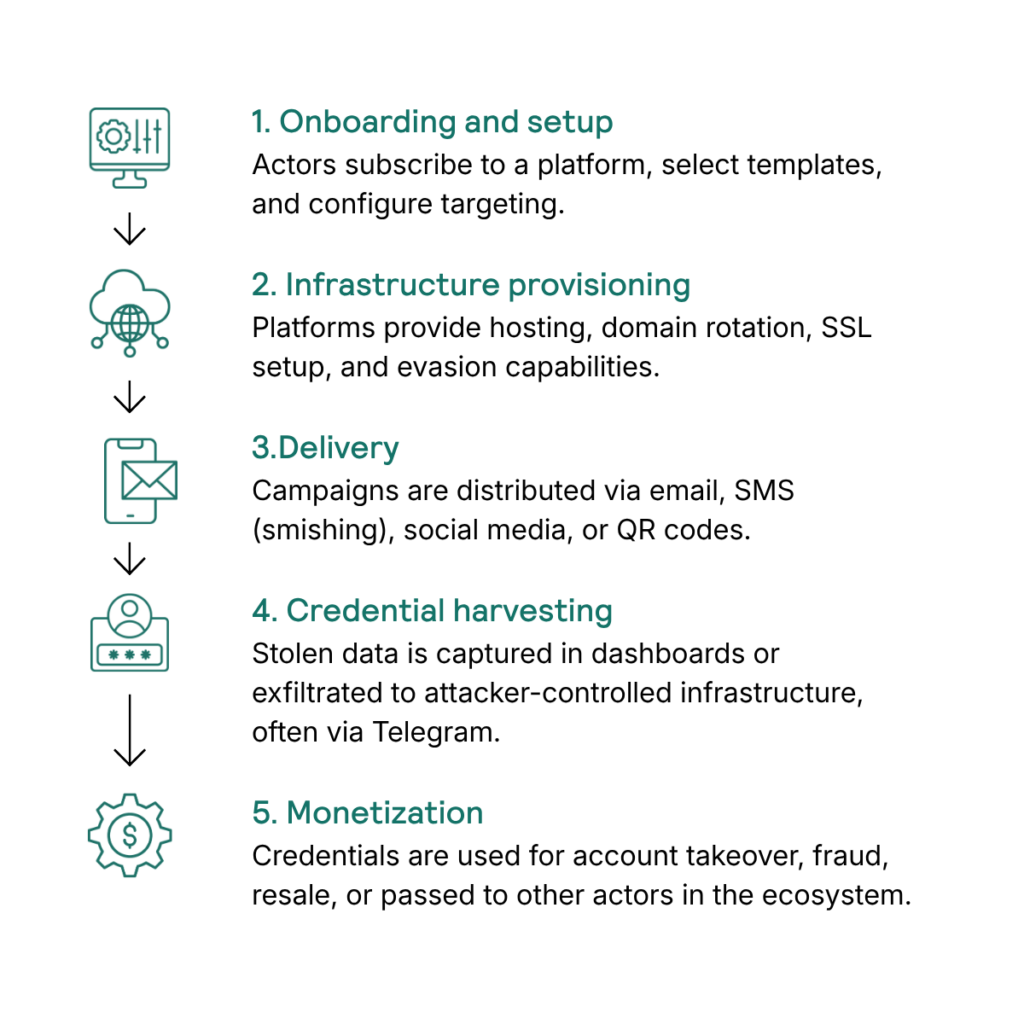
This pipeline is supported by a network of specialized providers, each responsible for a different stage of the attack lifecycle.

Infrastructure, Delivery, and Exfiltration Are Increasingly Specialized

Flashpoint analysis highlights how different actors focus on distinct parts of the ecosystem.

Infrastructure and Kit Development

Phishing kit developers provide increasingly sophisticated tooling, including:

  • Reverse proxy (AiTM) capabilities for MFA bypass
  • Anti-bot protections to evade researchers
  • “Live panels” enabling real-time interaction with victims

Platforms such as GhostFrame, Rapid Pages, and MUH Pro Admin illustrate how these tools are being productized and distributed at scale.

SMS Delivery and Spoofing

Smishing has become a critical delivery vector.

Threat actors operate dedicated SMS gateway services capable of sending large volumes of messages via APIs or bulk uploads. Others actively seek advanced spoofing capabilities to bypass authentication controls such as SPF, DKIM, and DMARC, enabling phishing messages to appear legitimate at the protocol level.

Credential Exfiltration and Telegram Integration

Credential collection is increasingly automated and centralized.

Many campaigns exfiltrate stolen credentials directly to Telegram bots or channels, enabling real-time access to victim data. This infrastructure also allows for rapid scaling and coordination across actors participating in the same campaign or ecosystem.

From Credential Theft to Financial Monetization

The ultimate goal of PhaaS operations is monetization.

Stolen credentials are used to enable account takeover (ATO), which allows attackers to:

  • Access financial accounts
  • Lock out legitimate users
  • Initiate fraudulent transactions
  • Launch follow-on scams

Flashpoint analysis of actors such as “JUN JUN,” associated with the Squirtle group, illustrates how these operations extend into structured financial fraud and laundering.

Observed activity shows a progression from acquiring phishing logs (“fish material”) to targeting high-value accounts and ultimately laundering funds through complex mechanisms, including tax fraud and credit card repayment schemes designed to recycle illicit funds.

This highlights how phishing is only the entry point into a broader fraud pipeline.

A Distributed Ecosystem of Threat Actors

The PhaaS landscape is not controlled by a single group, but by a network of loosely connected actors and clusters.

Examples include:

  • Fluffy Spider: Focused on large-scale infrastructure deployment and domain generation
  • IVAN: A more exclusive, high-tier operation leveraging SEO poisoning and advanced evasion techniques
  • Smishing Triad: A highly coordinated group conducting global SMS phishing campaigns
  • System Bot: A modular phishing toolkit with credential harvesting and OTP bypass capabilities

These actors operate across different regions and languages but demonstrate comparable levels of technical capability and operational maturity.

Many of these groups function with enterprise-like structures, including support teams, affiliate models, and performance-based operations, further reinforcing the industrialization of phishing-driven fraud.

Law Enforcement Pressure Is Increasing, but the Model Persists

Recent takedowns, including operations targeting platforms such as Tycoon 2FA, demonstrate growing coordination between public and private sector defenders.

These efforts have:

  • Disrupted infrastructure
  • Increased operational costs for threat actors
  • Accelerated collaboration between intelligence providers and law enforcement

However, the underlying PhaaS model remains resilient.

Even as major platforms are dismantled, operators frequently rebrand, migrate infrastructure, or fragment into smaller services. The demand for scalable, low-cost phishing capabilities continues to sustain the ecosystem.

What This Means for Security Teams

Phishing-as-a-service has evolved from a tactic to an ecosystem that industrializes fraud.

Flashpoint assesses that the increasing coordination between phishing kit developers, infrastructure providers, and financial fraud actors will continue to drive large-scale credential harvesting and account takeover activity targeting global organizations.

For defenders, this means that effective mitigation requires more than user awareness and traditional controls. Organizations must account for:

  • MFA bypass techniques such as AiTM
  • Rapid infrastructure rotation and evasion
  • The integration of phishing into broader fraud and access broker pipelines

Protecting Your Organization from the PhaaS Ecosystem

Understanding how phishing ecosystems operate — from infrastructure and delivery to monetization — is critical for disrupting attacks before they result in fraud.

Flashpoint provides intelligence that helps organizations track phishing campaigns, identify emerging threat actors, and detect compromised credentials in real time. By correlating activity across the full attack lifecycle, security teams can better anticipate threats and respond before they escalate.

To learn how Flashpoint can support your team with actionable intelligence on phishing and fraud ecosystems, schedule a demo.