





Citrini who? Why are markets reacting to a ‘blog post’? These were some of the questions floating around when news emerged last Monday that an article published by Citrini Research added fuel to fears of how artificial intelligence (AI) will devour the value of software stocks. An over 7,000-word essay titled ‘The 2028 Global Intelligence Crisis’ and defined as ‘A Thought Exercise in Financial History, from the Future’ is set in an apocalyptic June 2028 and seeks to warn of an unpleasant scenario that could play out if AI is allowed to grow unhinged.
As software stocks in India and globally got rattled, questions also emerged on whether there was some kind of attempt at market manipulation going on? For now, these are unsubstantiated. On the other hand, the report was deemed important enough by many in the top echelons of the global finance landscape to respond to. Federal Reserve Governor Christopher Waller, who till recently was one of the candidates in the race to replace Jerome Powell as Fed Chair, commented that while he had not read the report ‘deeply’, he disagreed with the possibility of an extreme job-loss scenario, as pointed out in the article. Citadel Securities, one of the largest market making firms, published a counter to the report. So did Deutsche Bank, which ironically in its research report published with the use of its in-house AI, termed the article as a ‘work of persuasive, emotional rhetoric disguised as a financial memo.’
Overall, there were many in praise of the note and many on the other side too. Should you factor the points mentioned in the report in your investment decisions or should you dismiss it? The fact that software stocks continued their downside through much of last week—that alone makes it important enough to consider.
In our view, the best course always is to look at what someone says, process the information and then make a call.
Read on as we explain five key themes from the note and give our take on whether you should ascribe any weight to it.
The end of white-collar jobs
If one were to point out a premise that Citrini is basing its arguments on, it should be the fall of the white-collar job market. It contemplates a scenario where AI, equipped with white-collar knowledge base gleaned over aeons, can operate independently and largely without human oversight. In its words, It should have been clear all along that a single GPU cluster in North Dakota generating the output previously attributed to 10,000 white-collar workers in midtown Manhattan is more economic pandemic than economic panacea.
It all begins with the rise of agentic coding tools in late 2025 and the disruption it causes to SaaS companies like Salesforce. By 2028, Fortune 500s, which are clients of SaaS firms, grow capable of developing in-house enterprise software, powered by AI or at least have the option to do so. This guts SaaS firms’ pricing power, as clients have more leverage to negotiate. It doesn’t stop there.
You see, the revenue model of these SaaS firms is based on how many licences they sell to a client. For instance, Salesforce will sell 20,000 Slack licences to a company because it needs a licence each for its 20,000 employees. Now, with clients too cutting back on white-collar labour in favour of AI-powered automation, the number of licences a SaaS firm can sell plummets.
With loss of both – business and pricing power, it sets off a ‘feedback loop’ with ‘no natural brakes’: AI capable of white-collar jobs > white-collar layoffs rise > companies invest the savings into AI > AI becomes more capable of white-collar labour than before and the loop goes on.
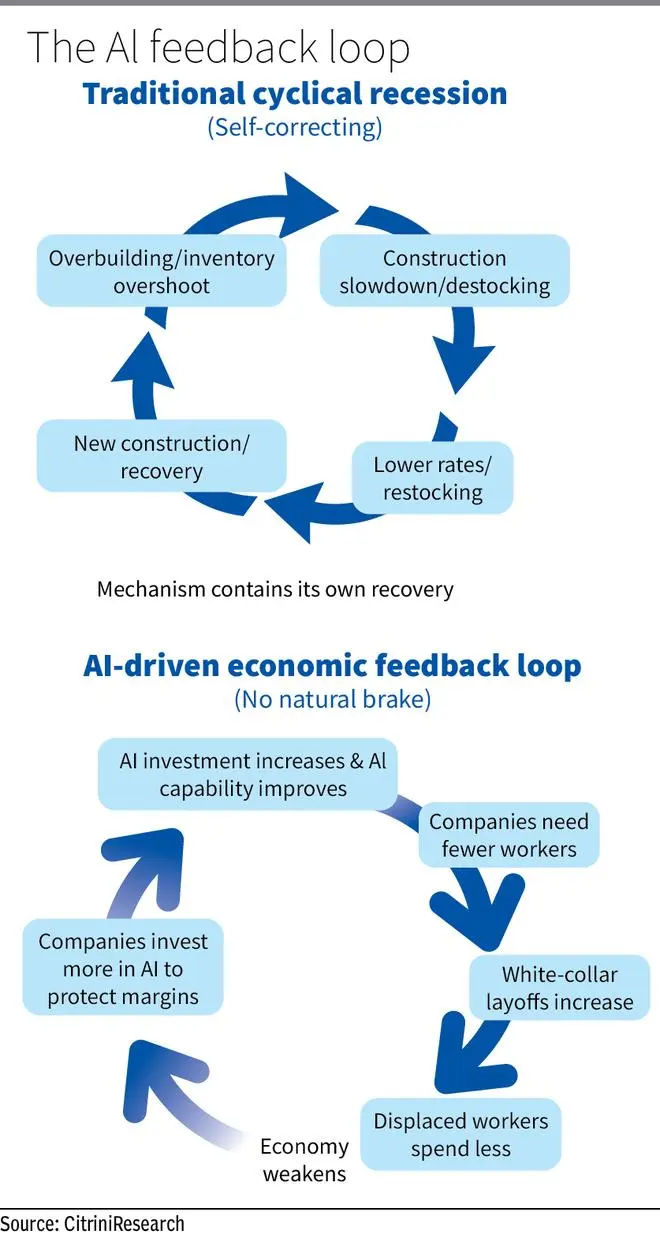
What begins in sectors such as SaaS, spreads wide to the entire white-collar labour market such as legal, accounting and auditing. As white-collar workers earn less or none at all, discretionary consumption goes for a toss and consumption loses its crown as the top contributor to US’ GDP (at 70 per cent). While consumption takes a hit, investment in AI compute and paying for model subscriptions keep the economy afloat, and this Citrini believes will come to be known as ‘ghost GDP’ — output that shows up in the national accounts but never circulates through the real economy.
Death of intermediation
Ever bought something on Swiggy, wondering what the same costed on Zomato, and yet proceeded with Swiggy, just because you are habituated to the app? This is the next theme Citrini talks about.
There are apps and businesses that offer ‘intermediation’ as their value proposition. Think real estate marketplaces, job portals, insurance aggregators and third-party tax platforms. In day-to-day life, there is friction for the average consumer, and this friction is what these businesses solve for and get paid while doing so. For instance, if you were to book a flight in the 1980s or 1990s, think about the number of agents you’ll have to contact to get the best quote. This friction has been addressed with the advent of Internet and online travel agent (OTA) sites. However, the success of this business model has attracted competition, and we have multiple OTAs today, giving rise to friction again. The same applies to real estate marketplaces, insurance aggregators and the like.
AI agents can sort it out for you. In Citrini’s 2028, AI agents can scour the Internet and bring you the best deal across services and products you consume. They don’t feel fatigue and can multi-task. They can crawl numerous websites of airlines, restaurants, employers, insurance companies, e-commerce platforms and bring the deal tailored for your needs. Businesses that made you habituated to their service stand disrupted and metrics such as average lifetime value (total projected revenue/ net profit a business can expect from a single customer throughout their entire relationship) no longer make sense.
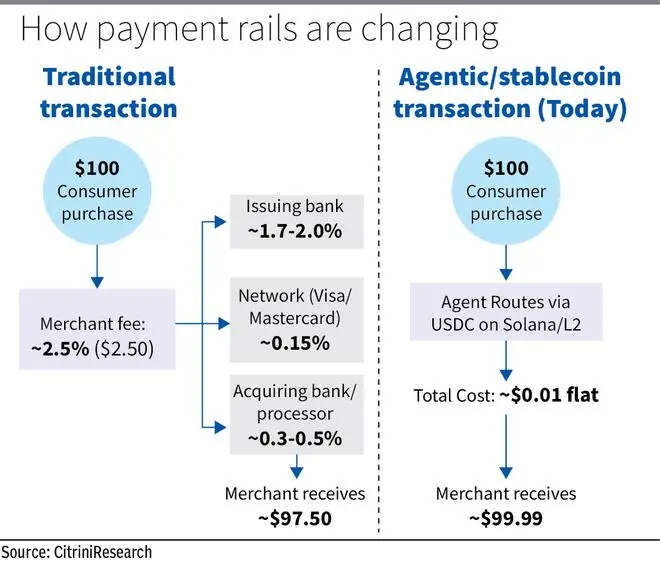
Extrapolating further, when let to handle payments, AI agents could prefer stablecoins (such as USDC), which virtually cost nothing, to conventional credit/ debit cards (see chart). This is because card networks (Visa, Mastercard) charge a small fee from merchants for facilitating the transaction. The buyer’s bank (issuing bank) and the merchant’s bank (acquiring bank) also take a cut. If payments using stablecoins become mainstream, then it’s goodbye Mastercard and Visa, according to Citrini Research.
Private credit crisis
The failing SaaS companies are just the first tile of the dominoes. What happens to the investors in these companies? Private credit firms are often the investors, having taken exposure to SaaS businesses through LBOs (leveraged buyouts). Citrini says the private credit market would have grown to a massive $2.5 trillion by 2026, and those with exposure to SaaS forming a meaningful part of it. Many deals have been done at exorbitant valuations assuming mid-teen growth in ARR (annual recurring revenue) till perpetuity. The model is only as good as the reality of this assumption.
However, by 2027, per Citrini, life insurers, too, could become casualties if private credit firms default. Over the last decade, alternative asset managers have acquired life insurers and turned them into funding vehicles – using policyholders’ annuity premium to fund private credit, which in turn acquired SaaS companies. If such private credit firms go belly up, it puts the lifetime savings and pensions of thousands at risk. Imagine the plight of the white-collar worker who had been living off of his 401(k) (similar to PF and NPS here) after getting laid off. Expecting him on a vacation in Hawaii (discretionary spend) is definitely not on the table.
Mortgage crisis
If discretionary consumption of white-collar workers is wiped out, what happens to the $13-trillion US mortgage market? No prizes for guessing! The value of the mortgage is primarily based on two assumptions — the value of the collateral and the ability of the borrower to earn to repay. We saw how the borrower’s ability to earn was impaired. With low to no demand for houses, property prices would crash.
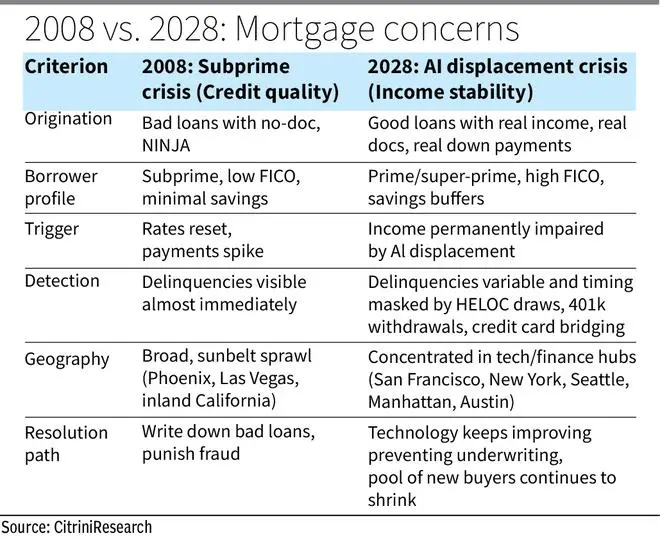
However, the 2028 mortgage crisis and the 2008 crisis differ like night and day. Back then, the problem was with underwriting. The loans were bad on day one. Loans were advanced to applicants with low income or low FICO scores (FICO scores are credit scores that range from 300 to 850). NINJA loans (no income, no job, no assets) were quite the rage. Banks had thrown caution to the wind and rating agencies did not exercise due diligence. When the rates went up, the bust became a question of when than if.
In 2028 though, it’s the most prime of borrowers who default. They carry FICO scores of 780+, put 20 per cent as down payment and are prompt to repay. Banks cannot be held guilty of underwriting loans to this cohort, can they? As Citrini puts it: They were the borrowers that every risk model in the financial system treats as the bedrock of credit quality.
But unlike in 2008 when delinquencies were immediate, in 2028 though, defaults could take time to show up, although there could be signs. Laid-off borrowers would initially live off their savings, then off credit cards and HELOCs (home equity line of credit — an overdraft facility that uses the property as collateral), delaying a default. This could be discerned though, with patterns such as rising credit card debt and HELOC draws while mortgage repayments are on time, large-scale white-collar layoffs — all concentrated in belts such as San Francisco, Seattle, Manhattan and Austin, where the tech sector thrives.
What’s the way out, then? What’s for sure is that the traditional toolkit of quantitative easing (QE) is not going to work. In 2028, no amount of QE can address the structural problem the real economy faces — that AI is superior to white-collar labour at only a fraction of the cost. To quote Citrini, It won’t change the fact that a Claude agent can do the work of a $180,000 product manager for $200/month.
Role of the State
Meanwhile, the government, too, will be perplexed. Its revenue base would have shrunk, as taxes (both on income and consumption) dwindle. Labour’s share of GDP would have crashed to 46 per cent (56 per cent in 2024). Jobless claims spike. Fiscal policies like the jobless claims are designed to provide only temporary relief, in the hopes that the market will reabsorb the laid-off workers. The State will find itself in uncharted waters. Hence, in addition to deficit spending, it might have to do something along the lines of (a) taxing AI inference compute or (b) taking a stake in AI companies to earn a dividend, in order to fund transfers to displaced workers. The later it takes for it to execute, it would only risk a social unrest that is just a spark away.
Our take
Citrini’s note is not perfect. It should not scare you, but neither should one treat it casually. One can argue that the report has done a good job, if it has alerted us to the exponential strides AI is making and the need to factor the same in our future plans, including investment decisions. For example, in the ongoing rout in Indian software stocks, the adverse impact it left on the portfolios of many investors could have been avoided had those investors been open to the view that AI can be detrimental to the business model of Indian IT services. bl.portfolio has consistently pointed out that AI could negatively impact business of Indian IT services stocks over the last two years. The key here is to not conclude either way, but to be open to the risk of disruption.
That said, here are some flaws that we noted in Citrini’s report. It takes the ‘loss of white-collar jobs’ argument and stretches it a bit too much – ignoring a scenario where highly-empowered workers can co-exist with AI, becoming 10x, 20x more productive than before. It also does not account for a widespread push-back by stakeholders and governments when a crisis of such a scale could unravel. It assumes stablecoins to become legal tender, when most central banks have vehemently voiced concerns against them.
This counter from Citadel Securities was interesting and credible: If the marginal cost of compute rises above the marginal cost of human labour for certain tasks, substitution will not occur, creating a natural economic boundary.
This point is worth noting, as Citrini’s view is based on a scenario where compute cost slides significantly from current levels. Arguments can be made on both sides. Technology costs have always reduced over time is one. That compute costs are so high today making it unrealistic to assume it will reduce significantly lower than the cost of labour, is the other.
On consideration, the reality in 2028 could be far different from how Citrini paints it. But it is important to be aware that things are changing and changing fast. Within a few days of the report, global fintech company Block laying off 40 per cent of its workforce, highlighting AI as the reason, has made the society stand up and take note.
Despite its flaws, the note has proudly succeeded in what it set out to do. Its purpose was not to forecast the unemployment rate in 2028, but to grab attention – to stop those pro-AI in their tracks and offer them an alternative perspective. It created an impact of a scale, even the 2023 AI Safety Summit at Bletchley Park, failed to create. Many of us wouldn’t even be aware that it happened.
On that count, Citrini deserves a 10 on 10!
Published on February 28, 2026