



惯性聚合 高效追踪和阅读你感兴趣的博客、新闻、科技资讯
阅读原文 在惯性聚合中打开

推荐订阅源

阮一峰的网络日志
阮一峰的网络日志
cs.AI updates on arXiv.org
Blog — PlanetScale
Blog — PlanetScale
Jina AI
Jina AI
MyScale Blog
MyScale Blog
N
Netflix TechBlog - Medium
月光博客
月光博客
云风的 BLOG
云风的 BLOG
T
The Blog of Author Tim Ferriss
博客园_首页
GbyAI
GbyAI
The Cloudflare Blog
博客园 - 叶小钗
CTFtime.org: upcoming CTF events
MongoDB | Blog
MongoDB | Blog
Y
Y Combinator Blog
博客园 - 三生石上(FineUI控件)
量子位
博客园 - Franky
WordPress大学
WordPress大学
freeCodeCamp Programming Tutorials: Python, JavaScript, Git & More
人人都是产品经理
人人都是产品经理
F
Fortinet All Blogs
Martin Fowler
Martin Fowler
OSCHINA 社区最新新闻
OSCHINA 社区最新新闻
M
MIT News - Artificial intelligence
奇客Solidot–传递最新科技情报
奇客Solidot–传递最新科技情报
I
InfoQ
Google DeepMind News
S
SegmentFault 最新的问题
大猫的无限游戏
大猫的无限游戏
Apple Machine Learning Research
让小产品的独立变现更简单 - ezindie.com
Stack Overflow Blog
Stack Overflow Blog
钛媒体:引领未来商业与生活新知
钛媒体:引领未来商业与生活新知
Last Week in AI
Last Week in AI
J
Java Code Geeks
腾讯CDC
aimingoo的专栏
aimingoo的专栏
C
Check Point Blog
Threat Intelligence Blog | Flashpoint
V
Vulnerabilities – Threatpost
S
Schneier on Security
D
Darknet – Hacking Tools, Hacker News & Cyber Security
L
Lohrmann on Cybersecurity
S
Securelist
F
Full Disclosure
Cisco Talos Blog
Cisco Talos Blog
小众软件
小众软件
The GitHub Blog
The GitHub Blog

Personal Finance News, Money, Investment, Loans | The HinduBusinessLine

Tax Query: Is Withdrawal from NPS Tier II Equity Fund Taxable as LTCG? Pack peace of mind for foreign trips Know a good forecaster? Anti mis-selling: rules, duty Your avenues for investments abroad Federal Reserve and the story of gold vs equities Electronic Gold Receipts explained: NSE launch gives demat gold a second chance Parcel Fraud: How fake courier, India Post and customs scams cheat customers Pros and cons of bank deposits The elusive choice in absence of collaterals Should you really await your second ‘marshmallow’? P/E multiples can be the same number yet poles apart Simply Put Logging the absolute chart Tax Query: Tax on NPS Corpus Withdrawn New NPS Fee Rules 2026: PFRDA Clarifies Maintenance Charges and Dormancy Relief Gold, Silver rate trade flat today Dodge that mis-selling bullet Marshmallow myths and the waiting child India’s D2C disruption: How new-age brands are rewriting the rules in innerwear and luggage While Planning IVF Treatment RBI Proposes Payment Delays, Kill Switch To Tackle Digital Fraud How The Salaried Can Stay Financially Secure Through Job Uncertainty Adani Power Q4 profit jumps 64% to Rs 4,271 crore on strong revenue growth Ask us on investments Rupee depreciation and its impact on investments Arriving at terminal wealth Eye-opener What to make of MF flows data Passive defence play Interplay between Dated Brent and Brent futures Why mis-selling takes place Spousal discussion: reconciling goal choice Where money sits, what it becomes, why it matters? How Benchmark Choice Changes PMS Outperformance Financial Security In The Age of Job Volatility How To Stay Financially Afloat When Your Paycheque Suddenly Stops Insurance Query: Travel Insurance For International Students No, life insurance isn’t like fixed deposit Why SIPs on individual stocks? Diagnose financial health at home with these vitals Insurance Query: Special Benefits For Women In Life Insurance Strong dollar pounds gold, silver When all assets look dull, it is the time to stay calm Personal loan, EMI, interest cost Bottom-fishing stocks? Five things to watch out for Travel insurance for your vacation amid war disruptions Simply put: Earnings Downgrades How ETFs fit into your portfolio When the ‘promise’ is not the ‘policy’ When the cannons boom: stock markets in wartime Before you buy an ETF These NPS schemes weathered the 18-month market pain Insurance Query: Reassessing Insurance Needs Weight-Loss Pill Brings Sweet Insurance Dose For Diabetes Patients Choices drive your decision Personal loan at lower cost NSEIX opens doors to US stocks for Indian investors New Mediclaim Policy For CGHS Beneficiaries: Is It Worth It? Key Takeaways from SEBI’s Consultation Paper on Nomination for Shares and Mutual Funds Simply Put: Bear Flattening Muthoot Fincorp NCD: Are The Yields Attractive For Investors? After 5 Years, Health Claims Cannot Be Rejected Unless Fraud Is Proven Why pension planning is no longer optional? To adjust or not to adjust the benchmark Choosing the right personal loan lender Taxes on SME IPO Gains and Derivatives Income Pre-okayed personal loans aid in emergency Can loss calibrate expectation? Her money, her investment choices Porting hospitalisation policy; if this, then that When SIP returns turn uncomfortable Dow Jones, S&P 500, Nasdaq, KOSPI, Nifty 50: How the indices fared during major wars and why it’s different this time Simply Put | Equity Risk Premium NRI remittances and taxes Insurance Query | Matters Of The Heart Rebalancing scenarios and rules Precious metals recover from early Feb. lows Arbitrage funds: Profiting from price gaps in volatile market How to trim your retirement target The HYPE and SUBSTANCE Of A ‘Blog Post’ That Shook Software Stocks Early retirement plan hits inadequate corpus roadblock Microsoft, Palantir, Salesforce, Adobe: How OpenAI and Anthropic crushed software's 23-year reign Opportunities, risks in porting health policy Guaranteed return plan On alpha fade rate Pledged Gold Or Jewels In Bank Locker Missing? Know The Next Steps And Compensation Rules New Income Tax rules 2026: What salaried class need to know Buy, hold vs. market timing Why two is better than one in a home loan Demystifying home loan insurance for borrowers Balance Beats Bravado When Cycles Turn Whiteoak Capital Flexicap Fund: Should You Invest? EPFO 3.0: ATM Access, Standardised Procedures And Higher Withdrawals CPI base year shifts to 2024: what it means for inflation and investors SDIs and PTCs Explained: Why 12% Debt Returns Carry Hidden Risks Are you tax aware? Gold and silver prices turn volatile The hidden risk in hospitalisation renewals Simply Put: Biopharma Shakti NPS Swasthya Pension Scheme: How it works, withdrawals, limits
Stock markets and Crude oil: Can the futures curve of crude oil give directions on where markets are headed?
2026-03-15 · via Personal Finance News, Money, Investment, Loans | The HinduBusinessLine

Where is oil headed in the medium term? In the answer to this lies the answer to where stock markets also could be headed. While there are many ways to assess this, none of which can enable us to forecast certainty, they are still useful tools to consider making some decisions. One such tool is trying to interpret what the F&O market is indicating.

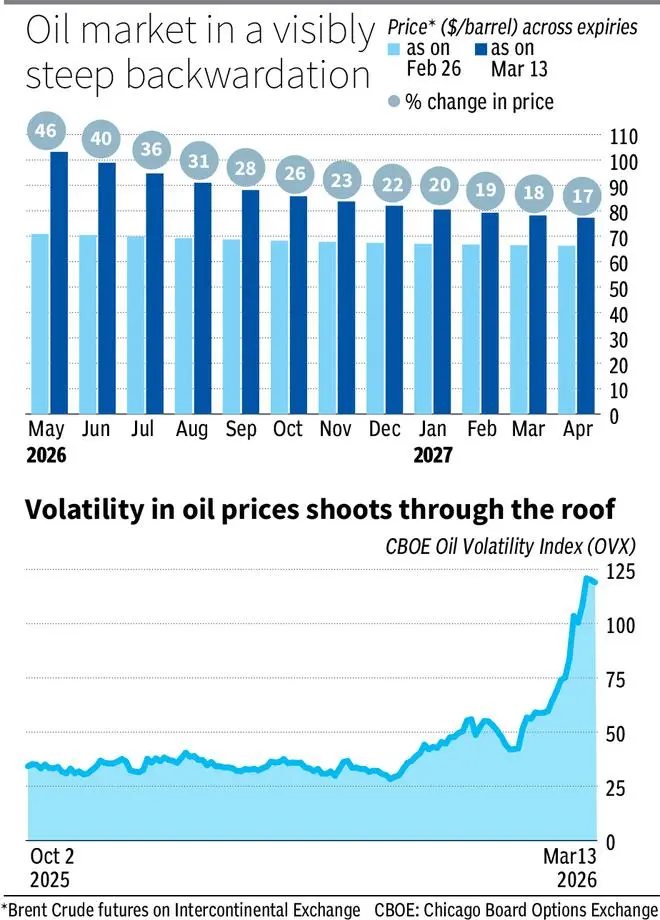
Crude oil futures are currently trading in steep backwardation, a market structure where near-term prices are higher than those of contracts farther out in time. For instance, Brent crude futures for May (the nearest active contract) and September are trading around $103/barrel and $88/barrel respectively. This is because, oil market participants like refiners and traders typically scramble to secure immediate barrels, pushing front-month prices sharply higher while the impact on later contracts remains relatively muted.

Backwardation generally indicates tight supply conditions in the immediate term, where buyers are willing to pay a premium to secure earliest delivery barrels. The structure suggests that the severe disruption in supply that is happening now, may be temporary rather than a prolonged structural shortage.

Before analysing what the current futures curve signals about the oil market, it is useful to briefly understand the concepts of contango and backwardation.

Contango vs backwardation

In commodity markets, futures prices normally reflect the cost of carry, which includes storage, insurance and financing costs. Under such circumstances, contracts for later delivery tend to trade at higher prices than near-term contracts, resulting in an upward sloping futures curve. This structure is known as contango.

Backwardation, on the other hand, occurs when futures prices decline, as one moves further along the curve. This results in a downward sloping futures curve. Such a structure usually emerges when the physical market tightens, either due to a sudden spike in demand or an unexpected disruption in supply. The present market structure reflects such a situation.

Near-term contracts spike

The current supply concerns stem from the disruption in shipping through the Strait of Hormuz, one of the most critical choke-points in the global oil trade.

Around 20 per cent of the world’s crude oil flows through this narrow waterway, making it highly sensitive to geopolitical tensions. With Iran positioned along the Strait, the threat of attacks on oil tankers has forced vessels to avoid the route, effectively choking supply flows in the near term.

The geopolitical escalation intensified after the first strike on Iran on February 28. Following this, Brent crude futures surged past the $100-a-barrel mark and touched multi-year highs. However, the magnitude of the rally varied significantly across different contracts.

The May contract rallied sharply to a high of $119.50 on March 9, marking a 69 per cent jump from the closing price of $70.84 on February 26. In comparison, the September contract rose to $90.23, gaining 31 per cent, while the December contract climbed to $82.35, registering an increase of 22 per cent.

Even after some correction, the gains remain uneven. As of March 13, the May, September and December contracts were up 46 per cent, 28 per cent and 22 per cent respectively from their February levels. Plotting prices across all contracts up to March 2027 clearly reveals a steep backwardation.

Time spreads signal tightness

The steepness of the curve becomes clearer when examining time spreads, which measure the price difference between near-term and longer-dated contracts.

Currently, the May-September spread stands at about $15 a barrel, while the May-December spread is roughly $21. The difference widens further to about $26 between May and April 2027 contracts. Such wide spreads suggest that the market is placing a substantial premium on immediate supply, indicating acute near-term tightness in the physical market.

The heightened uncertainty is also visible in options markets. The CBOE Oil Volatility Index (OVX) surged to 125.99 on March 12, reflecting extreme uncertainty in crude markets.

For perspective, the OVX had earlier spiked to 102.01 in November 2021 following the discovery of the Omicron Covid variant and to 86.67 during the initial phase of the Russia-Ukraine war in early 2022.
Temporary supply concerns 

The outperformance of near-term contracts relative to longer-dated ones points to a sharp shortage in prompt supply. This suggests that the market sees the current disruption as severe but concentrated in the near term and likely to ease in the coming months. 

Forecasts from the US Energy Information Administration (EIA) broadly align with this interpretation. According to the EIA’s latest Short-Term Energy Outlook, published on March 10, shut-in production due to the conflict is expected to peak in April. But the report forecast the supply to ease thereafter. However, this needs to be monitored given the level of uncertainty around.

They also expect global oil production to outpace consumption in 2026 and 2027, despite the recent developments. Global oil inventories are projected to increase by about 1.9 million barrels per day in 2026 and 3 million barrels per day in 2027.

In fact, the EIA estimates excess crude production of 1.87 million barrels per day in 2026, and 3 million barrels per day in 2027. In 2025, supply exceeded demand by 2.37 million barrels per day.

What it means for price

If oil flows through the Strait of Hormuz normalise, the anticipated oversupply could exert downward pressure on crude prices. The EIA expects Brent crude to average around $70/barrel in the fourth quarter of 2026 and $64 in 2027. On the other hand, the futures curve indicates a higher price as October, November and December contracts are now trading above $80/barrel.

That said, the outlook remains highly uncertain at the moment. If the conflict persists and supply disruptions continue, the futures curve could start flattening as markets begin to price in sustained higher prices for longer-dated contracts. But this is what the futures market is indicating for now.

Published on March 14, 2026