








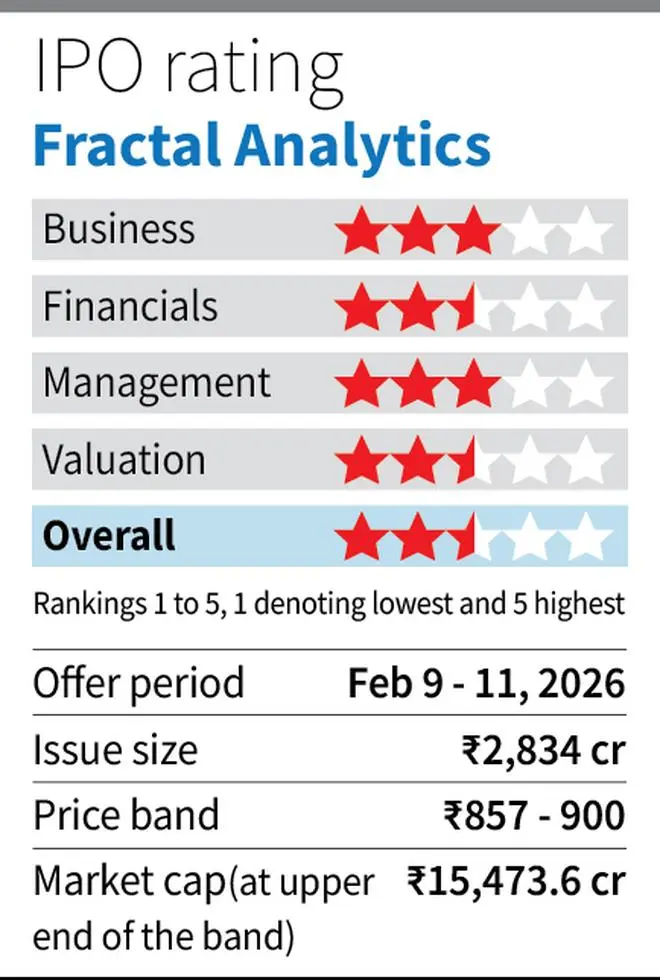
Fractal Analytics is hitting the IPO mart on February 9 to raise over ₹2,800 crore at the time of an ongoing tech rout. Global IT services stocks have taken a sharp hit on fears that new AI tools can finish the tech work much faster, disrupting business models involving large teams engaged in multi-quarter / multi-year projects.
With early signals that artificial intelligence (AI) could eat into the software value chain, there also has been heavy selling across listed SaaS, consulting and data analytics stocks in India as well as globally.
The Fractal IPO comprises issue of fresh stock (₹1,023.5 crore) and offer-for-sale (up to ₹1,810.4 crore) by investors, including PE giants Apax Partners and TPG, at a price band of ₹857-900/share. Promoters are not selling any stock in the IPO and shall hold about 17 per cent stake post-IPO.
Net IPO proceeds are largely earmarked for debt repayment in material subsidiary Fractal USA (₹264.9 crore) and R&D plus sales and marketing under Fractal Alpha (₹355.1 crore), which holds independent AI businesses either incubated or acquired. The rest includes money for new India office premises (₹121.1 crore) and laptops (₹57.1 crore), with M&A and general corporate purposes capped at 35 per cent of gross proceeds.
The more than 25-year-old company, which had emerged as India’s first AI unicorn in 2022, is aiming for an m-cap of ₹15,473 crore ($1.7 billion) and would be the largest analytics firm listed on Indian bourses, almost twice the size of Latent View Analytics (m-cap ₹8,800 crore) that had done a record-breaking subscription in 2021. But times have changed since those heady days.
At the IPO price, Fractal’s price to earnings (P/E) based on FY25 and last 12 months’ profit is around 70 times. This is a demanding valuation for a company that has grown revenue from operations at only a modest pace (18 per cent CAGR between FY23 and FY25 and 20 per cent year-on-year rise in H1FY26) and does not have premium EBITDA margins (reported), while bottom-line growth is marred by one-offs. Even if future revenue optimistically grows at the FY25 run-rate of 26 per cent, the valuation leaves little room for execution slip-ups, because the company’s operating overhead is heavy and PAT conversion has been relatively thin. In short, the risk-reward at the IPO price in the current context of AI disruption is unfavourable (details later). Hence, investors need not subscribe to the IPO.
Fractal may not be the primary casualty hurt by the AI-led software disruption, but it is in the blast radius. As the AI surge gains deeper ground, analytics businesses that use third-party AI (LLMs/platforms) and bill clients for project effort shall be more vulnerable to business getting impacted.
Decoding the business
Fractal started in 2000. Over 25 years, Fractal has moved in three clear steps. First, it was a data and analytics services firm doing client projects. Second, it built scale across countries and industries, and added specialised skills through acquisitions (Senseforth, Final Mile, Neal, Samya, Eugenie). Now, it is trying to become a company that also owns and sells its own software platforms and AI products (such as Cogentiq and Trial Run), instead of only delivering projects for clients. It has over 5,700 employees, with about 16 per cent attrition rate. Analytical services account for 97 per cent of topline, while subscription/product revenue is minimal today. Over 65 per cent of revenue comes from the US. Top-10 clients contribute more than half of topline.
Think of Fractal as a ‘decision improvement’ vendor for large enterprises. Its focus industries are consumer packaged goods and retail; technology, media and telecom; healthcare and life sciences; and banking, financial services and insurance. Most big companies already have data. The hard part is turning that data into repeatable decisions. Fractal does this using two engines — Services (teams that build and run these solutions with the client), and Products/platforms (software tools Fractal provides that can be reused)
The company organises everything into two segments: Fractal.ai and Fractal Alpha. Fractal.ai is its main business and contributes to 97-98 per cent of operational revenue (14 per cent segment operating margin). It has two parts. First is AI services. Second is products built on Cogentiq, its flagship platform to build and deploy internal AI solutions faster.
Fractal Alpha is a portfolio of “independent AI businesses”. This is where Fractal is trying to create more software-like revenue over time (subscriptions/licensable offerings), rather than only project-led services. Right now, this component is loss-making.
Overall, Fractal tries to grow accounts by actively engaging with ‘must win clients’ (over 122 now). Its reported client base includes Citibank, Costco, Franklin Templeton, Mars, Mondelez, Nationwide, Nestle, Philips. Put together, it has 80 clients contributing at least $1 million annually.
Besides, it has also built foundation models Vaidya.ai and Fathom. Its GenAI stack powers Cogentiq products and public demos like MarshallGoldsmith.ai, Kalaido.ai and Vaidya.ai. Fractal spends about 5-6 per cent of revenue on R&D. It has filed for 66 patents, of which 28 have been granted.
Financials
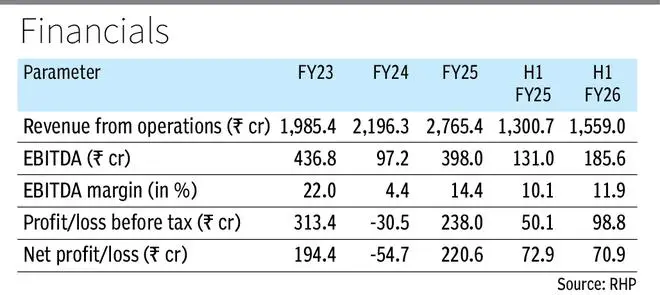
Fractal’s numbers show a company whose delivery economics are decent, but whose profits are held back by a heavy cost layer after delivery and by below-the-line drags (see table).
FY23 and FY24 were uneven years. Even as revenue grew, the core business was not consistently profitable. FY23 reported profit was helped by a large one-off exceptional gain (₹541 crore), while FY24 ended in a loss as costs remained high, absence of any one-off gain and operating leverage was still weak.
FY25 is the first year that looks like a cleaner operating turnaround. Revenue rose decently (26 per cent) and profits were driven more by the business itself than by exceptional items. Employee costs (including ESOP expense) still form the biggest expense line (over 70 per cent of revenue) and the company began showing better operating leverage.
In the latest half-year (H1FY26), revenue continued to grow (20 per cent) at a healthy pace and operating performance improved. However, net profit did not rise because two distortions worked against it — losses from associate (Qure.ai) doubled, and last year’s comparable period had a tax credit that inflated profits.
Valuation
Fractal is being offered at valuations that look demanding whichever way you look at them.
At the upper end of the IPO price, Fractal is valued at about 70x profit (FY25 and TTM). That is an expensive starting point for a business whose growth is healthy but not exceptional, while reported EBITDA margin remains sub-15 per cent and reported PAT has been volatile in the past three years.
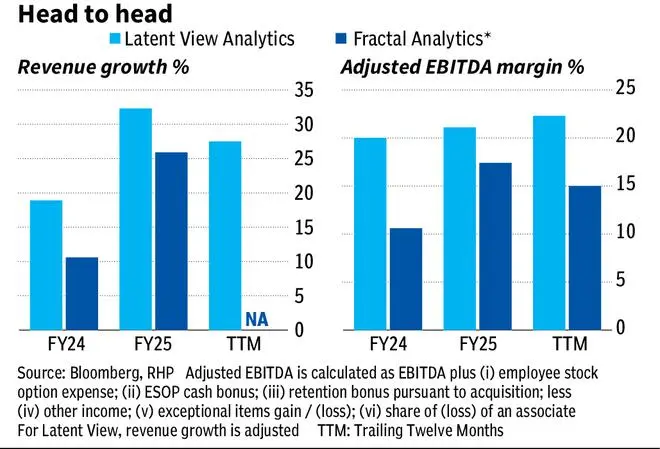
The closest Indian comparable is Latent View Analytics, which has a cleaner, higher-margin profile. Even after post-IPO margin compression, Latent View’s adjusted EBITDA margins (as per Bloomberg) are in the high-20s, well above Fractal’s adjusted EBITDA margin 15-17 per cent (vs. reported 12-14 per cent EBITDA margin). Yet Latent View’s FY25 and TTM P/E valuation (44 and 51x) is cheaper even though its revenue growth and margins are higher. This further does not justify paying up for Fractal’s lower profitability and heavier overhead stack.
Global context is equally uncomfortable. Diversified IT services leaders, who also have strong data, analytics and AI capabilities, such as Accenture, TCS, Infosys and EXL trade at materially-lower P/E multiples while delivering superior adj. EBITDA margins (over 20 per cent). At the other extreme, “AI platform” winners like Palantir command steep multiples because revenue growth is far higher (over 50 per cent last year); Fractal does not have that growth profile to earn a similar valuation.
Net-net, Fractal sits in a tough middle. It is priced like a premium AI play, but its current financial profile still looks closer to a services-led model with modest margins. That leaves limited room for execution slip-ups unless growth accelerates and margins expand meaningfully.
Published on February 7, 2026