


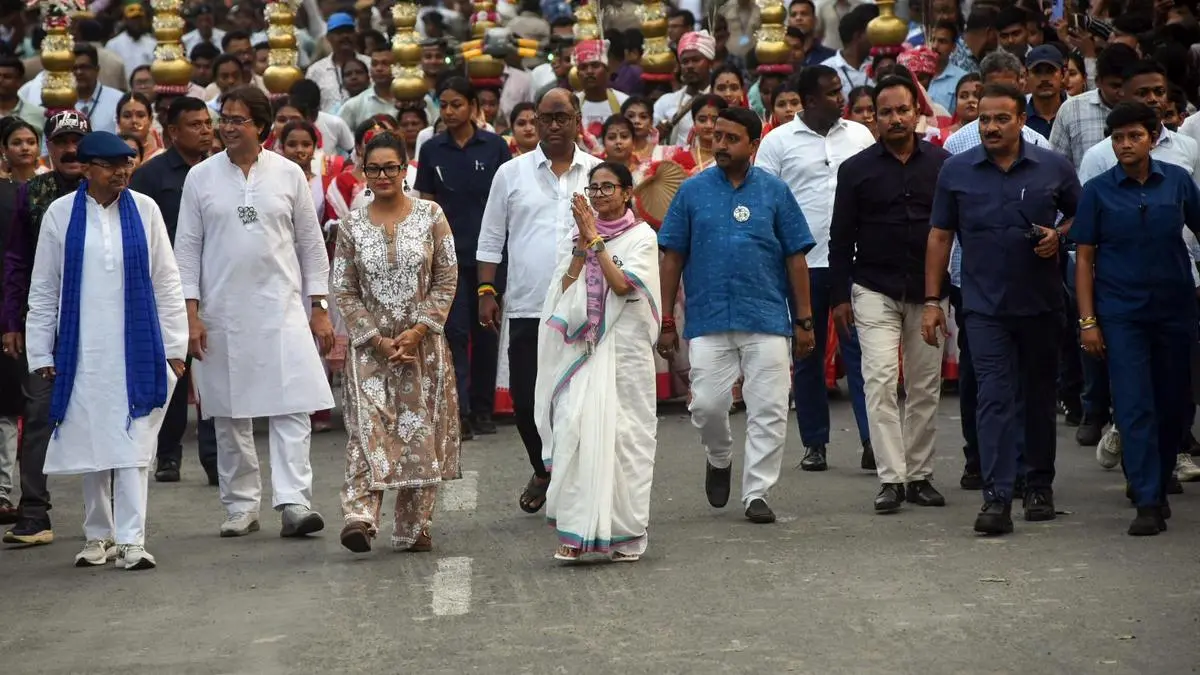
File picture: West Bengal Chief Minister and Trinamool Congress supremo Mamata Banerjee takes part in a roadshow from Sarat Sadan to Pilkhana in support of party candidates ahead of the West Bengal assembly elections, in Howrah on Saturday (April 18). | Photo Credit: ANI
With West Bengal heading into Assembly elections, scheduled in two phases on April 23 and April 29, the spotlight is on the economic track record of the ruling All India Trinamool Congress (AITC), led by Chief Minister Mamata Banerjee. Following the ouster of the longest running democratically elected Communist government in the world, the initial euphoria saw West Bengal beat national average metrics in growth, debt reduction, capital expenditure (capex) and expenditure on education. However, since then, the repeated terms of the same government seem to have added inertia to the momentum, as the failure to attract foreign or domestic investments into the State to rejuvenate the ailing manufacturing and services sectors has firmly placed West Bengal among the laggard States.

Three terms in power: growth, slowdown and recovery
Data from the RBI and West Bengal’s budget documents suggest that the AITC’s first term (2011-16) delivered a relatively strong economic performance. Five-year cumulative average growth rate (CAGR) of gross State domestic product (GSDP) at almost 17 per cent outpaced national trends, supported by improvements in agriculture and services. Flagship welfare schemes such as Kanyashree, Sabooj Sathi and Rupashree contributed to human capital development and boosted rural consumption, creating a stable demand base.
However, momentum slowed in the second term (2016-21). Industrial growth underperformed expectations, with private investment failing to pick up meaningfully. CAGR slowed to around 5 per cent due to policy uncertainties and persistent land-related challenges dampening investor sentiment. The AITC government held the Bengal Global Business Summit (BGBS) eight times since 2015, positioning it as the primary vehicle for attracting investment. By organising eight global summits, the State has received investment worth ₹23,94,595 crore ($278.44 billion) in large industries, a headline figure the government regularly cites. The problem is that these are memorandum of understanding (MoU) pledges, not actual investments. According to the Central government’s Department for Promotion of Industry and Internal Trade (DPIIT), by 2019, only 4.16 per cent of these investment proposals worth ₹37,051 crore were on paper.
At the same time, revenue growth remained constrained, even as welfare commitments expanded, leading to tighter fiscal space. While in their first term in office, the AITC government could reduce West Bengal’s debt burden from almost 41 per cent of GSDP to 33 per cent of GSDP; by the end of the second term, with the onset of Covid-19 pandemic, the debt burden rose to 42 per cent of GSDP.
The third term (2021 to present) shows signs of recovery. Increased focus on infrastructure, particularly rural connectivity and road development, has supported economic activity. However, the share of capex in the total budget has continued its decline. The expansion of direct benefit transfers and improvements in digital governance has enhanced administrative efficiency.
Yet, the recovery has not been broad-based, with large-scale industrial investments still lagging behind expectations. As such, the per capita income of the State has seen a secular downfall, from third among all States in FY21, to twenty first among States in FY26. Although, the unemployment rate in FY23 stood at 2.2 per cent — one of the lowest among States, particularly the the large ones — this metric is heavily skewed by the large unorganised sector and agricultural workforce. Agriculture still employs about 45 per cent of the population, with manufacturing employment at just 17 per cent. This traps the State in a quagmire of low-income work.
Beyond economic indicators, political and social dynamics will also shape voter decisions. The continued popularity of welfare schemes, influence across rural and minority voter bases, and issues of cultural identity all remain crucial. As a result, the upcoming election will not be determined by economic performance alone, but by a broader interplay of governance, welfare, and social sentiment.
Published on April 20, 2026
此内容由惯性聚合(RSS阅读器)自动聚合整理,仅供阅读参考。 原文来自 — 版权归原作者所有。