






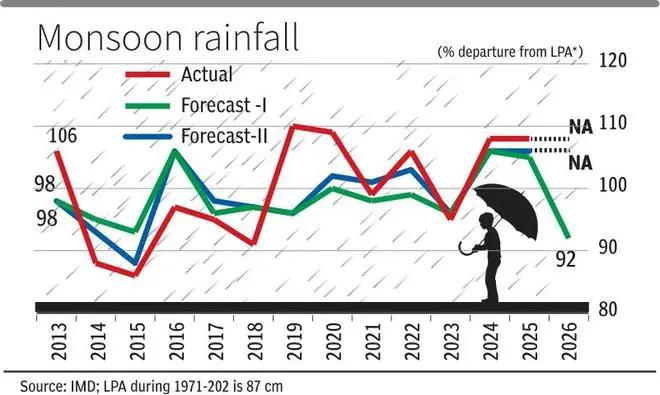
India’s South-West monsoon, which makes up 75 per cent of the country’s annual rainfall of 116 cm, is likely to be “below normal” this year. It will quantitatively be 92 per cent of the Long Period Average (LPA) of 87 cm, said M Ravichandran, Secretary, Ministry of Earth Sciences.
The dominance of impact from a possible emergence of El Niño scales higher as the other two influencers -- Indian Ocean Dipole (IOD) and Eurasia snow cover -- are either neutral of positive for the Indian monsoon. The below-normal monsoon forecast, which could impact the country’s agriculture sector, comes at a time when input costs for the growers are on the rise due to the Iran war.
The India Meteorological Department’s projection is for a rainfall lower than the forecast of 94 per cent rainfall made by private forecast agency Skymet last week. If IMD’s forecast turns out to be correct, this year’s monsoon rainfall will be the lowest since 2018, when India received 91 per cent of normal rainfall.
Increased resilience
However, as India’s irrigated area has been rising continuously (55 per cent of net cultivable area has assured water sources), mainly driven by groundwater resources, the resilience to a lower rainfall has increased after the 2009 drought. In 2018-19, the kharif foodgrains output increased to 141.52 million tonnes (mt) from 140.47 mt in the year-ago period, despite a 9 per cent deficit monsoon. But, it marginally brought down the rabi season (winter-sown) foodgrains production 143.69 mt from 144.55 mt.
Due to the robust foodgrain production, the lower rainfall did not affect the retail food inflation, which declined to 0.1 per cent in FY2018-19. In 2023, too, the country experienced El Niño. However, it had a different impact as the 94 per cent rainfall of LPA affected the production of key crops such as pulses and oilseeds. It also led to drought in about a third of the country. It also resulted in food inflation and forced the Centre to ban the export of rice and permit the duty-free import of pulses.
According to MK Dhanuka, Chairman, Dhanuka Agritech Limited, IMD’s forecast of a below-normal monsoon makes planning more critical. “For key crops like paddy, cotton, pulses, and oilseeds, the distribution and timing of rainfall will be critical. Rainfall variability could influence sowing decisions and regional demand for crop protection products,” he said.
The IMD projection was a highly anticipated announcement following predictions of below-normal precipitation from various experts and agencies. While this initial outlook is confined to the cumulative rainfall for the June–September season, omitting specific geographic or monthly breakdowns, it remains a critical driver for policy decisions and fluctuations in the stock and commodities markets.
Super El Nino
Briefing media, IMD’s director-general M Mohapatra said that most of the climate models indicate that El Niño conditions are likely to emerge after June, and it may negatively impact the monsoon in the second half (August-September) of the season. Currently, weak La Niña conditions are transitioning to ENSO-neutral conditions over the equatorial Pacific and that may remain till June.
A Super El Niño has been predicted for this year by some global weather agencies. Earlier instances of Super El Niño were: 1532, 1578, 1789-93 (termed Mega El Niño), 1876-78 (Greatest El Niño), 1982-83, 1997-98 and 2014-16 (it tied with 1997-98 for the strongest El Niño on record).
Mohapatra said that out of 16 El Niño years since 1951, Indiathe n monsoon was either below normal or deficient 9 times, whereas in 7 such years, there was normal or higher rainfall. The lowest monsoon rainfall was 78 per cent in 1972 in an El Nino year.
Monsoon’s significance
The South-West monsoon is key to the country’s economic growth as a good kharif harvest leads to a thriving rural economy. Higher purchases by rural India lead to demand for FMCGs, tractors, automobiles, jewellery, electronics and other white goods. Any failure in the monsoon could undermine economic growth.
This year, the below-normal forecast comes at a time when the agriculture sector is facing rising costs of fertilizers, crop inputs and fuel due to the Iran war.
Mohapatra said the IOD conditions (sea surface temperature in the Indian Ocean) are neutral and may turn positive towards the end of the monsoon season. While a positive IOD helps monsoon, its negative conditions lowers the rainfall. Mohapatra also said that the northern hemisphere and Eurasia snow cover area during the last three months (January to March) was slightly below normal and such conditions help monsoon rains in India.
Rainfall between 96-104 per cent of LPA is considered ‘normal’ and between 90-95 is ‘below normal’. Similarly, IMD has categorised rainfall between 105-110 per cent of LPA as ‘above normal’ and more than 110 per cent as ‘excess’. Below 90 per cent rainfall is considered ‘deficient’ or meteorological drought.
Skymet has said as El Niño is expected to strengthen, the second half of the monsoon season may be negatively impacted with lower rainfall. According to Skymet, rainfall in June may be 101 per cent of normal, in July 95 per cent, August 92 per cent, and in September 89 per cent. Prediction of geographical distribution in the entire season shows that it may be normal in the southern states, above normal in east and north-east India. But the key foodgrain producing Central and North-West regions may have below normal rainfall, it said last week.
In 2025, the monsoon rainfall was above normal, or quantitatively 108 per cent of the LPA (during 1971-2020). The IMD had predicted 105 per cent above normal rainfall in the first forecast and 106 per cent in its second stage forecast.
Dhanuka said while the current supply situation is manageable, continued pressure on raw material costs and logistics requires careful inventory planning to ensure timely availability during peak demand months”
Published on April 13, 2026