







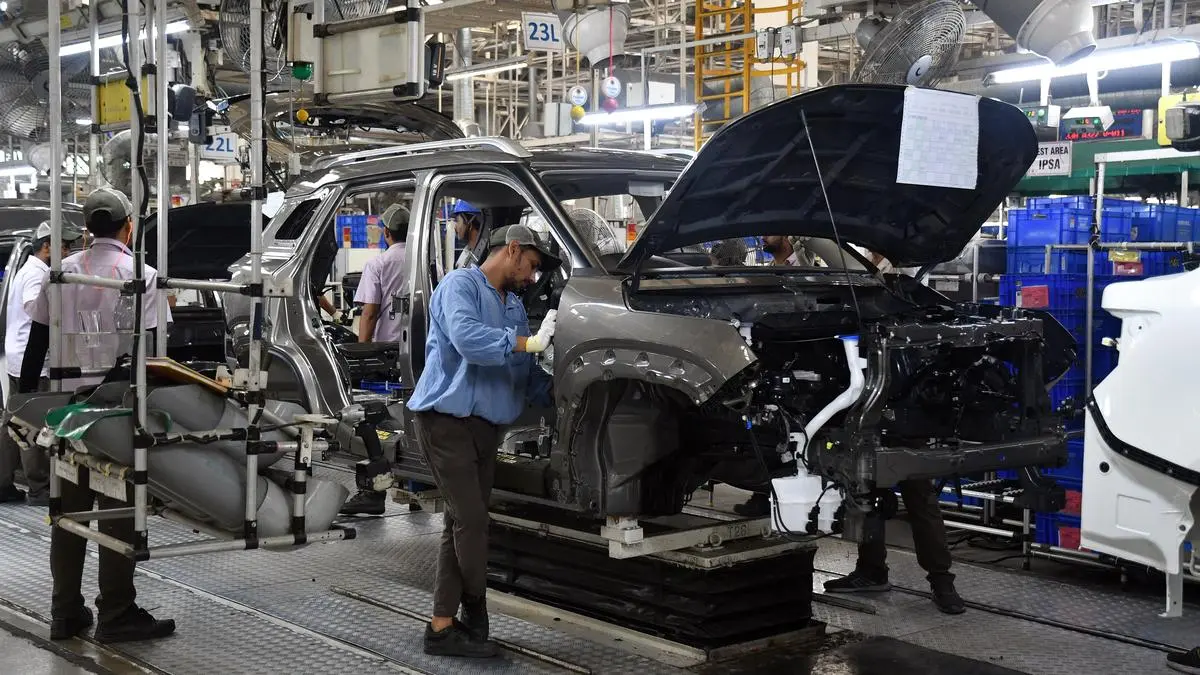
As per the draft, OEMs are permitted to offset any debit balance accumulated in their passbooks through the purchase of credits from the Bureau of Energy Efficiency (BEE). | Photo Credit: KAMAL NARANG
The government has proposed a more flexible compliance framework under the draft Corporate Average Fuel Efficiency-3 (CAFE-3) norms, easing penalty norms and allowing automakers to trade carbon credits to meet emission targets, sources told businessline.
The revised framework shifts the focus away from the earlier small-car versus large-vehicle debate and instead prioritises reducing overall fleet emissions. The objective is to push original equipment manufacturers (OEMs) to produce vehicles with lower CO₂ emissions while accelerating adoption of electric vehicles (EVs), hybrids, and alternative fuels such as biofuels, in line with India’s net-zero target for 2070.
The five-year plan for CAFE-3 norms will kick in from April 2027 and will cover the financial years 2027-28 to 2031-32.
A key feature of the draft norms is the introduction of a market-based compliance mechanism. Automakers that exceed emission reduction targets will be allowed to trade surplus carbon credits with manufacturers that fall short, subject to mutually agreed terms.
Under the draft, the outcome of such credit trading must be completed and reported to the designated agency responsible for monitoring compliance.
For instance, manufacturers that overachieve emission targets could monetise surplus credits by transferring them to companies struggling to meet prescribed limits, thereby reducing compliance costs across the industry. The move signals a shift toward flexibility-driven regulation, aimed at securing industry buy-in while maintaining pressure on manufacturers to progressively reduce fleet emissions.
When calculating the weighted average CO2 of an OEM, clean vehicles such as electric vehicles (EVs), hybrids, plug-in hybrids, flex-fuel or flex-fuel hybrid vehicles, are assigned higher weightage. When a lower CO2 car is given higher weightage, it helps reducing overall weighted average CO2 of an OEM, thereby benefitting the OEM.

As per the draft, OEMs are permitted to offset any debit balance accumulated in their passbooks through the purchase of credits from the Bureau of Energy Efficiency (BEE).
“The price per gram of CO₂/km of such credits shall be as prescribed for each reporting period — FY28–₹2,500; FY29–₹3,000; FY30–₹3,500; FY31–₹.4,000; and FY32–₹4,500,” it stated.
For performance assessment, the annual average of actual fuel consumption for OEM would be calculated on the Modified Indian Driving Cycle (MIDC), a laboratory-based chassis dynamometer test cycle used to certify fuel efficiency and emissions for passenger vehicles, similar to the New European Driving Cycle (NEDC).
“The government has addressed the automobile industry’s grievances, shifting focus from penalising manufacturers to incentivising a greener transition. This latest draft prioritises the promotion of low-emission vehicles, including EVs, hybrids, and biofuels, as a core strategy to meet India’s 2070 carbon-neutral target,” said an automobile expert.
Published on April 12, 2026
此内容由惯性聚合(RSS阅读器)自动聚合整理,仅供阅读参考。 原文来自 — 版权归原作者所有。