




惯性聚合 高效追踪和阅读你感兴趣的博客、新闻、科技资讯
阅读原文 在惯性聚合中打开

推荐订阅源

Microsoft Azure Blog
WordPress大学
WordPress大学
让小产品的独立变现更简单 - ezindie.com
The Cloudflare Blog
U
Unit 42
D
Docker
Hugging Face - Blog
Hugging Face - Blog
博客园 - 聂微东
Recent Announcements
GbyAI
GbyAI
T
The Blog of Author Tim Ferriss
Last Week in AI
Last Week in AI
V
Visual Studio Blog
I
InfoQ
Google DeepMind News
小众软件
小众软件
L
LangChain Blog
C
Check Point Blog
宝玉的分享
宝玉的分享
Martin Fowler
Martin Fowler
酷 壳 – CoolShell
酷 壳 – CoolShell
博客园 - 【当耐特】
J
Java Code Geeks
罗磊的独立博客

Latest Share Market News, Sensex, Nifty, BSE, NSE Today | The HinduBusinessLine

IMD forecast of below-normal Indian monsoon poses risk to agriculture, economy BALCO deploys AI humanoid agent for real-time training, operations and safety Om Power Transmission IPO subscribed 3.33 times on final day Broker’s call: Anand Rathi Wealth (Neutral) Broker’s call: Paytm (Outperform) Pakistan Stock Exchange plunges 5,000 points after US-Iran talks fail NSE gets MCA approval to launch National Coal Exchange of India Citius TransNet Investment Trust's ₹1,105-cr IPO to open on Apr 17 NSE gets MCA nod for coal exchange entity name Coal stock adequate for 90 days available: Union Coal Minister Kishan Reddy Rupee falls most in two weeks as oil spikes on US move to blockade Iran ports India auctions 46 critical mineral blocks, launches 7th round with 19 more: G Kishan Reddy Dalal Street midday: Sensex, Nifty down nearly 1%, Reliance, Eicher among top laggards, auto, oil Stocks weigh Iranian crude returns to India after seven years as tankers dock at key ports Sensex, Nifty pare early losses but stay in red at noon; Auto, Financials drag India's March palm oil imports fall 19% to three-month low Government bonds slump after US-Iran peace talks falter Failure of US-Iran talks set to weigh on risk assets Monday Failure of US-Iran truce talks: Rupee opens 57 paise weaker RBI criticises banks’ rupee arbitrage trades Crude oil futures rise as US moves to blockade Iranian ports Gold falls on stronger dollar, fading Fed rate-cut hopes Crude oil jumps 7% to above $100 on US’ maritime blockade on Iran Japan’s benchmark bond yield jumps to 29-year high as US-Iran talks collapse How govt policy initiatives to impact shares of EV makers, oil exporters Stock Market Highlights: Sensex ends at 76,776; Nifty 50 down 226 pts (0.94%) at 23,823 Draft CAFE-3 Norms: Govt eases penalties, focuses on carbon credit trading for auto sector Brokers’ ISF explores unified documentation framework to ease compliance burden K-shaped trend emerges in jewellery as premium demand stays resilient Retail investors give recent IPOs a miss due to lack of bumper listing gains
SEBI weighs uniform regime for options strike prices
2026-04-29 · via Latest Share Market News, Sensex, Nifty, BSE, NSE Today | The HinduBusinessLine
The move follows concerns around the way strike prices are currently introduced and managed, particularly during periods of sharp intraday price movement. 

The move follows concerns around the way strike prices are currently introduced and managed, particularly during periods of sharp intraday price movement.  | Photo Credit: ANI

The Securities and Exchange Board of India (SEBI) is evaluating a proposal to introduce a uniform framework for managing options strike prices, including the possibility of allowing exchanges to add new strikes during market hours, according to people aware of the discussions.

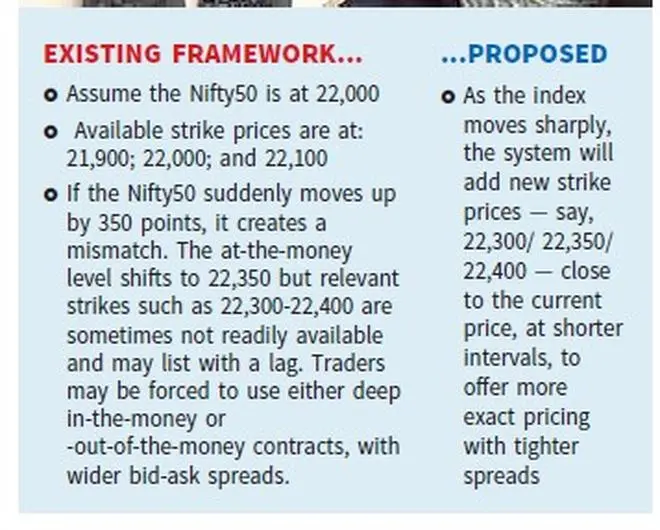
The move follows concerns around the way strike prices are currently introduced and managed, particularly during periods of sharp intraday price movement. The system is not always equipped to handle sudden price swings and the gap between available pre-defined strike prices and prevailing market prices may be too wide to allow efficient hedging. New strikes that are added are usually implemented with a lag.

A strike price is the fixed level at which an options contract can be exercised. The availability of a range of strikes and liquidity allows traders to take positions based on their market view or hedge existing exposures.

Uniform framework

The uniform framework may allow exchanges to introduce new strike prices during market hours, especially in the direction of sharp movements in the underlying asset. The idea is to not require any system modifications by brokers or market participants during live trading to avoid operational disruptions.

“Most of the time, especially around at-the-money (ATM) strikes, the market is fairly liquid and trades smoothly. But when the move is very sharp and sudden, prices can sometimes jump rather than move tick by tick,” said Feroze Azeez, Joint CEO at Anand Rathi Wealth.
“In those moments, you might see what traders casually call “phantom prices”, where the last traded price is visible, but execution at that exact level is not always possible,” he said.

During sharp intraday movements, trading interest typically shifts towards strike prices closer to the prevailing level of the underlying. However, the addition of such strikes may take time under existing mechanisms, even as a number of far-off strikes continue to remain listed, an exchange source said.

Strike prices

Market participants said that in most conditions, trading remains concentrated around actively used strike prices. “In such situations, if an out-of-the-money strike that fits the usual trading criterion is not available, traders typically shift to at-the-money or in-the-money options to ride the move,” said Anand James, Chief Market Strategist at Geojit Investments.

In fast markets, traders need to allow for some slippage or be ready to manage positions more actively rather than relying entirely on very tight stop losses.

At present, SEBI’s regulatory framework primarily covers long-dated index options, while other segments, including stock, currency and commodity options, follow exchange-specific practices, leading to differences in how strike prices are introduced and managed. An email sent to SEBI did not elicit a response.

While exchanges have their own rules for adding strike prices, the proposed framework will make it uniform across exchanges. It has been discussed with exchanges and intermediaries and will also be reviewed periodically through market participants, the source said.

Published on April 28, 2026