
惯性聚合 高效追踪和阅读你感兴趣的博客、新闻、科技资讯
阅读原文 在惯性聚合中打开

推荐订阅源

V
V2EX
爱范儿
爱范儿
Martin Fowler
Martin Fowler
T
The Blog of Author Tim Ferriss
B
Blog RSS Feed
博客园 - 聂微东
G
GRAHAM CLULEY
Engineering at Meta
Engineering at Meta
Threat Intelligence Blog | Flashpoint
WordPress大学
WordPress大学
Scott Helme
Scott Helme
AI
AI
S
Security Affairs
T
Threat Research - Cisco Blogs
M
MIT News - Artificial intelligence
T
Troy Hunt's Blog
H
Hackread – Cybersecurity News, Data Breaches, AI and More
人人都是产品经理
人人都是产品经理
AWS News Blog
AWS News Blog
T
Threatpost
Cyberwarzone
Cyberwarzone
www.infosecurity-magazine.com
U
Unit 42
V
Vulnerabilities – Threatpost
J
Java Code Geeks
博客园 - Franky
月光博客
月光博客
Blog — PlanetScale
Blog — PlanetScale
NISL@THU
NISL@THU
D
Docker
小众软件
小众软件
N
News and Events Feed by Topic
Microsoft Security Blog
Y
Y Combinator Blog
A
Arctic Wolf
D
DataBreaches.Net
云风的 BLOG
云风的 BLOG
Forbes - Security
Forbes - Security
量子位
PCI Perspectives
PCI Perspectives
美团技术团队
K
KPMG report finds enterprise disconnect between AI and its ROI | CIO
I
InfoQ
Security Archives - TechRepublic
有赞技术团队
有赞技术团队
腾讯CDC
P
Proofpoint News Feed
S
Security @ Cisco Blogs
G
Google Developers Blog
C
Cisco Blogs

Databricks

How lakebase architecture delivers 5x faster Postgres writes Why Talent Transformation Is the Missing Focus of Enterprise AI Public Health Intelligence Shouldn't Require a Data Scientist Mean Time to Detect Is a Data Access Problem First-party audience data is the ad sales relationship now Rethinking Distributed Systems for Serverless Performance and Reliability The AI Scaling Gap Hiding in Digital Native Companies 10 trillion samples a day: Scaling beyond traditional monitoring infra at Databricks AI success starts with clean data, not just better models How nOps Rebuilt Their Cloud Optimization Platform on Databricks Lakebase, and Why Other ISVs Should Too Peril Predicts: Precision Payouts for a Volatile World The foundation of AI scalability: one team, one platform, one operating model The Federal Data Paradox: Rich in Data, Poor in Access Driving Budapest Forward: How BKK Uses Databricks to Transform City Mobility LLM Vs AI: A Practical Guide to Differences, Use Cases, and Tools Model Risk Governance Is Not the Same as Risk Intelligence Generative AI for Business: A Complete Strategy and Implementation Guide Data Science vs Data Engineering: Choosing Analysis or Infrastructure AI Applications: Tools, Use Cases, and Platforms MLOps vs DevOps: A Practical Guide for Data Scientists and IT Teams Top Data Warehouse Tools For Modern Data Analytics Unlocking SAP Business Context in Databricks with Semantic Metadata Delta Sharing The marketing activation gap has a fix: Databricks and Stitch partner to turn data infrastructure into marketing performance Alert Fatigue Is a Business Risk Backstage with Lakebase Shipping Faster isn’t Learning Faster Why Your OEE Dashboard Is Lying to You The Turbine That Tried to Tell You It Was Failing Predicting Readmissions Isn't Enough. Acting in Time Is. Clinical Trials Run Longer Than They Have To. That's a Patient Problem Network Quality Is a Revenue Problem, Not a Technical One Shelf Availability Starts with Better Demand Visibility When Predicting the Next Hit Requires More Than Intuition Approximate Answers, Exact Decisions: New Sketch Functions for Analytics Companies Winning with AI Built the Data Layer First Rethinking SQL ETL for modern data platforms Stripe data now available on Databricks via Databricks Marketplace Databricks and Stripe Projects: Infrastructure Built for Agents Agents are ready but your architecture probably isn't Interoperability Between Unity Catalog and Google BigQuery via Catalog Federation Built In, Not Bolted On: What AI-Native Actually Means in Cybersecurity Operationalizing AI for public sector fraud prevention From months to minutes: Building real-time clinical data pipelines with natural language Agentic Data Engineering with Genie Code and Lakeflow Securely send first-party conversion signals with Snapchat Conversions API on Databricks Marketplace How leading tech companies are killing the builder’s tax with Lakebase Inside one of the first production deployments of Lakebase: LangGuard's agentic workflow governance engine The next generation of Databricks Genie Model Risk Management in 2026: A Banker’s Guide to the Revised Interagency Guidance OpenAI GPT-5.5 now available on Databricks, fully-governed through Unity AI Gateway Operational databases: How they work and when to use them Databricks partners with OpenAI on GPT-5.5 Announcing the Public Preview of Lakeflow Designer Are LLM agents good at join order optimization? How conversational analytics removes the BI bottleneck How to transform document activation workflows with Genie and Agent Bricks Beyond the spreadsheet: how Databricks is delivering the modern CFO in Financial Services AI App Development: Guide To Building AI-Powered Apps IoT in Manufacturing: Strategy, Components, Use Cases, and Challenges Stop Hand-Coding Change Data Capture Pipelines Multimodal Data Integration: Production Architectures for Healthcare AI Personalization Strategies for Media Companies A Modern AI Risk Management Framework Introducing the Databricks Excel Add-in for Business Users Real-Time Decisioning for AI Agents: Why you Need a Customer Context Layer First A Practical Guide to LLM Fine Tuning AI Data Transformation Guide for Data Engineers and Data Scientists Concurrency Control in DBMS: How Locking, MVCC and Optimistic Strategies Keep Data Consistent Bridging data science and marketing: Databricks unveils Delta Sharing integration for Adobe Experience Platform and agentic marketing workflows Take Control: Customer-Managed Keys for Lakebase Postgres Get hands on with agents, vibe coding and more at Data+ AI Summit Mercedes-Benz Builds a Cross-Cloud Data Mesh with Delta Sharing and Intelligent Replication, Cutting Costs by 66% What Is a Transactional Database? Introducing Genie Agent Mode Governing coding agent sprawl with Unity AI Gateway Governing Coding Agent Sprawl with Unity AI Gateway What is pgvector? Banks Don’t Have an AI Problem – They Have a Data Platform Problem Open Platform, Unified Pipelines: Why dbt on Databricks is Accelerating Why Your Agents Can’t Read Enterprise Documents — and How to Fix It Building with Databricks Document Intelligence and Lakeflow Databricks on Google Cloud: Innovate Faster. Smarter. Together. Introducing the Databricks Connector for Google Sheets: Real-Time, Governed Lakehouse Data in the Sheets Users Love Unity AI Gateway: How to connect agents to external MCPs securely Expanding agent governance with Unity AI Gateway Agentic reasoning in practice: Making sense of structured and unstructured data Agent Bricks: The Governed Enterprise Agent Platform 8 AI and data trends shaping financial services in 2026 Building real-time product search on Databricks Lovable + Databricks: Build Data-Driven Apps at the Speed of Thought Memory scaling for AI agents Powering clinical research innovation: How TriNetX uses Databricks to accelerate drug development Database Branching in Postgres: Git-Style Workflows with Databricks Lakebase How Zalando built a unified data foundation for AI and analytics on Databricks The next era of the open lakehouse: Apache Iceberg™ v3 in Public Preview on Databricks How FSIs eliminate silos between clients, operations, and finance How MakeMyTrip achieved millisecond personalization at scale with Databricks AiChemy: Next-generation agent with MCP, skills and custom data for drug discovery Accelerate business insights with Lakeflow Connect, now with a Free Tier Unlocking Next-Gen Customer Experiences with Data Intelligence for Marketing
A multi-agent approach to audience intelligence
Bradley Munday, Tyler Hickey · 2026-04-06 · via Databricks

Defining the North Star

Every advertising campaign shares the same core objectives: to reach the right audience, create meaningful engagement, and deliver measurable results. Where campaigns begin to differ is in how they pursue those objectives. The divergence starts in the strategy phase, where planners and strategists align on clear goals that, when executed effectively, drive the desired outcomes. At this stage, the business is behind the wheel—drawing on years of experience with its brand, messaging, and past campaign performance to guide decisions. The result is a campaign brief that serves as the North Star for all downstream activities, including audience creation, data science modeling, and activation. This blog explores how the common challenges advertisers face today can be resolved through an AI-powered audience generation solution on Databricks.

The Gap between Strategy and Execution

It’s during this exchange of campaign briefs between the hands of the business and those of data teams that agencies and advertisers begin to face challenges in aligning the core strategy to execution, Including:

  1. Strategy Dilution: While briefs are intended to be prescriptive and clear in their definition, translating strategy into “data terms” is a challenge for any analyst. Inevitably, bits and bytes are lost during communication, and it’s critically important to not lose the most important bits.
  2. Incomplete Strategies: In the reverse flow, insights from data teams don’t always make it back to the business, limiting the ability to act on non-obvious patterns and create competitive advantage. It’s through these data-driven discoveries that agencies and advertisers differentiate themselves, challenging industry conventions and assumptions held by competitors to approach the market in unique ways.
  3. Data Blind Spots: Both sides operate with constraints—planners rely on a narrow set of signals, while data teams may lean too heavily on familiar attributes. With datasets this large and complex, neither group is ever fully data-informed. Considering most agencies and advertisers possess datasets containing thousands of attributes on millions of existing and potential customers, it’s fair to assume that even the most experienced of data users has their blind spots.

To summarize these challenges, they are each a symptom of a fragmented process where:

  • The people closest to the strategy are furthest from the data.
  • The people closest to the data lack the full strategic context.
  • Regardless of one's access to data, their scope is limited.

Building the Bridge on Databricks

One can’t ignore the role that technology has played in the hardening of these sub-optimal processes. Technology lacked the ability to accurately translate intent and data platforms themselves offered few tools to synthesize data insights in a meaningful way for the business. The most effective bridge between these two groups was either a data-curious strategist or a data analyst who could articulate an organization's mission, product-market fit, and strategic goals. This also assumes the strategist has access to the database, and the analyst has the ear of the business (a big assumption).

To address the gap between intent and execution that persists today, our AI-powered solution, built on Databricks Data Intelligence Platform, enables advertisers and agencies to build audiences in natural language, discover previously unknown patterns in their data, and drive more effective campaigns.
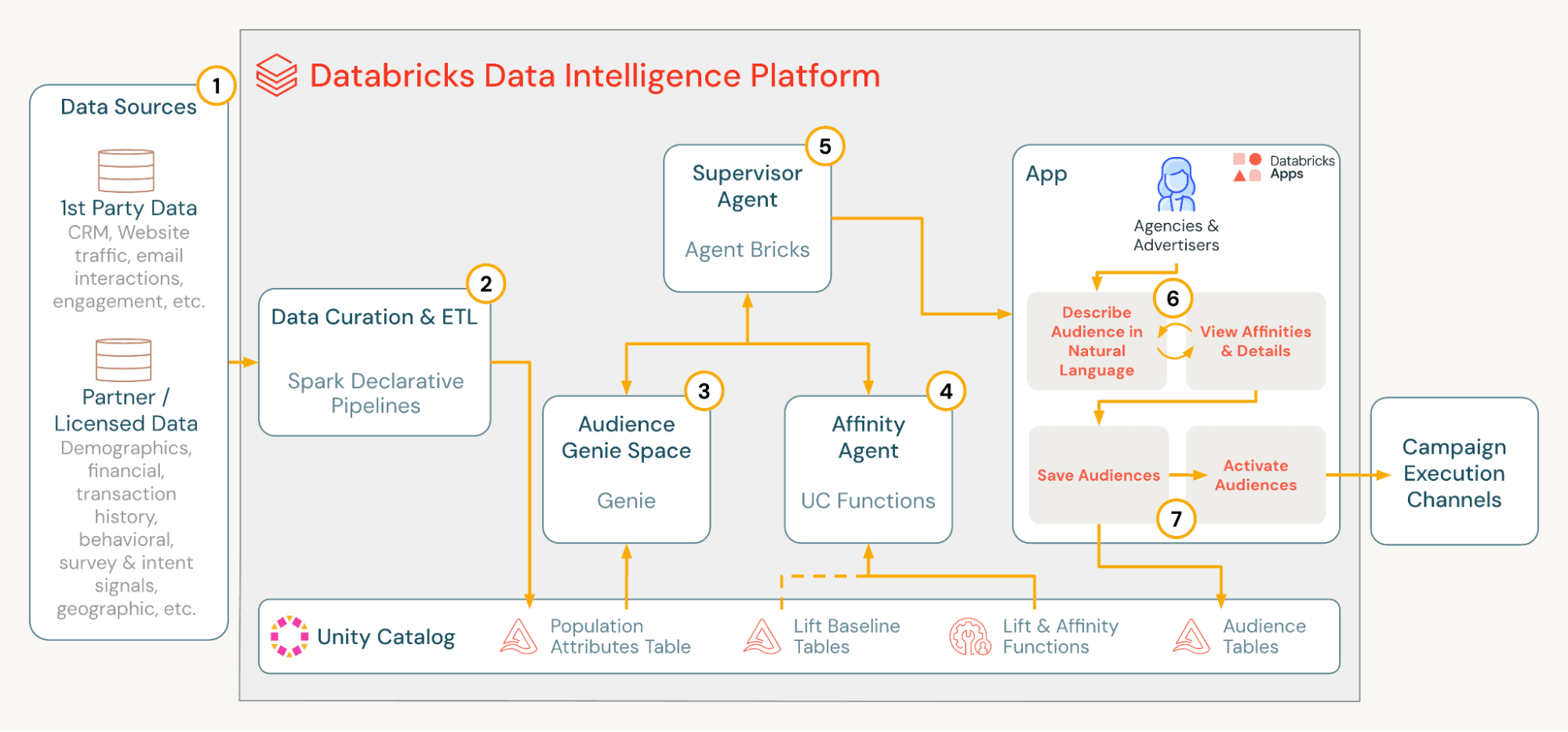
AI audience builder architecture

Figure 1. AI audience builder architecture
  1. Data Sources: First-party data and partner/licensed data are ingested into the platform
  2. Data Curation: Spark Declarative Pipelines cleanse, transform, and unify raw data into population attributes table in Unity Catalog
  3. Audience Genie Space: Curated Genie Space on top of Population Table translates natural language requests into audience segments
  4. Affinity Agent: UC Tools analyze additional audience affinities by computing statistical patterns
  5. Supervisor Agent: Agent Bricks orchestrates multi-agent system, routing requests to Genie & Affinity sub agents
  6. App: A Databricks App gives advertisers an intuitive interface to describe audiences, view affinities, and explore insights
  7. Activate & Save: Audiences are saved as tables in Unity Catalog and activated to downstream execution channels (e.g., DSPs, email platforms, social media, etc.)

At its core, this solution leverages Databricks’ latest advancements in agentic AI – Genie, custom tool-calling agents, and Agent Bricks – to more effectively surface insights to advertisers and enable faster audience segmentation against unified population datasets that span hundreds of millions of consumers and thousands of attributes.

Consider an example to make this tangible, where a campaign planner is preparing a brief for a luxury travel brand promoting exclusive resort packages. The brief calls for "affluent travelers aged 35-54 who frequently book premium experiences." Traditionally, this brief lands on an analyst's desk, who translates it into SQL queries to segment audiences and perform adhoc analyses. While this is a reasonable approach, it inevitably narrows the strategic intent into a handful of familiar attributes.

Instead of needing to manually generate SQL, our solution enables the planner to directly describe that audience directly in natural language. Genie then translates this into a precise query against millions of records in just seconds, complete with the SQL logic behind it for full transparency.

But the real unlock comes next. The system automatically analyzes additional behavior and attributes that define this audience to identify unrealized patterns. These findings and new insights are a gamechanger. Examples for this segment may include:
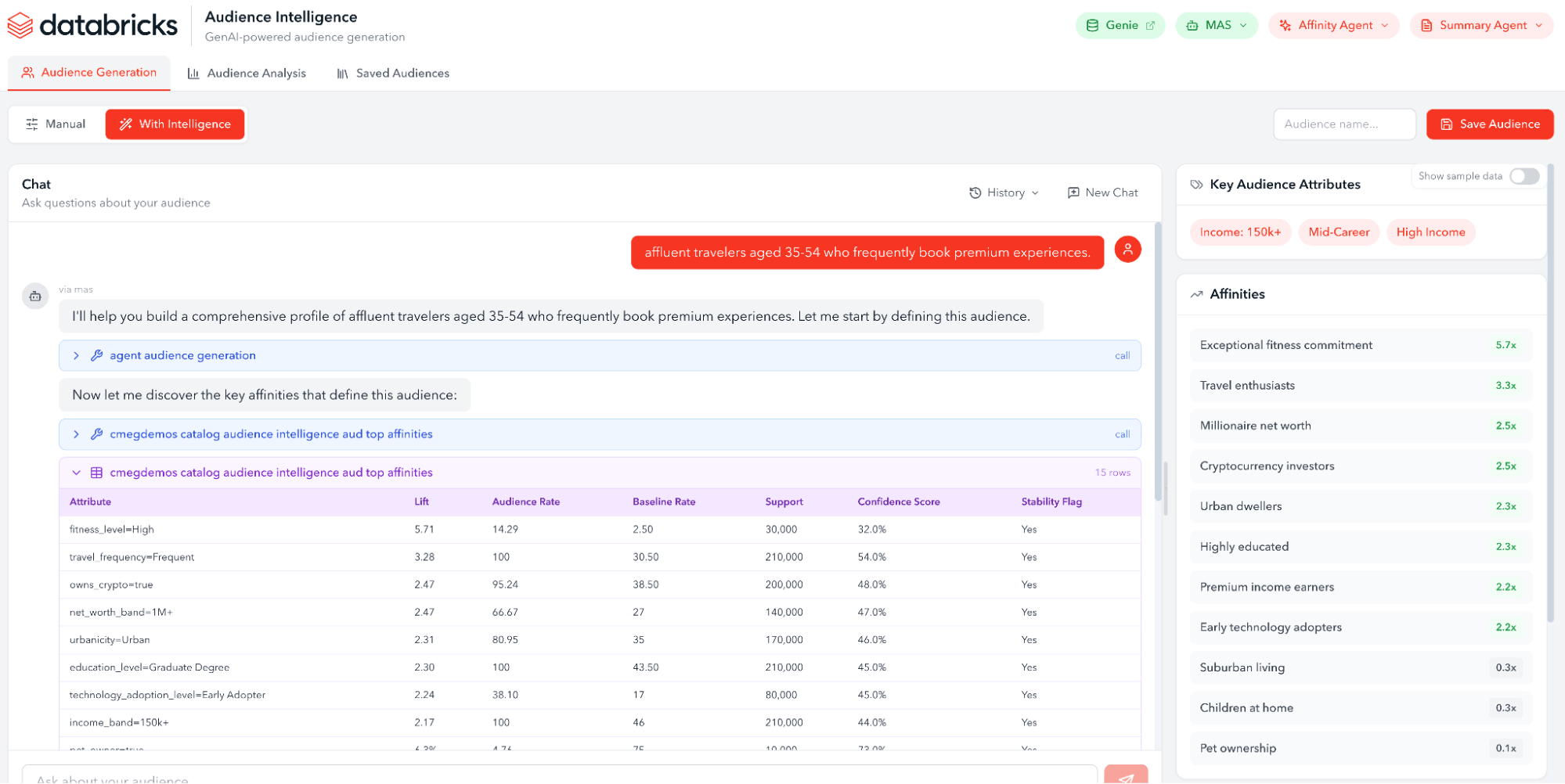
  • Over-indexes as early technology adopters compared to the rest of the population
  • Invests in cryptocurrency 2.5x the baseline rate
  • Shows a strong affinity for wellness and spa content (e.g., exceptional fitness commitment 5.7x)

AI audience builder

Figure 2. AI audience builder example

And the best part is, these are not assumptions. They are statistically validated lift calculations against the full population. Planners are no longer working from just a brief, but rather working from a brief enriched with discoveries that can reshape creative strategy, media placement, and channel selection.

Further, this solution drives tangible and compounding business impact:

  • Campaigns move from idea to activation faster, compressing planning cycles that previously took days or weeks
  • Planners can respond to market shifts, pacing issues, or clients requests in real time without waiting on analyst queues
  • Embedding strategic intent directly into the audience generation process leads to better targeting and campaign performance

However, making this experience feel seamless requires careful orchestration behind the scenes. In the following sections, we will break down the three core building blocks that power this solution, including how each component works, why it's built the way it is, and the design decisions that ensure this system is production-ready.

Databricks Genie: Bringing Natural Language to your Data

The first step teams take in any audience workflow is defining the “who” for their campaigns to reach. Genie Spaces allow advertisers to do this in natural language, translating requests like "find affluent travelers aged 35-54 who frequently book premium experiences" into governed SQL queries executed against the population table, without any direct interaction with the data team.
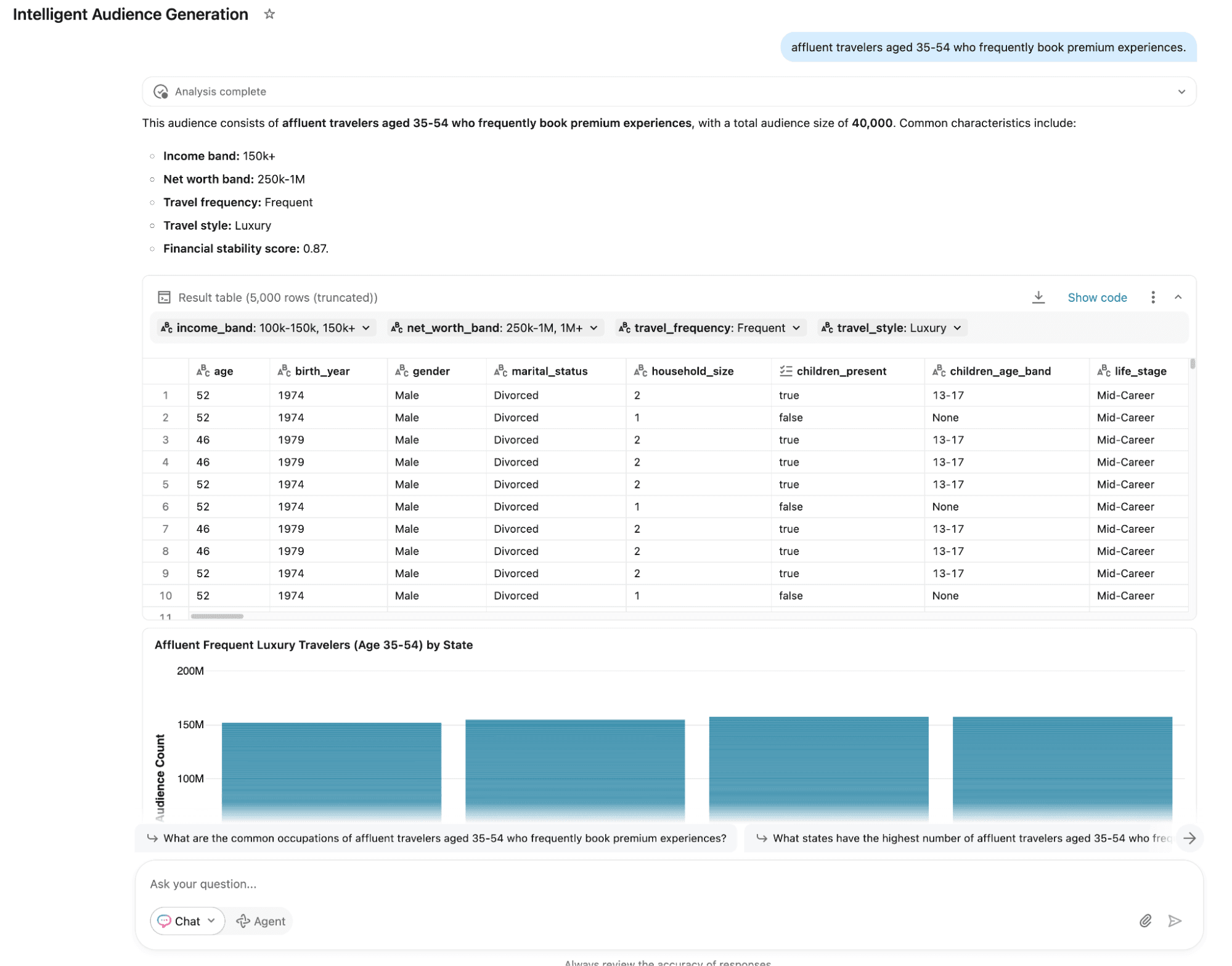
Genie responding to user query

Figure 3. Genie responding to user query

While Genie may reduce the direct interactions between strategy and data teams, the data teams still play a critical role in this workflow by meticulously curating the layer under the hood. A Genie Space is only as good as the context and data it's given, and for audience generation, that means investing in four areas:

  1. A strong data model, including pre-joined or de-normalized gold tables and metric views
  2. Descriptive column comments on every attribute in the table
  3. Example SQL queries that teach Genie the patterns and conventions of the data
  4. Text instructions that define business terms and scoring logic the model wouldn't otherwise know

By spending time curating the data layer and metadata, the data team’s expertise is encoded once, continuously improved over time, and scaled across the entire organization. Every executive, planner, and strategist benefits from the same curated logic without filing a ticket or waiting for manual, ad-hoc analyses to be performed.

For example, the Genie in this solution is configured with over 30 curated example queries spanning common audience patterns, from "find consumers with auto purchase intent and credit scores above 750" to "identify luxury travelers in urban areas with high net worth." These examples don't just improve accuracy, they teach Genie how the organization thinks about its data.
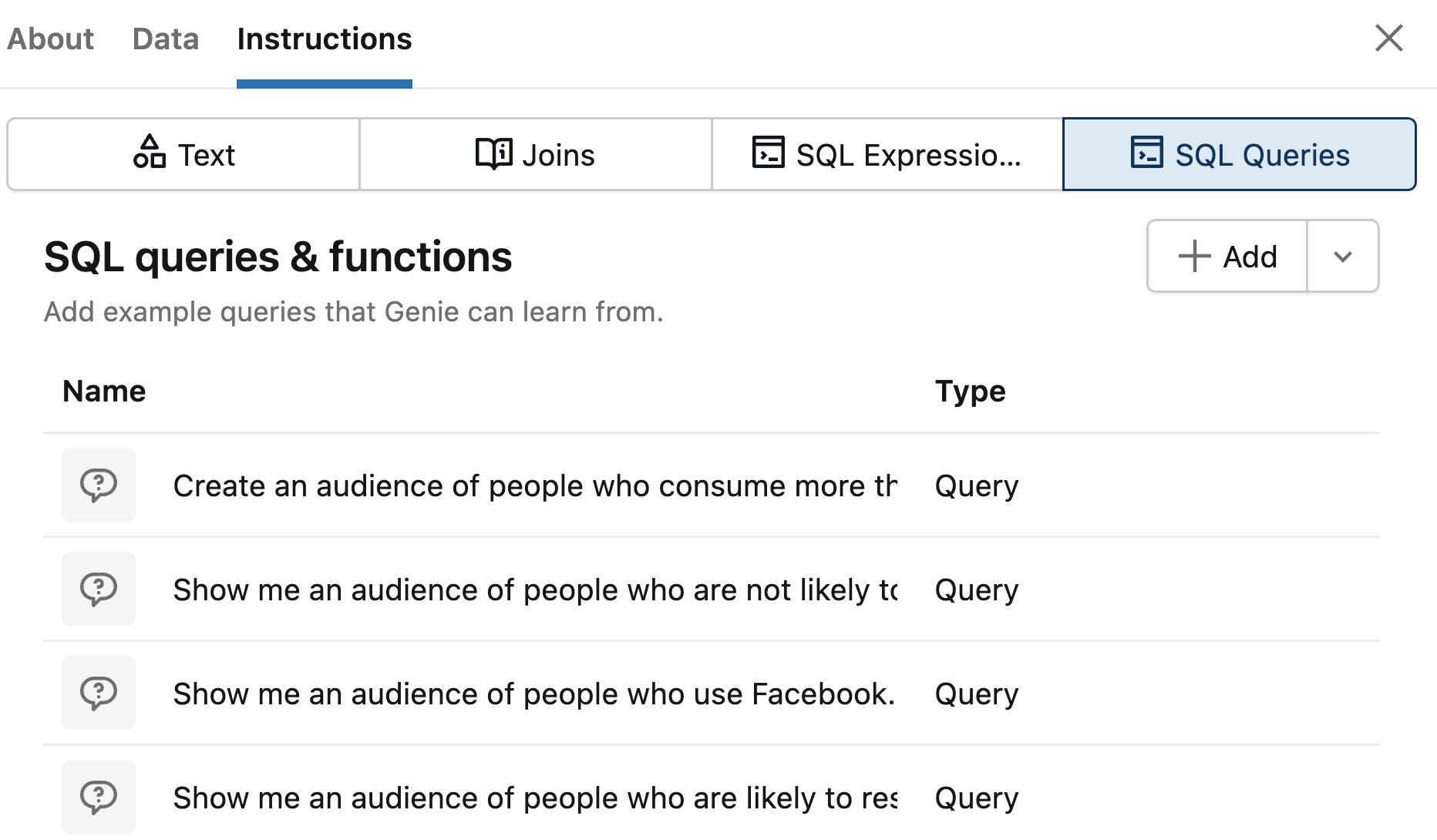
SQL queries

Figure 4. Example SQL queries

The result is a system where a planner can describe their target audience for a given campaign brief and receive accurate segment data, audience size, percentage comparisons against the total population, and sample data – all within seconds.

Ultimately, Genie fundamentally changes how marketing teams can build audience segments and execute new campaigns by:

  • Democratizing access to data by shifting audience creation from a technical task to a strategic conversation. Any planner can describe the audience they need without knowledge of the underlying table schema or SQL syntax
  • Compressing iteration cycles from days to seconds, enabling teams to test more hypotheses and refine targeting in real time rather than waiting on analyst queues
  • Capturing institutional knowledge – every curated query, column comment, and text instruction encodes the organization's data expertise into a reusable layer that onboards new team members and standardizes how audiences are built across campaigns
  • Strengthening governance by logging the natural language intent and the generated SQL for every audience, creating an audit trail that is readable by both technical and non-technical stakeholders

Together, these benefits transform audience creation from a bottleneck into a competitive advantage.

Affinity Agent: Discovering Unknown Relationships and Audiences

When building a comprehensive audience builder solution, defining the audience is only half the battle. The real strategic value comes from understanding the “what else” about the audience. In other words, are there unthought-of patterns, behaviors, tendencies, and affinities that might strengthen the overall campaign distribution strategy? This is where the Affinity Agent becomes a differentiator.

Once Genie builds a segment, the Affinity Agent automatically takes that segment and analyzes it against the full population to surface statistically significant patterns. In advertising terms, it answers the question every strategist should be asking but rarely has the time or tools to pursue: "Beyond the criteria I specified, what actually makes this audience unique?"

In this solution, the answer comes in the form of lift. This simple yet powerful metric compares how frequently an attribute appears in a given audience segment versus the general population. A lift of 2.0x means the given audience is twice as likely to exhibit that trait. For a campaign planner, these insights are immediately actionable. Let’s take, for example, the luxury travel audience that over-indexes on wellness content and cryptocurrency investment. These signals directly inform execution and instead of running standard travel ads across broad lifestyle channels, the media team might shift spend towards premium wellness publications, podcast sponsorships in the personal finance space, or programmatic placements on fintech platforms. The creative team, meanwhile, might lead with messaging around experiential wellness retreats rather than generic resort imagery.

Under the hood, the Affinity Agent follows a deliberate design pattern, which equips an LLM with tools that execute statistical analysis for a given audience. The agent reasons which analyses to run, but every number is computed by deterministic tools. These tools are functions which are pre-registered and governed in Unity Catalog.

In practice, a given audience serves as the input data, and the agent leverages Unity Catalog functions to compute lift against the baseline population, and returns only results that meet minimum confidence and support thresholds. The following pseudo code snippet describes how this function operates.

This separation between reasoning and computation is a deliberate and critical choice for advertising. When millions of dollars in media spend depend on audience insights, those insights need to be auditable, reproducible, and grounded in real data. By governing every analytical function through Unity Catalog, the system provides a clear lineage from natural language questions to SQL execution to statistical results. The LLM adds intelligence to the workflow without introducing risk.

Agent Bricks: Creating Multi-Agent Audience Intelligence

With Genie handling audience creation and the Affinity Agent surfacing hidden patterns, the final piece is assembling an intelligent orchestration layer to ensure these components work together as a single, coherent experience rather than disconnected tools.

Agent Bricks makes this possible in just minutes with a few clicks. The pre-built Supervisor Agent receives every user request, determines which sub-agent is best equipped to handle it, and routes it accordingly. A request like "build me an audience of frequent luxury travelers" goes to Genie. A follow-up like "what else defines this group?" is routed to the Affinity Agent. And when a user asks a complex question like "find high-income outdoor enthusiasts and tell me what makes them unique," the supervisor chains both agents together – Genie builds the segment, then the Affinity Agent analyzes it – and returns a unified response.
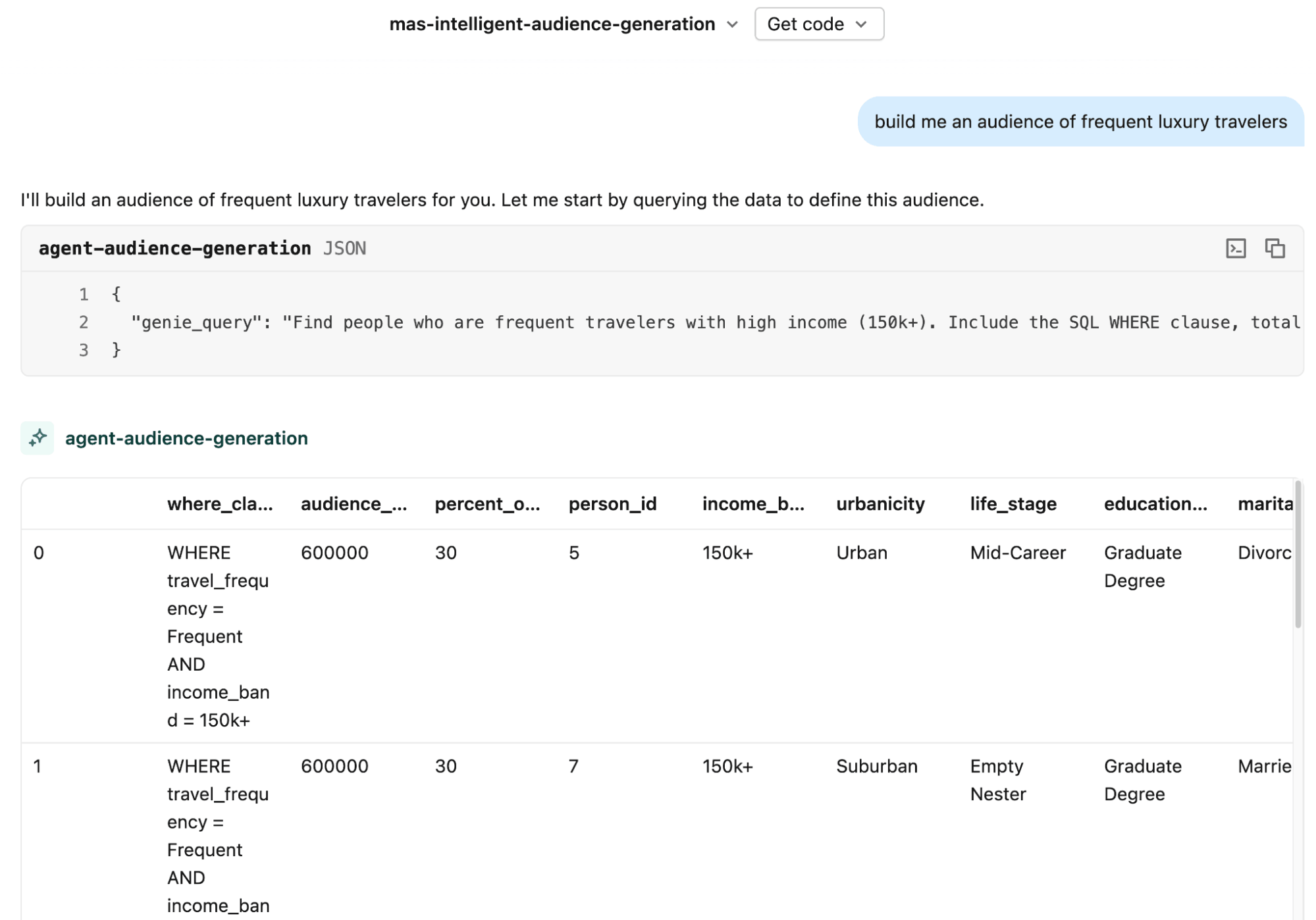
Supervisor agent routing request to appropriate sub-agent

Figure 5. Supervisor agent routing request to appropriate sub-agent

For end users of this multi-agent system, the power lies in the fact that they never need to know which agent is doing the work, because the supervisor agent works together with its sub-agents to handle the requests. As a result, the experience is seamless and feels like a single conversation.

Beyond routing, the supervisor is what transforms individual agents into a compounding system. By orchestrating the handoff between Genie and the Affinity Agent, it creates a feedback loop between human intent and data discovery that doesn't exist in traditional workflows. A planner can build an audience, review the affinities that surface, and immediately refine the segment based on what they've learned, all within the same conversation. This collapses what is typically a days-to-weeks cycle of briefs, analyst queues, QA, and iteration into minutes, enabling teams to test more hypotheses and arrive at stronger audiences faster. Over time, every interaction builds a growing library of audience definitions and discovered patterns, which leads to institutional knowledge that compounds with each campaign and scales to every user in the organization.

The Finished Product

So far, we've explored how Genie translates strategic intent into governed audience segments, how the Affinity agent uncovers patterns that no one thought to look for, and how the Supervisor agent orchestrates the two sub-agents into a seamless workflow. But these capabilities only deliver value if the people who need them most can actually access them without navigating Databricks workspaces, notebooks, or API endpoints. Databricks Apps remove this barrier, providing a native application layer that brings the entire multi-agent system into a single, intuitive interface purpose-built for the end user.

Within this app, advertisers can:

Build, discover, and iterate on audience segments through natural language.
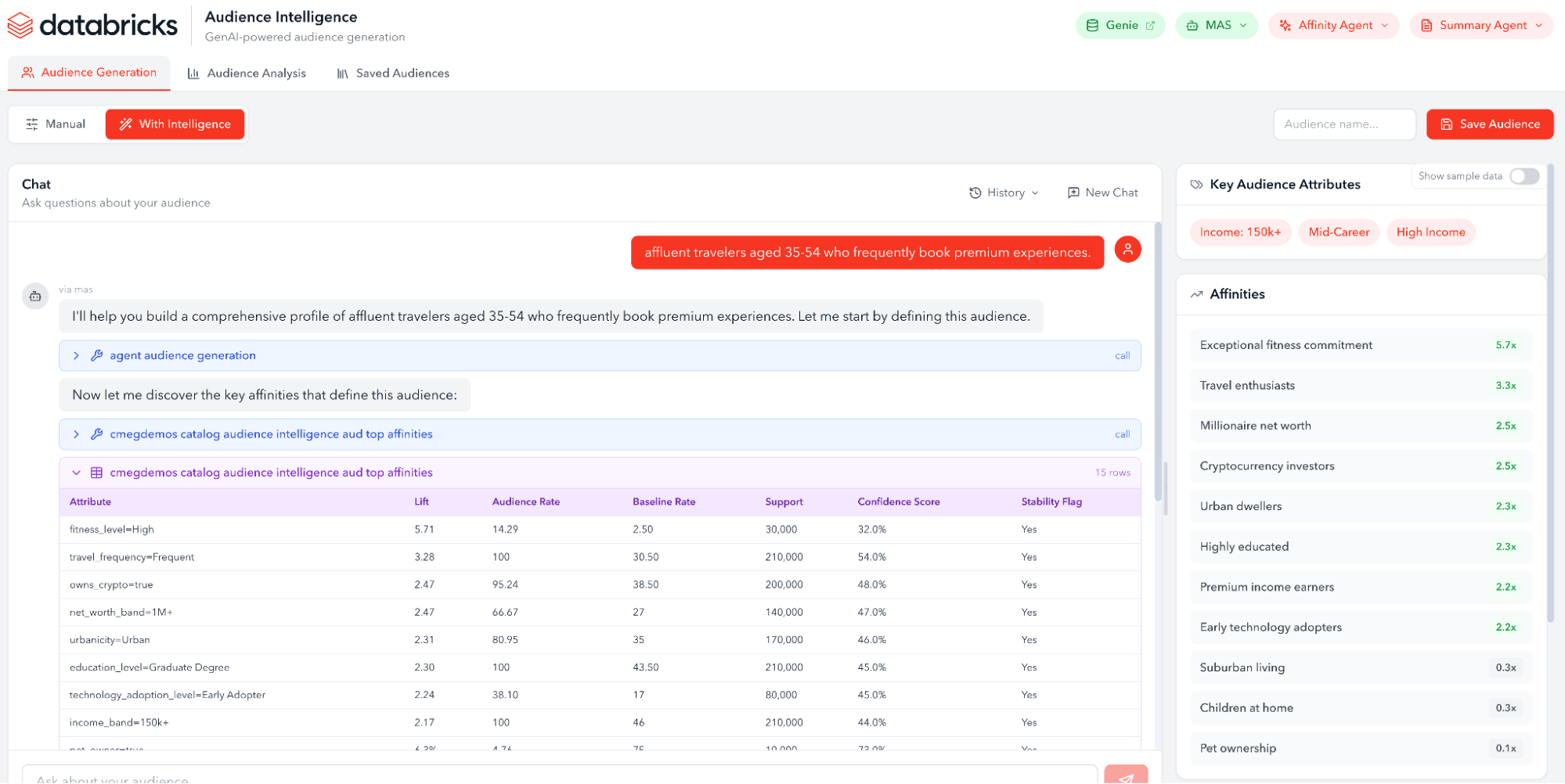
Build audiences through natural language

Figure 6. Build audiences through natural language

Explore details about audiences, including underlying SQL code used to generate, affinity summaries, and recommendations for placement and campaign strategies.
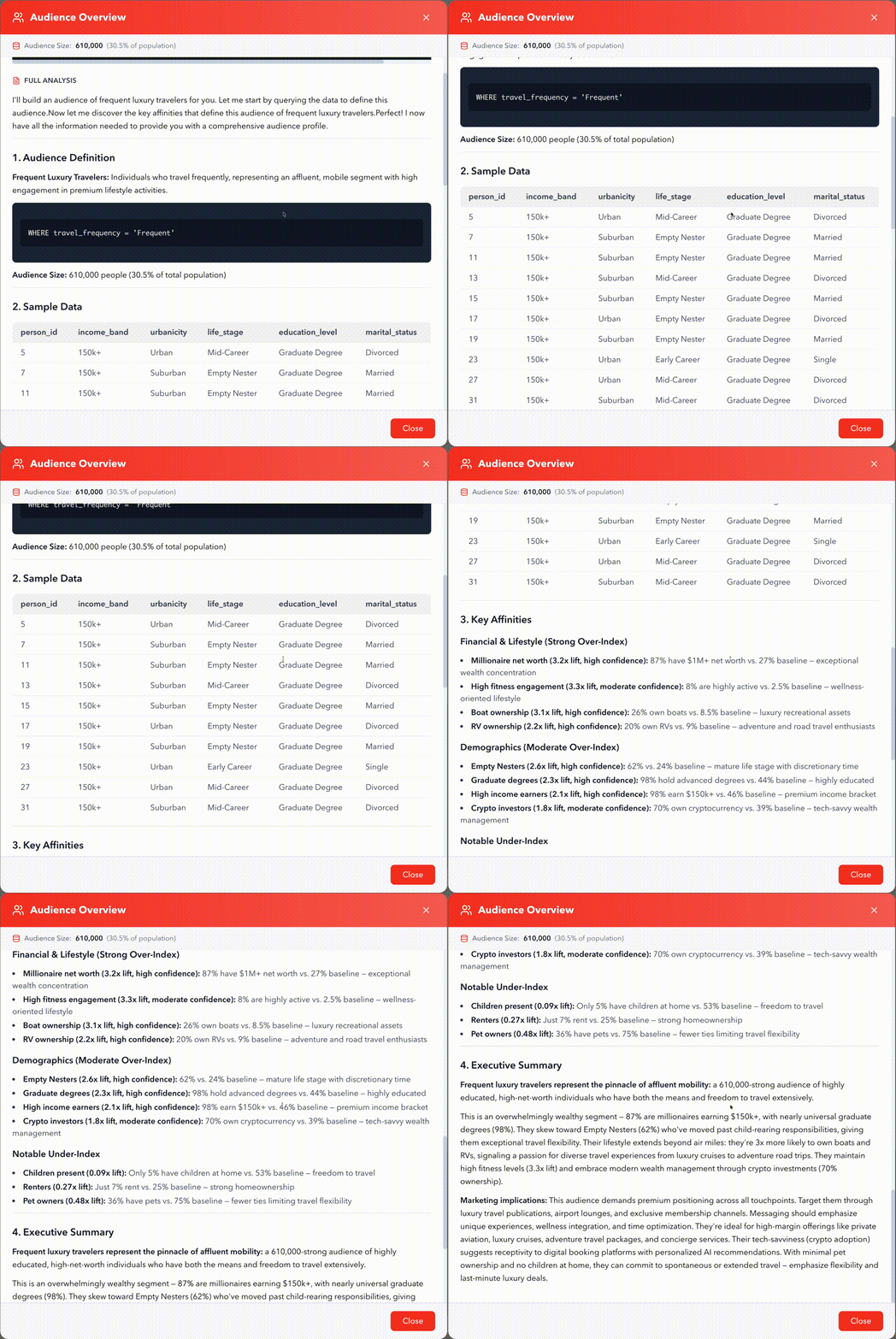
AI/BI Dashboards

Dive deeper into audience segments with integrated AI/BI Dashboards embedded directly within the app.
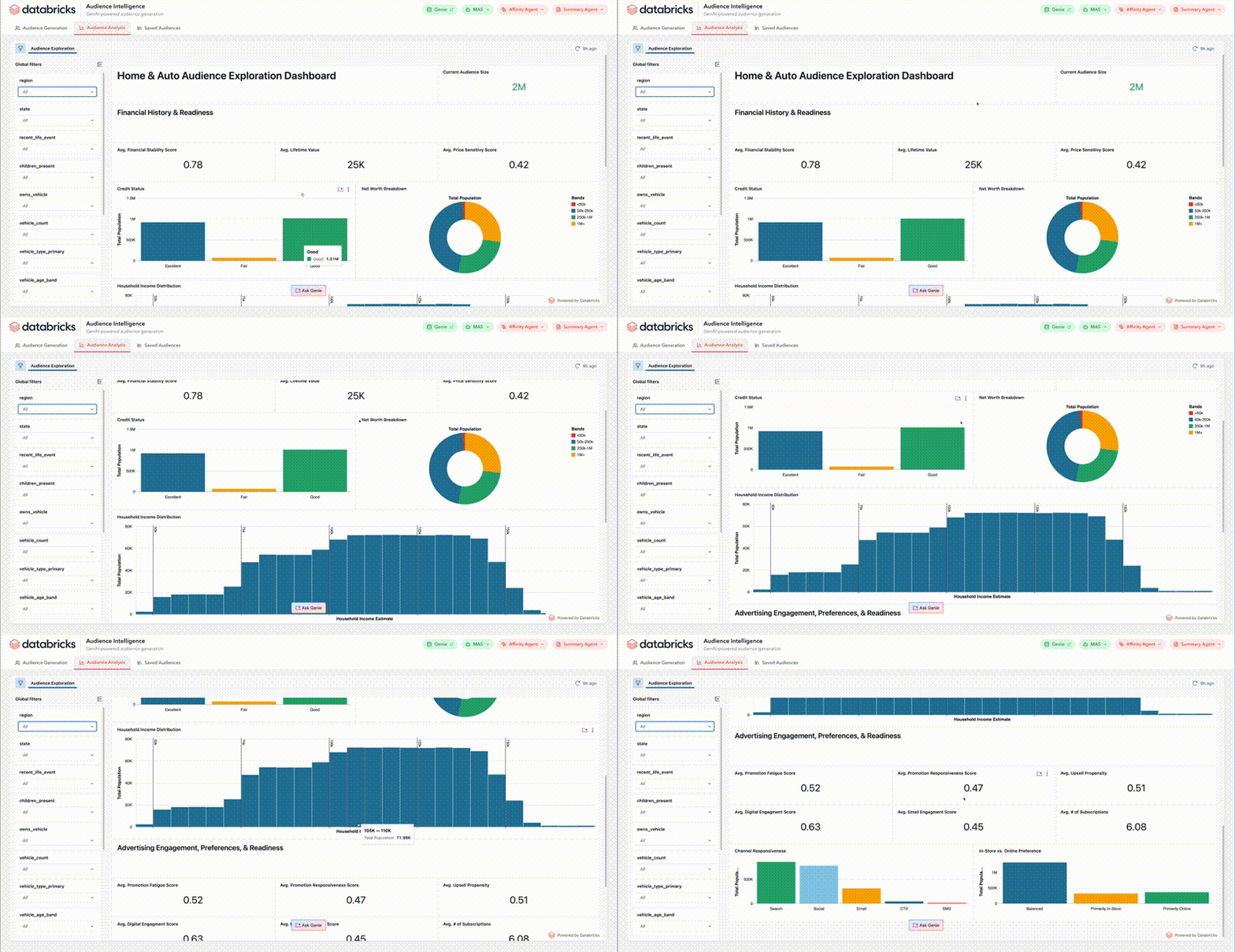
Unity Catalog

Save audiences as persisted tables in Unity Catalog for future viewing, management, and auditability, then, export audiences to execution channels for campaign activation.
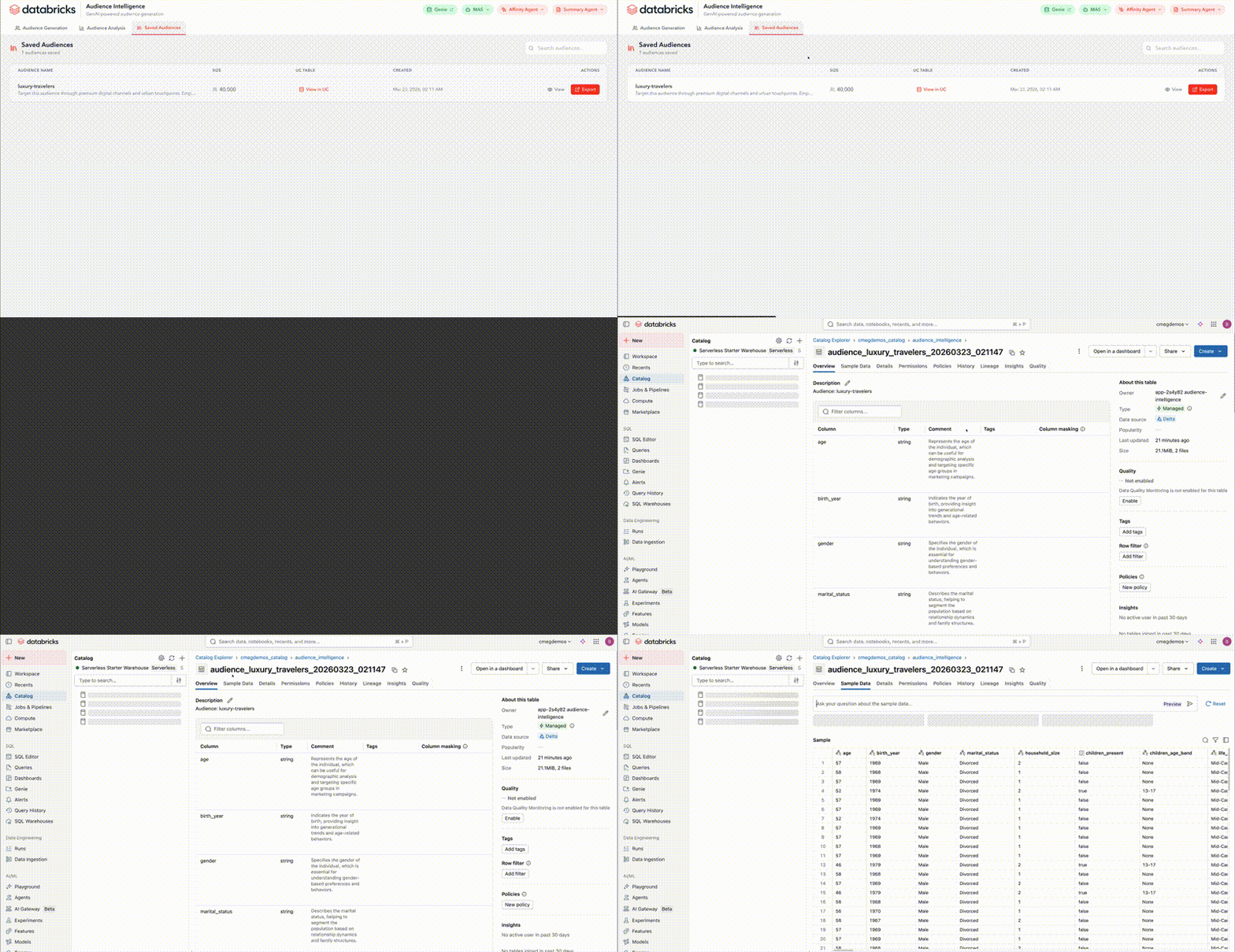
Tables in Unity Catalog

Democratizing the Future of Audience Creation

The gap between strategic intent and data execution has persisted for years – not because organizations lack data, but because their tools weren't built to bridge it. With Databricks' agentic AI capabilities, that bridge now exists, empowering all personas with the tools to discover and build high-quality audiences that differentiate. That audience you didn't know you were looking for is already in your data, you just needed the right system to find and curate it.

To learn more about best practices for building an effective Genie Space, check out this guide.