
惯性聚合 高效追踪和阅读你感兴趣的博客、新闻、科技资讯
阅读原文 在惯性聚合中打开

推荐订阅源

GbyAI
GbyAI
Simon Willison's Weblog
Microsoft Security Blog
Y
Y Combinator Blog
The GitHub Blog
The GitHub Blog
Engineering at Meta
Engineering at Meta
F
Fortinet All Blogs
OSCHINA 社区最新新闻
OSCHINA 社区最新新闻
A
About on SuperTechFans
Last Week in AI
Last Week in AI
月光博客
月光博客
有赞技术团队
有赞技术团队
P
Proofpoint News Feed
MyScale Blog
MyScale Blog
Martin Fowler
Martin Fowler
钛媒体:引领未来商业与生活新知
钛媒体:引领未来商业与生活新知
C
Check Point Blog
U
Unit 42
The Register - Security
奇客Solidot–传递最新科技情报
奇客Solidot–传递最新科技情报
Cyber Security Advisories - MS-ISAC
Hugging Face - Blog
Hugging Face - Blog
阮一峰的网络日志
阮一峰的网络日志
V
Visual Studio Blog
酷 壳 – CoolShell
酷 壳 – CoolShell
D
DataBreaches.Net
WordPress大学
WordPress大学
aimingoo的专栏
aimingoo的专栏
H
Hacker News: Front Page
Recent Announcements
C
CXSECURITY Database RSS Feed - CXSecurity.com
Latest news
Latest news
小众软件
小众软件
P
Palo Alto Networks Blog
PCI Perspectives
PCI Perspectives
Security Latest
Security Latest
S
Secure Thoughts
Scott Helme
Scott Helme
Threat Intelligence Blog | Flashpoint
T
Threat Research - Cisco Blogs
P
Proofpoint News Feed
M
MIT News - Artificial intelligence
Application and Cybersecurity Blog
Google DeepMind News
Recorded Future
Recorded Future
O
OpenAI News
S
Securelist
云风的 BLOG
云风的 BLOG
H
Help Net Security
T
Troy Hunt's Blog

Databricks

How lakebase architecture delivers 5x faster Postgres writes Why Talent Transformation Is the Missing Focus of Enterprise AI Public Health Intelligence Shouldn't Require a Data Scientist Mean Time to Detect Is a Data Access Problem First-party audience data is the ad sales relationship now Rethinking Distributed Systems for Serverless Performance and Reliability The AI Scaling Gap Hiding in Digital Native Companies 10 trillion samples a day: Scaling beyond traditional monitoring infra at Databricks AI success starts with clean data, not just better models How nOps Rebuilt Their Cloud Optimization Platform on Databricks Lakebase, and Why Other ISVs Should Too Peril Predicts: Precision Payouts for a Volatile World The foundation of AI scalability: one team, one platform, one operating model The Federal Data Paradox: Rich in Data, Poor in Access Driving Budapest Forward: How BKK Uses Databricks to Transform City Mobility LLM Vs AI: A Practical Guide to Differences, Use Cases, and Tools Model Risk Governance Is Not the Same as Risk Intelligence Generative AI for Business: A Complete Strategy and Implementation Guide Data Science vs Data Engineering: Choosing Analysis or Infrastructure AI Applications: Tools, Use Cases, and Platforms MLOps vs DevOps: A Practical Guide for Data Scientists and IT Teams Top Data Warehouse Tools For Modern Data Analytics Unlocking SAP Business Context in Databricks with Semantic Metadata Delta Sharing The marketing activation gap has a fix: Databricks and Stitch partner to turn data infrastructure into marketing performance Alert Fatigue Is a Business Risk Backstage with Lakebase Shipping Faster isn’t Learning Faster Why Your OEE Dashboard Is Lying to You The Turbine That Tried to Tell You It Was Failing Predicting Readmissions Isn't Enough. Acting in Time Is. Clinical Trials Run Longer Than They Have To. That's a Patient Problem Network Quality Is a Revenue Problem, Not a Technical One Shelf Availability Starts with Better Demand Visibility When Predicting the Next Hit Requires More Than Intuition Approximate Answers, Exact Decisions: New Sketch Functions for Analytics Companies Winning with AI Built the Data Layer First Rethinking SQL ETL for modern data platforms Stripe data now available on Databricks via Databricks Marketplace Databricks and Stripe Projects: Infrastructure Built for Agents Agents are ready but your architecture probably isn't Interoperability Between Unity Catalog and Google BigQuery via Catalog Federation Built In, Not Bolted On: What AI-Native Actually Means in Cybersecurity Operationalizing AI for public sector fraud prevention From months to minutes: Building real-time clinical data pipelines with natural language Agentic Data Engineering with Genie Code and Lakeflow Securely send first-party conversion signals with Snapchat Conversions API on Databricks Marketplace How leading tech companies are killing the builder’s tax with Lakebase Inside one of the first production deployments of Lakebase: LangGuard's agentic workflow governance engine The next generation of Databricks Genie Model Risk Management in 2026: A Banker’s Guide to the Revised Interagency Guidance OpenAI GPT-5.5 now available on Databricks, fully-governed through Unity AI Gateway Operational databases: How they work and when to use them Databricks partners with OpenAI on GPT-5.5 Announcing the Public Preview of Lakeflow Designer Are LLM agents good at join order optimization? How conversational analytics removes the BI bottleneck How to transform document activation workflows with Genie and Agent Bricks Beyond the spreadsheet: how Databricks is delivering the modern CFO in Financial Services AI App Development: Guide To Building AI-Powered Apps IoT in Manufacturing: Strategy, Components, Use Cases, and Challenges Stop Hand-Coding Change Data Capture Pipelines Multimodal Data Integration: Production Architectures for Healthcare AI Personalization Strategies for Media Companies A Modern AI Risk Management Framework Introducing the Databricks Excel Add-in for Business Users Real-Time Decisioning for AI Agents: Why you Need a Customer Context Layer First A Practical Guide to LLM Fine Tuning AI Data Transformation Guide for Data Engineers and Data Scientists Concurrency Control in DBMS: How Locking, MVCC and Optimistic Strategies Keep Data Consistent Bridging data science and marketing: Databricks unveils Delta Sharing integration for Adobe Experience Platform and agentic marketing workflows Take Control: Customer-Managed Keys for Lakebase Postgres Get hands on with agents, vibe coding and more at Data+ AI Summit Mercedes-Benz Builds a Cross-Cloud Data Mesh with Delta Sharing and Intelligent Replication, Cutting Costs by 66% What Is a Transactional Database? Introducing Genie Agent Mode Governing coding agent sprawl with Unity AI Gateway Governing Coding Agent Sprawl with Unity AI Gateway What is pgvector? Banks Don’t Have an AI Problem – They Have a Data Platform Problem Open Platform, Unified Pipelines: Why dbt on Databricks is Accelerating Why Your Agents Can’t Read Enterprise Documents — and How to Fix It Databricks on Google Cloud: Innovate Faster. Smarter. Together. Introducing the Databricks Connector for Google Sheets: Real-Time, Governed Lakehouse Data in the Sheets Users Love Unity AI Gateway: How to connect agents to external MCPs securely Expanding agent governance with Unity AI Gateway Agentic reasoning in practice: Making sense of structured and unstructured data Agent Bricks: The Governed Enterprise Agent Platform 8 AI and data trends shaping financial services in 2026 Building real-time product search on Databricks Lovable + Databricks: Build Data-Driven Apps at the Speed of Thought Memory scaling for AI agents Powering clinical research innovation: How TriNetX uses Databricks to accelerate drug development Database Branching in Postgres: Git-Style Workflows with Databricks Lakebase How Zalando built a unified data foundation for AI and analytics on Databricks The next era of the open lakehouse: Apache Iceberg™ v3 in Public Preview on Databricks How FSIs eliminate silos between clients, operations, and finance How MakeMyTrip achieved millisecond personalization at scale with Databricks A multi-agent approach to audience intelligence AiChemy: Next-generation agent with MCP, skills and custom data for drug discovery Accelerate business insights with Lakeflow Connect, now with a Free Tier Unlocking Next-Gen Customer Experiences with Data Intelligence for Marketing
Building with Databricks Document Intelligence and Lakeflow
2026-04-16 · via Databricks

Despite decades of perfecting structured data pipelines, 80% of enterprise knowledge remains functionally invisible, trapped in PDFs, images, and office documents. 

Traditionally, Intelligent Document Processing (IDP) has been a fragmented nightmare. Before the era of Generative AI, organizations were forced to rely on disconnected NLP and computer vision APIs that were outside of their primary data platforms. These siloed OCR (optical character recognition) vendors offered limited accuracy and lacked formal governance protocols, creating significant friction. To deliver on the promise of Enterprise AI, we need a unified approach that integrates data intelligence directly into the data lifecycle. 

Today, we’re showing how data engineers can leverage Lakeflow, Databricks’ unified data engineering solution, and Databricks Document Intelligence to unlock that data and turn it into business-impacting intelligence by building production-grade autonomous IDP in their Databricks Platform.
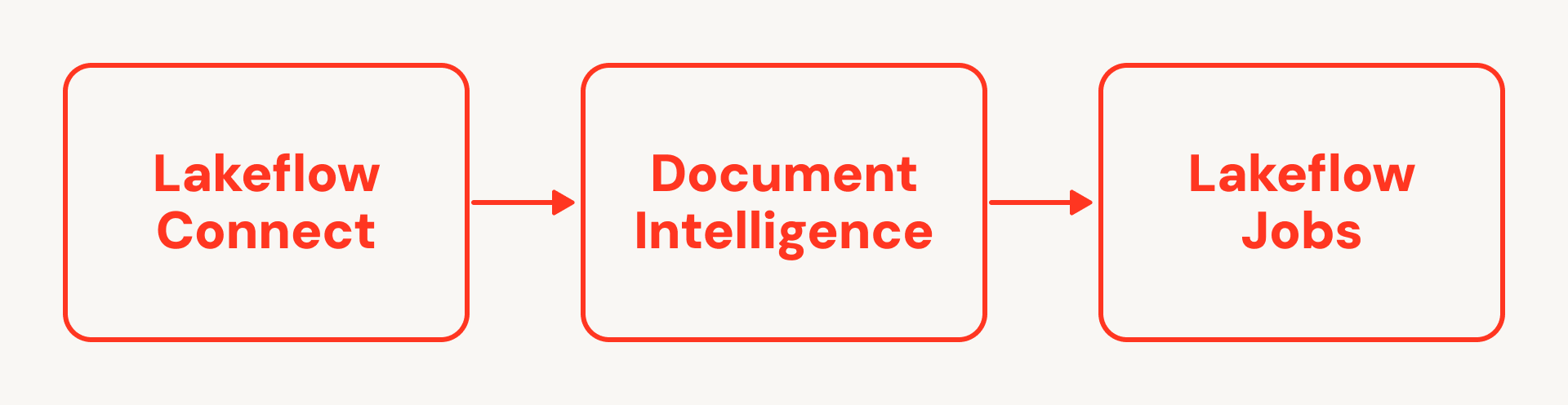
Lakeflow Connect - Document Intelligence - Lakeflow Jobs

Step 1: Secure Ingestion with Lakeflow Connect

Enterprise documents live in siloed graveyards, accessible only through fragile, custom-coded API integrations that break the moment a folder is renamed. Lakeflow Connect, Databricks' solution for ingesting data into the lakehouse, changes the game with built-in connectors for many popular enterprise applications, databases, and file sources including SharePoint and Google Drive.

This solution offers zero-maintenance ingestion by removing the need to manage complex OAuth flows or custom Python scripts. Documents land directly in Unity Catalog Volumes and tables, so access control, lineage, and auditing apply as soon as the file is in the lakehouse, and you can reuse the same fine‑grained, attribute‑based policies you already rely on for structured data.

You also get fast and efficient ingestion at scale thanks to Lakeflow Connect’s robust capabilities, including incremental reads and writes which avoids full re‑pulls of large libraries for both batch backfills and near‑real‑time document flows when combined with streaming downstream.

Step 2: Getting started with Databricks Document Intelligence

These enterprise documents carry some of your organization’s most valuable insights but are inherently messy, variable and inconsistent. Scanned pages, handwritten notes and nested tables trap your most valuable insights. To fix this, you don’t just need another document extraction tool; as Forrester notes, you need a “reasoning-first architectural evolution.” With this approach, Gartner predicts GenAI will reduce the need for custom-trained document models by 70%.

Today, with Databricks Document Intelligence, you can bring state-of-the-art document understanding directly to your data. Your data engineering teams can leverage purpose-built AI functions that can reliably parse, structure, and enrich complex documents right alongside your existing data pipelines, all seamlessly governed by Unity Catalog.

  • ai_parse_document (new - GA): This function converts unstructured files into structured representations using the Variant data type. It natively handles input complexity that typically trips up traditional parsers, such as scanned images, handwriting, and variable layouts, while preserving critical document structure (e.g., nested tables, sections, and headers) that flat text extraction would lose. This allows you to evolve schemas over time without breaking your pipelines. Downstream, you treat the VARIANT output as a flexible bronze/silver representation, projecting it into Delta columns in your silver/gold layers using SQL or PySpark in Lakeflow Spark Declarative Pipelines.

On top of the parsed structure, you can chain additional research-tuned AI Functions:

  • ai_extract (PuPr) to pull structured insights such as contract effective and expiration dates, counterparties, invoice totals, taxes, currency, and PO numbers.
  • ai_classify (PuPr) to route documents by type (invoice, PO, SOW, NDA), urgency/risk, or owning business unit.
  • ai_prep_search (new - Beta) to intelligently divide documents into chunks for high-quality downstream embedding, preparing them for retrieval or search use cases

Below is a simple example of chaining ai_parse_document and ai_extract together. 
Note: this example shows PySpark, but you can also use SQL (see documentation). 

Because these are managed AI Functions integrated into the Databricks Platform, Document Intelligence can combine them with your enterprise context (catalog metadata, business semantics, existing tables) to power agentic workflows that reason over your data with high accuracy, grounded in your enterprise domain context.

Step 3: Productionizing IDP Workloads at Scale

Once you have ingestion and parsing working in notebooks, you need to productionize your IDP: orchestrate ingestion, parsing, enrichment, and serving. But you also want to monitor SLAs, failures, and retries in CI/CD to ensure pipelines remain healthy. 

With Lakeflow Jobs, Databricks’ native orchestrator, you can turn IDP workloads into robust, automated pipelines with the same orchestration system you use for ETL, analytics, and ML. It provides unified orchestration for every task in the IDP DAG, so you can chain notebooks, Python scripts, SQL queries, pipelines, LLMs, or agent calls in a single job and model the full flow from document ingestion. 

Lakeflow Jobs also comes with built-in advanced control flow (including if/else conditions, for each, retries, etc.) and triggers (table update, file arrival, continuous, etc.). This makes it easy to 1) re‑process only failed partitions or specific document batches and 2) manage jobs to fit specific schedules, event‑based triggers, or continuous mode for real‑time document streams.

With Lakeflow Jobs’ serverless compute with native observability, you also get automatic scaling with spikes in document volume while surfacing real‑time monitoring, metrics, and alerts so you can pinpoint bottlenecks and repair failures without needing to re-run successful tasks.
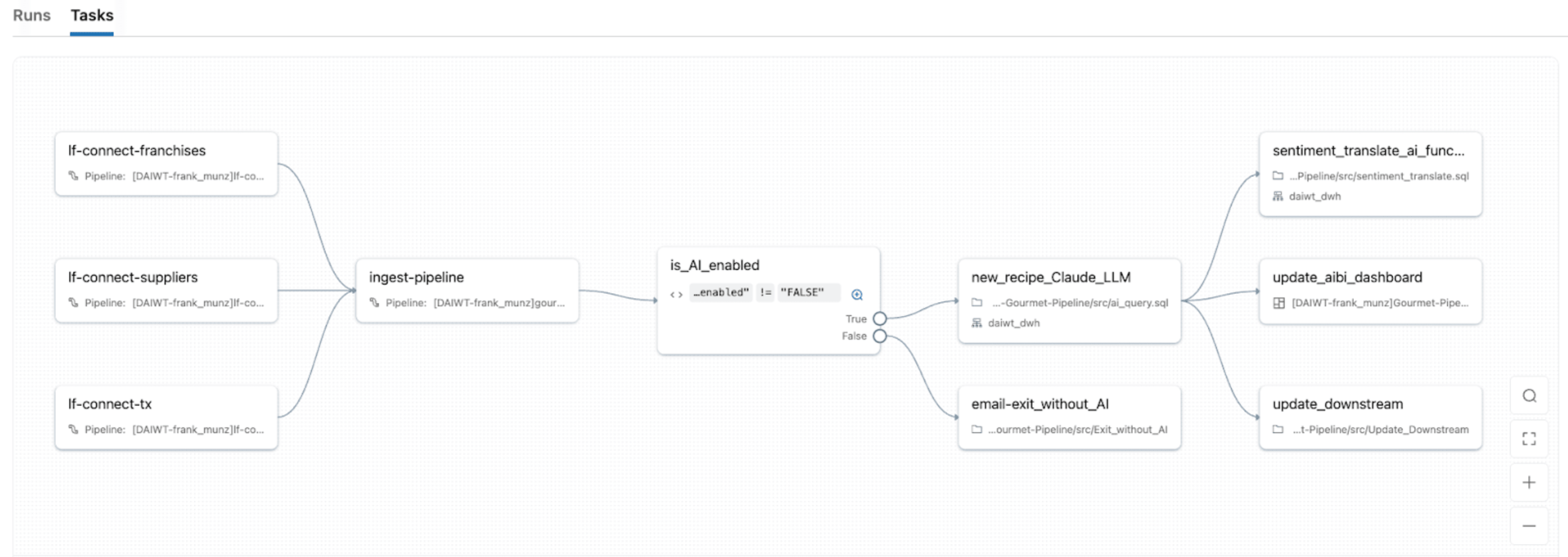
DAG displaying productionizing IDP workloads

Grounding AI in Enterprise Context

IDP is most valuable when it is backed by enterprise context: your unique schemas, business definitions, and custom semantics. 

Unity Catalog 

Unity Catalog provides unified governance and discovery across structured data, unstructured files, ML models, and business metrics on any cloud. For IDP, that means: 

  • A single place to define access policies, lineage, and auditing for both raw documents and derived structured tables
  • Support for open formats (Delta, Apache Iceberg, Hudi, Parquet) so you aren’t locked into a proprietary document representation
  • Business semantics and catalog‑level metadata that agents can use to consistently name and interpret entities such as “Vendor,” “Customer,” or “Contract Value.”

Document Intelligence

Document Intelligence uses this context to build production AI agents that know which tables, tools, and models to use for a given IDP task, are governed end‑to‑end so they never access more than they should, and continuously improve via LLM‑based quality scoring, task‑specific benchmarks, and learning loops. For developers, Databricks provides APIs and SDKs so you can define these agents as code and integrate them into your existing CI/CD pipelines, just like any other data or ML asset.

Best Practices for the Modern IDP Stack

To move from pilot to platform, keep these best practices in mind:

  • Data Enrichment: Don’t just extract a "Vendor Name." Join it with your internal Master Data or third-party sources (like Dun & Bradstreet) to provide full business context.
  • Operational Excellence: Use Service Principals for Lakeflow Jobs to ensure pipeline stability.
  • Monitoring: Use Lakehouse Monitoring to track model drift and extraction accuracy over time.

The Path to Modern Data Intelligence

With Databricks, you can own the full lifecycle of Intelligent Document Processing on a modern data platform. Combining Lakeflow and AI functions lets you turn unstructured, hidden data into trusted, queryable datasets and seamlessly run observable document pipelines alongside your core ETL and ML. 

Now that we’ve covered the strategic value of autonomous document intelligence, it’s time to build it. Check out our companion post, From PDF to Insights, for a step-by-step technical walkthrough on deploying this exact architecture using Databricks.

You can also explore the Document Intelligence and Lakeflow documentation to start building your first IDP pipeline today!