

惯性聚合 高效追踪和阅读你感兴趣的博客、新闻、科技资讯
阅读原文 在惯性聚合中打开

推荐订阅源

爱范儿
爱范儿
Know Your Adversary
Know Your Adversary
Google DeepMind News
A
Arctic Wolf
P
Privacy & Cybersecurity Law Blog
云风的 BLOG
云风的 BLOG
Stack Overflow Blog
Stack Overflow Blog
V
Visual Studio Blog
Project Zero
Project Zero
L
LangChain Blog
N
News and Events Feed by Topic
博客园 - Franky
Last Week in AI
Last Week in AI
cs.AI updates on arXiv.org
T
The Blog of Author Tim Ferriss
宝玉的分享
宝玉的分享
Scott Helme
Scott Helme
T
The Exploit Database - CXSecurity.com
P
Proofpoint News Feed
Blog — PlanetScale
Blog — PlanetScale
www.infosecurity-magazine.com
W
WeLiveSecurity
月光博客
月光博客
博客园_首页
美团技术团队
CTFtime.org: upcoming CTF events
freeCodeCamp Programming Tutorials: Python, JavaScript, Git & More
腾讯CDC
Latest news
Latest news
WordPress大学
WordPress大学
cs.CV updates on arXiv.org
Spread Privacy
Spread Privacy
Attack and Defense Labs
量子位
L
LINUX DO - 热门话题
C
CERT Recently Published Vulnerability Notes
Webroot Blog
Webroot Blog
L
Lohrmann on Cybersecurity
aimingoo的专栏
aimingoo的专栏
T
Troy Hunt's Blog
Security Latest
Security Latest
小众软件
小众软件
Cloudbric
Cloudbric
Hacker News: Ask HN
Hacker News: Ask HN
S
Secure Thoughts
雷峰网
雷峰网
T
Threat Research - Cisco Blogs
H
Hacker News: Front Page
IT之家
IT之家
Simon Willison's Weblog

Databricks

Why Talent Transformation Is the Missing Focus of Enterprise AI Public Health Intelligence Shouldn't Require a Data Scientist Mean Time to Detect Is a Data Access Problem First-party audience data is the ad sales relationship now Rethinking Distributed Systems for Serverless Performance and Reliability The AI Scaling Gap Hiding in Digital Native Companies 10 trillion samples a day: Scaling beyond traditional monitoring infra at Databricks AI success starts with clean data, not just better models How nOps Rebuilt Their Cloud Optimization Platform on Databricks Lakebase, and Why Other ISVs Should Too Peril Predicts: Precision Payouts for a Volatile World The foundation of AI scalability: one team, one platform, one operating model The Federal Data Paradox: Rich in Data, Poor in Access Driving Budapest Forward: How BKK Uses Databricks to Transform City Mobility LLM Vs AI: A Practical Guide to Differences, Use Cases, and Tools Model Risk Governance Is Not the Same as Risk Intelligence Generative AI for Business: A Complete Strategy and Implementation Guide Data Science vs Data Engineering: Choosing Analysis or Infrastructure AI Applications: Tools, Use Cases, and Platforms MLOps vs DevOps: A Practical Guide for Data Scientists and IT Teams Top Data Warehouse Tools For Modern Data Analytics Unlocking SAP Business Context in Databricks with Semantic Metadata Delta Sharing The marketing activation gap has a fix: Databricks and Stitch partner to turn data infrastructure into marketing performance Alert Fatigue Is a Business Risk Backstage with Lakebase Shipping Faster isn’t Learning Faster Why Your OEE Dashboard Is Lying to You The Turbine That Tried to Tell You It Was Failing Predicting Readmissions Isn't Enough. Acting in Time Is. Clinical Trials Run Longer Than They Have To. That's a Patient Problem Network Quality Is a Revenue Problem, Not a Technical One Shelf Availability Starts with Better Demand Visibility When Predicting the Next Hit Requires More Than Intuition Approximate Answers, Exact Decisions: New Sketch Functions for Analytics Companies Winning with AI Built the Data Layer First Rethinking SQL ETL for modern data platforms Stripe data now available on Databricks via Databricks Marketplace Databricks and Stripe Projects: Infrastructure Built for Agents Agents are ready but your architecture probably isn't Interoperability Between Unity Catalog and Google BigQuery via Catalog Federation Built In, Not Bolted On: What AI-Native Actually Means in Cybersecurity Operationalizing AI for public sector fraud prevention From months to minutes: Building real-time clinical data pipelines with natural language Agentic Data Engineering with Genie Code and Lakeflow Securely send first-party conversion signals with Snapchat Conversions API on Databricks Marketplace How leading tech companies are killing the builder’s tax with Lakebase Inside one of the first production deployments of Lakebase: LangGuard's agentic workflow governance engine The next generation of Databricks Genie Model Risk Management in 2026: A Banker’s Guide to the Revised Interagency Guidance OpenAI GPT-5.5 now available on Databricks, fully-governed through Unity AI Gateway Operational databases: How they work and when to use them Databricks partners with OpenAI on GPT-5.5 Announcing the Public Preview of Lakeflow Designer Are LLM agents good at join order optimization? How conversational analytics removes the BI bottleneck How to transform document activation workflows with Genie and Agent Bricks Beyond the spreadsheet: how Databricks is delivering the modern CFO in Financial Services AI App Development: Guide To Building AI-Powered Apps IoT in Manufacturing: Strategy, Components, Use Cases, and Challenges Stop Hand-Coding Change Data Capture Pipelines Multimodal Data Integration: Production Architectures for Healthcare AI Personalization Strategies for Media Companies A Modern AI Risk Management Framework Introducing the Databricks Excel Add-in for Business Users Real-Time Decisioning for AI Agents: Why you Need a Customer Context Layer First A Practical Guide to LLM Fine Tuning AI Data Transformation Guide for Data Engineers and Data Scientists Concurrency Control in DBMS: How Locking, MVCC and Optimistic Strategies Keep Data Consistent Bridging data science and marketing: Databricks unveils Delta Sharing integration for Adobe Experience Platform and agentic marketing workflows Take Control: Customer-Managed Keys for Lakebase Postgres Get hands on with agents, vibe coding and more at Data+ AI Summit Mercedes-Benz Builds a Cross-Cloud Data Mesh with Delta Sharing and Intelligent Replication, Cutting Costs by 66% What Is a Transactional Database? Introducing Genie Agent Mode Governing coding agent sprawl with Unity AI Gateway Governing Coding Agent Sprawl with Unity AI Gateway What is pgvector? Banks Don’t Have an AI Problem – They Have a Data Platform Problem Open Platform, Unified Pipelines: Why dbt on Databricks is Accelerating Why Your Agents Can’t Read Enterprise Documents — and How to Fix It Building with Databricks Document Intelligence and Lakeflow Databricks on Google Cloud: Innovate Faster. Smarter. Together. Introducing the Databricks Connector for Google Sheets: Real-Time, Governed Lakehouse Data in the Sheets Users Love Unity AI Gateway: How to connect agents to external MCPs securely Expanding agent governance with Unity AI Gateway Agentic reasoning in practice: Making sense of structured and unstructured data Agent Bricks: The Governed Enterprise Agent Platform 8 AI and data trends shaping financial services in 2026 Building real-time product search on Databricks Lovable + Databricks: Build Data-Driven Apps at the Speed of Thought Memory scaling for AI agents Powering clinical research innovation: How TriNetX uses Databricks to accelerate drug development Database Branching in Postgres: Git-Style Workflows with Databricks Lakebase How Zalando built a unified data foundation for AI and analytics on Databricks The next era of the open lakehouse: Apache Iceberg™ v3 in Public Preview on Databricks How FSIs eliminate silos between clients, operations, and finance How MakeMyTrip achieved millisecond personalization at scale with Databricks A multi-agent approach to audience intelligence AiChemy: Next-generation agent with MCP, skills and custom data for drug discovery Accelerate business insights with Lakeflow Connect, now with a Free Tier Unlocking Next-Gen Customer Experiences with Data Intelligence for Marketing
Advancing Apache Iceberg on Databricks: Iceberg v3 GA, Open Sharing, and Unified Governance
Jason Reid, Ryan Blue, Daniel Weeks, Michelle Leon · 2026-05-29 · via Databricks

The next phase of the open lakehouse will be defined by the catalog. Open table formats made it possible for many engines to work on the same data, but the catalog determines whether that data can be governed, optimized, and shared consistently across systems. As more workloads, including AI and agentic applications, depend on governed access to data across many systems, enterprises need an Iceberg catalog that can provide interoperability, great performance, and enterprise-ready governance.

That is why today, we are announcing the most comprehensive set of Iceberg capabilities available on any lakehouse catalog. In this blog, we will discuss new enhancements for Iceberg support in Unity Catalog and break down 5 things that make Unity Catalog the most interoperable Iceberg catalog on the market today.

What’s new: Iceberg capabilities at the glance

We’ve pushed a broad set of Iceberg capabilities across Databricks and Unity Catalog into General Availability and Preview to ensure every engine, every catalog, and every team can work seamlessly together. 
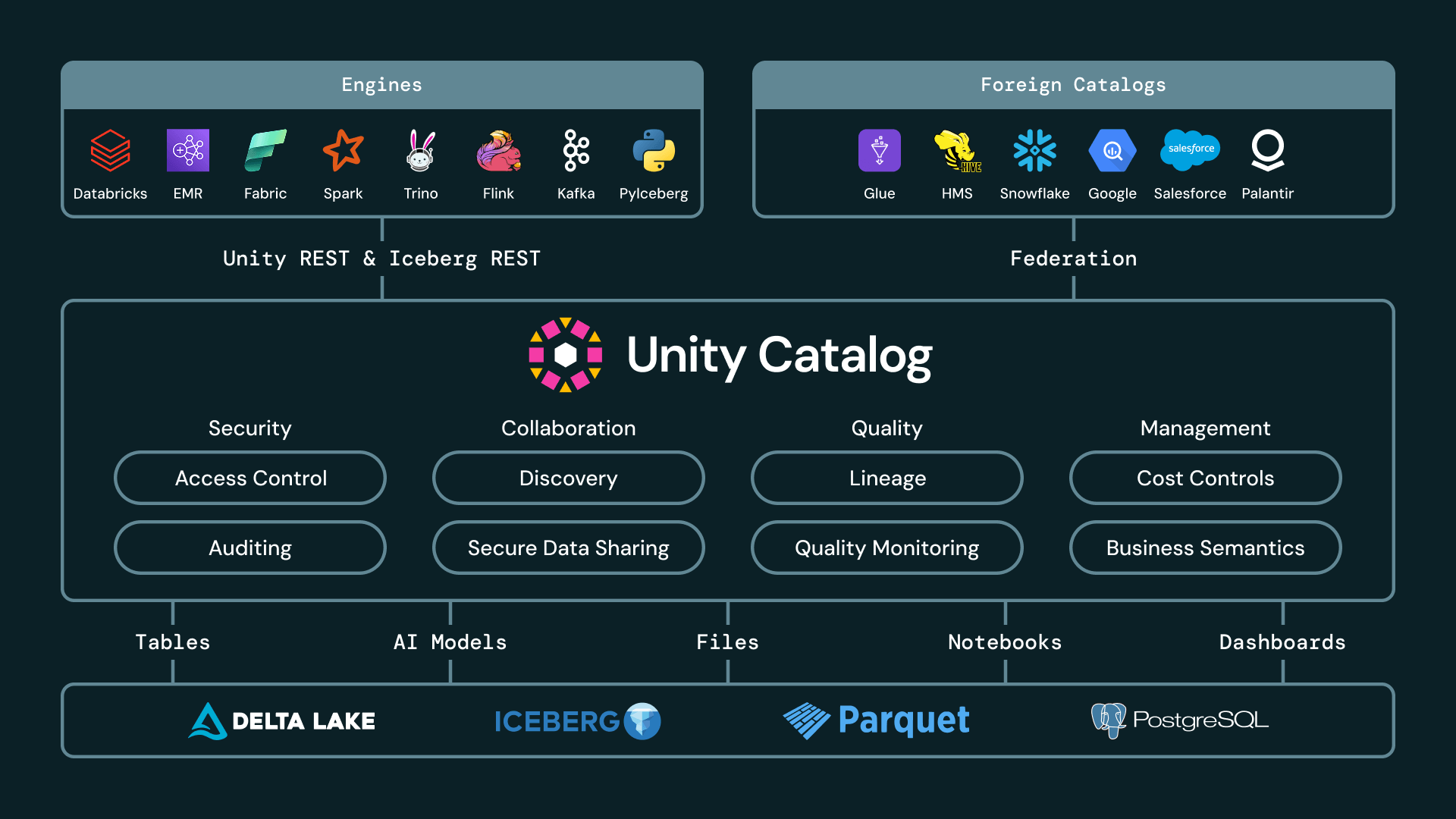
  • Managed Iceberg (GA):  Create, read, write, optimize, govern, and share Iceberg tables directly in Unity Catalog, with Predictive Optimization and Liquid Clustering eliminating the manual work required to keep tables performant.
  • Iceberg v3 (GA): Native support for deletion vectors, row tracking, and the new VARIANT type across managed, foreign, and UniForm-enabled tables.
  • Foreign Iceberg (GA) & Credential Vending for Foreign Iceberg (GA): Register, govern, and securely query Iceberg tables managed in external catalogs.
  • External Sharing to Iceberg clients (GA): Share live data with any Iceberg REST-compatible clients using the open DeltaSharing protocol. 
  • External Sharing of Foreign Iceberg tables (Public Preview): Share Iceberg tables managed outside Databricks natively in Databricks & across the Delta Sharing ecosystem.
  • Iceberg-compatible materialized views (Gated Public Preview): Create high-performance materialized views in Databricks and expose them downstream as native Iceberg tables.
  • Cross-engine Attribute-Based Access Control (Beta): Enforce fine-grained governance policies for external Iceberg engines through Iceberg REST Catalog Scan APIs.
  • New catalog federation connectors (Preview):  Expanding Unity Catalog’s catalog federation support beyond AWS GlueSnowflake HorizonHive Metastore, and Salesforce Data Cloud to include Google Cloud Lakehouse and Palantir, making Unity Catalog your single pane of glass.

Unity Catalog Ecosystem

Five things that make Unity Catalog the most interoperable Iceberg catalog

To deliver a fully open lakehouse, an Iceberg catalog must go beyond basic metadata tracking. It needs to give you absolute flexibility across diverse engines, vendors, and governance models. We believe evaluating an open Iceberg catalog comes down to how well it addresses five fundamental operational requirements: providing open APIsfederating across external estatesenforcing cross-engine governanceenabling secure and open sharing, and continuous performance and format innovation.

Unity Catalog is the only catalog that delivers on all five requirements.
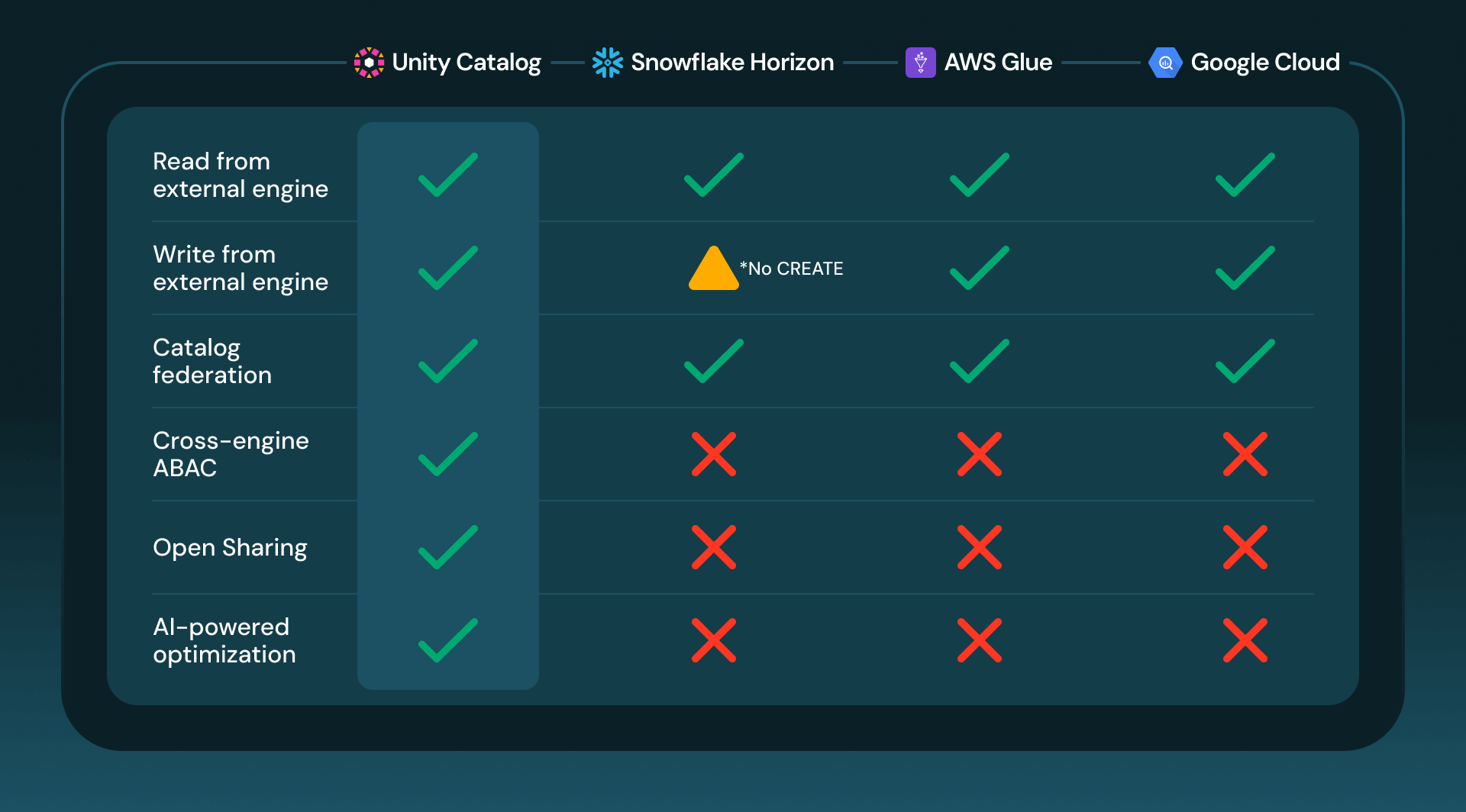
Iceberg Catalog Comparison

1. Open APIs and credential vending

Customers should be able to use the engine that best fits the workload, whether Spark, Trino, Flink, Snowflake, DuckDB, pandas, or another Iceberg-compatible client, without copying data or giving every engine broad storage permissions.

With Managed Iceberg now generally available on Databricks, customers can create, read, and write to Iceberg tables in Unity Catalog from any engine using UC’s Iceberg REST Catalog APIs.

UC’s Iceberg REST Catalog APIs now also extend beyond managed Iceberg tables. UC also vends credentials for federated Iceberg tables, providing secure access via open APIs even to tables managed in external catalogs. And, currently in Gated Public Preview, customers can create materialized views in Databricks and expose them as Iceberg tables to downstream consumers. With broader availability in the coming weeks, customers will be able to create Iceberg-compatible materialized views directly with CREATE MATERIALIZED VIEW my_mv USING ICEBERG.
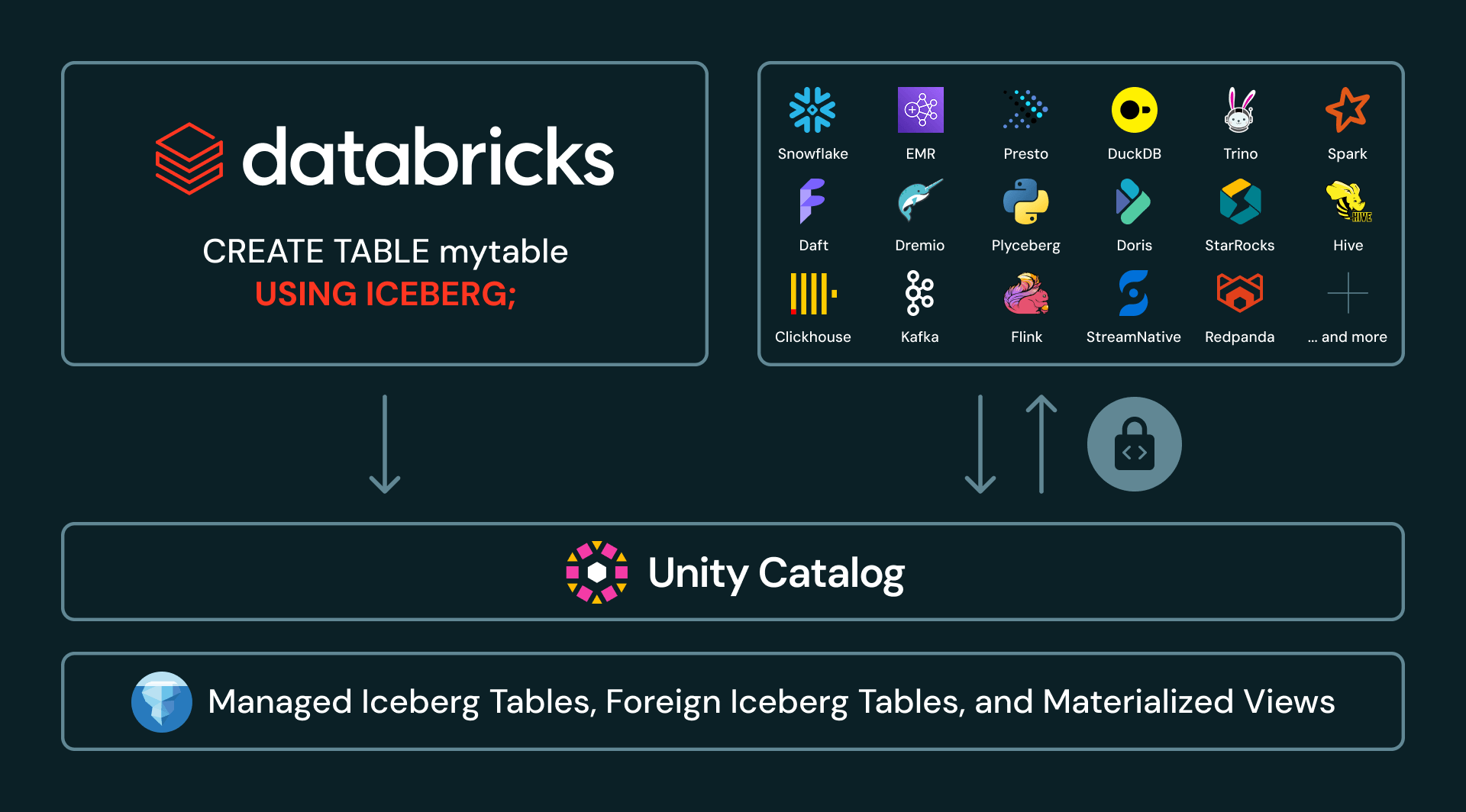
Create Iceberg Table

2. Catalog federation: your entire Iceberg estate in one view

Many large enterprises have multiple catalogs in their lakehouse. For example, they may have data distributed across Unity Catalog, AWS Glue, Snowflake Horizon, and Hive Metastore. With Foreign Iceberg now generally available, Unity Catalog can govern Iceberg tables managed in other catalogs. Customers can discover, secure, query, and share external Iceberg tables through Databricks while leaving the data and source catalog in place.

Unity Catalog now supports a broad and growing set of Iceberg catalog integrations, including AWS Glue, Google Cloud Lakehouse Runtime Catalog, Snowflake Horizon, Palantir, Salesforce, and Workday. These integrations allow enterprises to treat Unity Catalog as the single pane of glass for their Iceberg estate, even when the data is produced or managed elsewhere.

3. Cross-engine Attribute-Based Access Control

Historically, row- and column-level controls were enforced inside a single engine. In the open lakehouse, the same table can be accessed by many engines. This introduced a hard problem: governance needs to work everywhere data can be accessed.

With cross-engine attribute-based access controls (ABAC) now in Beta, Unity Catalog extends attribute-based access control to Iceberg clients using the Iceberg REST Catalog Scan APIs. 

How it works: Administrators define policies once in UC, including column masks, row filters, and tag-based policies. When an external Iceberg engine requests access, UC evaluates the applicable policies during server-side scan planning. UC then returns a filtered scan plan so the engine only reads authorized data when processing the query.

This brings fine-grained governance to external Iceberg engines using open standards. Any engine, such as Apache Spark or DuckDB, which implements the Iceberg REST catalog scan planning client (added in the Iceberg 1.11 release) can access data with ABAC enforced. Customers can use the best engine for each workload while maintaining one governance model across the lakehouse.

Unity Catalog and managed Iceberg give us the best of both worlds: native performance for our AI and ML pipelines, and open interoperability for every downstream consumer. One write path, zero duplication, and a governance layer every engine respects, including the AI-driven products we're building for Rippling's Data Cloud.— Tae Lee, Staff Engineer, Data Platform at Rippling

4. Zero copy secure sharing for external & cross-domain collaborations 

Cross-domain sharing often forces data providers into bad tradeoffs: copy data into another platform, build complex external authentication mechanisms, or require every recipient to use the same vendor ecosystem. Databricks pioneered secure open data sharing with Delta Sharing, the most widely adopted open source protocol for Data and AI sharing - supporting both Databricks-to-Databricks and Databricks-to-Open sharing. 

We are excited to announce that Iceberg is now a first class citizen in Databricks DeltaSharing both as a source format, as well as a destination. With sharing to Iceberg clients now generally available, Databricks customers can share live data externally with any recipient that supports the Iceberg REST Catalog API. Recipients can query shared data from Iceberg-compatible clients such as Snowflake, Trino, Flink, and Spark, without manual ingestion or copies. Providers continue to manage access, auditing, and governance through Unity Catalog.

We are also announcing Public Preview of foreign Iceberg sharing. Customers can share Iceberg tables that are managed or cataloged outside Databricks but registered and governed in Unity Catalog. This means UC can serve as the sharing layer for managed and foreign Iceberg tables, while keeping data in place and governance centralized.
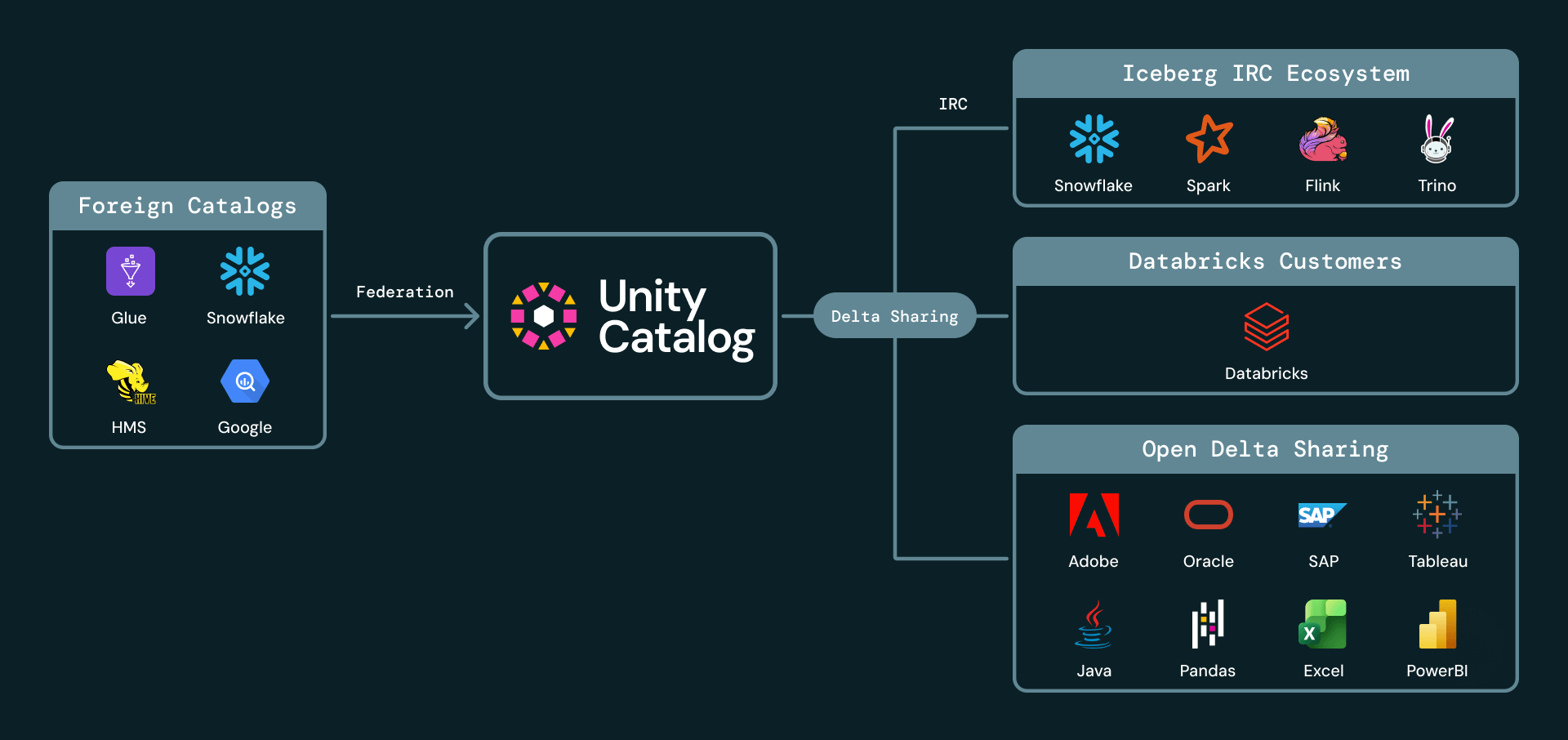
Iceberg Sharing

5. Performance and format innovation: faster open tables without manual tuning

Open interoperability only works if the tables remain performant at production scale. Unity Catalog is the only catalog that uses AI to optimize your tables for faster queries and lower operational overhead. Predictive Optimization determines which tables need maintenance, which optimizations to run, and how often to run them, and adapts your table’s data layout based on workload patterns. This reduces the operational work required to keep Iceberg tables fast and cost-efficient as usage changes, and these optimizations benefit all engines - for example data layout optimization techniques improve data skipping for queries running outside of Databricks such as in Apache Spark.   We are constantly innovating on the customer experience – and are the only catalog that can intelligently select clustering keys for optimal performance or automatically upgrade open tables with the latest innovations based on prior access patterns.

Databricks is also advancing the Iceberg standard itself. With Iceberg v3 now generally available on Databricks, customers get support for deletion vectors, row tracking, and VARIANT across managed Iceberg tables, foreign Iceberg tables, and UniForm-enabled managed tables. These capabilities close important gaps between performance and interoperability: deletion vectors accelerate updates, merges, and deletes; row tracking supports more efficient incremental processing; and VARIANT provides a standard representation for semi-structured data. These features also work seamlessly across both Delta and Iceberg tables, enabling interoperability without rewriting data.

These investments point to the same goal: open tables that do not force customers to choose between ecosystem interoperability and the performance capabilities required for production workloads.

Unity Catalog gives us one place to govern data across teams and systems, while managed Iceberg delivers the performance we need at our scale.— Kayvon Raphael, Head of Data Engineering, Magnite

Taken together, these five capabilities make Unity Catalog the best catalog for Apache Iceberg. UC gives customers open access to Iceberg tables, a unified view across catalogs, fine-grained governance across engines, secure sharing across domains, and automatic optimization for production workloads.

The next frontier: Iceberg v4

With Iceberg v4, we are rethinking the core metadata structure from the ground up for better performance, scalability, and interoperability. Our goal is to continuously raise the bar for performance and feature innovation, and to do so in a way that brings Iceberg and Delta Lake closer together. This is why we are also proposing that the next version of Delta, Delta 5.0, adopts the adaptive metadata tree structure.

The result is simple: all managed tables are automatically optimized in Unity Catalog, governed through open APIs, and available to any engine. While other platforms make you choose between interoperability and advanced performance and capabilities. With Unity Catalog, you get both.

Learn more at Data + AI Summit

Join us at Data + AI Summit to learn more about Apache Iceberg, Unity Catalog, open sharing, federation, and the next phase of Delta and Iceberg format unification.