惯性聚合 高效追踪和阅读你感兴趣的博客、新闻、科技资讯
阅读原文 在惯性聚合中打开

推荐订阅源

F
Fortinet All Blogs
宝玉的分享
宝玉的分享
酷 壳 – CoolShell
酷 壳 – CoolShell
T
The Exploit Database - CXSecurity.com
Help Net Security
Help Net Security
腾讯CDC
Project Zero
Project Zero
C
CXSECURITY Database RSS Feed - CXSecurity.com
IT之家
IT之家
C
Cyber Attacks, Cyber Crime and Cyber Security
T
Tailwind CSS Blog
Threat Intelligence Blog | Flashpoint
D
Darknet – Hacking Tools, Hacker News & Cyber Security
L
LINUX DO - 最新话题
K
KPMG report finds enterprise disconnect between AI and its ROI | CIO
T
Threatpost
N
News | PayPal Newsroom
C
Cybersecurity and Infrastructure Security Agency CISA
Hacker News - Newest:
Hacker News - Newest: "LLM"
S
SegmentFault 最新的问题
cs.AI updates on arXiv.org
P
Proofpoint News Feed
A
Arctic Wolf
B
Blog RSS Feed
Forbes - Security
Forbes - Security
P
Privacy & Cybersecurity Law Blog
Attack and Defense Labs
V2EX - 技术
V2EX - 技术
P
Proofpoint News Feed
I
Intezer
Application and Cybersecurity Blog
阮一峰的网络日志
阮一峰的网络日志
aimingoo的专栏
aimingoo的专栏
T
Tenable Blog
MyScale Blog
MyScale Blog
U
Unit 42
Cyber Security Advisories - MS-ISAC
WordPress大学
WordPress大学
W
WeLiveSecurity
D
DataBreaches.Net
奇客Solidot–传递最新科技情报
奇客Solidot–传递最新科技情报
G
GRAHAM CLULEY
有赞技术团队
有赞技术团队
Martin Fowler
Martin Fowler
罗磊的独立博客
The Last Watchdog
The Last Watchdog
让小产品的独立变现更简单 - ezindie.com
V
Vulnerabilities – Threatpost
美团技术团队
Microsoft Security Blog

Databricks

How lakebase architecture delivers 5x faster Postgres writes Why Talent Transformation Is the Missing Focus of Enterprise AI Public Health Intelligence Shouldn't Require a Data Scientist Mean Time to Detect Is a Data Access Problem First-party audience data is the ad sales relationship now Rethinking Distributed Systems for Serverless Performance and Reliability The AI Scaling Gap Hiding in Digital Native Companies 10 trillion samples a day: Scaling beyond traditional monitoring infra at Databricks AI success starts with clean data, not just better models How nOps Rebuilt Their Cloud Optimization Platform on Databricks Lakebase, and Why Other ISVs Should Too Peril Predicts: Precision Payouts for a Volatile World The foundation of AI scalability: one team, one platform, one operating model The Federal Data Paradox: Rich in Data, Poor in Access Driving Budapest Forward: How BKK Uses Databricks to Transform City Mobility LLM Vs AI: A Practical Guide to Differences, Use Cases, and Tools Model Risk Governance Is Not the Same as Risk Intelligence Generative AI for Business: A Complete Strategy and Implementation Guide Data Science vs Data Engineering: Choosing Analysis or Infrastructure AI Applications: Tools, Use Cases, and Platforms MLOps vs DevOps: A Practical Guide for Data Scientists and IT Teams Top Data Warehouse Tools For Modern Data Analytics Unlocking SAP Business Context in Databricks with Semantic Metadata Delta Sharing The marketing activation gap has a fix: Databricks and Stitch partner to turn data infrastructure into marketing performance Alert Fatigue Is a Business Risk Backstage with Lakebase Shipping Faster isn’t Learning Faster Why Your OEE Dashboard Is Lying to You The Turbine That Tried to Tell You It Was Failing Predicting Readmissions Isn't Enough. Acting in Time Is. Clinical Trials Run Longer Than They Have To. That's a Patient Problem Network Quality Is a Revenue Problem, Not a Technical One Shelf Availability Starts with Better Demand Visibility When Predicting the Next Hit Requires More Than Intuition Approximate Answers, Exact Decisions: New Sketch Functions for Analytics Companies Winning with AI Built the Data Layer First Rethinking SQL ETL for modern data platforms Stripe data now available on Databricks via Databricks Marketplace Databricks and Stripe Projects: Infrastructure Built for Agents Agents are ready but your architecture probably isn't Interoperability Between Unity Catalog and Google BigQuery via Catalog Federation Built In, Not Bolted On: What AI-Native Actually Means in Cybersecurity Operationalizing AI for public sector fraud prevention From months to minutes: Building real-time clinical data pipelines with natural language Agentic Data Engineering with Genie Code and Lakeflow Securely send first-party conversion signals with Snapchat Conversions API on Databricks Marketplace How leading tech companies are killing the builder’s tax with Lakebase Inside one of the first production deployments of Lakebase: LangGuard's agentic workflow governance engine The next generation of Databricks Genie Model Risk Management in 2026: A Banker’s Guide to the Revised Interagency Guidance OpenAI GPT-5.5 now available on Databricks, fully-governed through Unity AI Gateway Operational databases: How they work and when to use them Databricks partners with OpenAI on GPT-5.5 Announcing the Public Preview of Lakeflow Designer Are LLM agents good at join order optimization? How conversational analytics removes the BI bottleneck How to transform document activation workflows with Genie and Agent Bricks Beyond the spreadsheet: how Databricks is delivering the modern CFO in Financial Services AI App Development: Guide To Building AI-Powered Apps IoT in Manufacturing: Strategy, Components, Use Cases, and Challenges Stop Hand-Coding Change Data Capture Pipelines Multimodal Data Integration: Production Architectures for Healthcare AI Personalization Strategies for Media Companies A Modern AI Risk Management Framework Introducing the Databricks Excel Add-in for Business Users Real-Time Decisioning for AI Agents: Why you Need a Customer Context Layer First A Practical Guide to LLM Fine Tuning AI Data Transformation Guide for Data Engineers and Data Scientists Concurrency Control in DBMS: How Locking, MVCC and Optimistic Strategies Keep Data Consistent Bridging data science and marketing: Databricks unveils Delta Sharing integration for Adobe Experience Platform and agentic marketing workflows Take Control: Customer-Managed Keys for Lakebase Postgres Get hands on with agents, vibe coding and more at Data+ AI Summit Mercedes-Benz Builds a Cross-Cloud Data Mesh with Delta Sharing and Intelligent Replication, Cutting Costs by 66% What Is a Transactional Database? Governing coding agent sprawl with Unity AI Gateway Governing Coding Agent Sprawl with Unity AI Gateway What is pgvector? Banks Don’t Have an AI Problem – They Have a Data Platform Problem Open Platform, Unified Pipelines: Why dbt on Databricks is Accelerating Why Your Agents Can’t Read Enterprise Documents — and How to Fix It Building with Databricks Document Intelligence and Lakeflow Databricks on Google Cloud: Innovate Faster. Smarter. Together. Introducing the Databricks Connector for Google Sheets: Real-Time, Governed Lakehouse Data in the Sheets Users Love Unity AI Gateway: How to connect agents to external MCPs securely Expanding agent governance with Unity AI Gateway Agentic reasoning in practice: Making sense of structured and unstructured data Agent Bricks: The Governed Enterprise Agent Platform 8 AI and data trends shaping financial services in 2026 Building real-time product search on Databricks Lovable + Databricks: Build Data-Driven Apps at the Speed of Thought Memory scaling for AI agents Powering clinical research innovation: How TriNetX uses Databricks to accelerate drug development Database Branching in Postgres: Git-Style Workflows with Databricks Lakebase How Zalando built a unified data foundation for AI and analytics on Databricks The next era of the open lakehouse: Apache Iceberg™ v3 in Public Preview on Databricks How FSIs eliminate silos between clients, operations, and finance How MakeMyTrip achieved millisecond personalization at scale with Databricks A multi-agent approach to audience intelligence AiChemy: Next-generation agent with MCP, skills and custom data for drug discovery Accelerate business insights with Lakeflow Connect, now with a Free Tier Unlocking Next-Gen Customer Experiences with Data Intelligence for Marketing
Introducing Genie Agent Mode
Hanlin Sun · 2026-04-17 · via Databricks

We are excited to introduce Agent mode in Genie spaces. Our team has developed a powerful agentic process that iteratively plans, explores, and reasons over your data to answer your business questions. As part of Databricks’ Week of Agents, this blog highlights another way we’re changing how organizations interact with their data using agentic AI.

This experience unlocks a much more actionable level of data analysis for everyone in your organization. Now, anyone can get real-time insights into complex business questions like: 
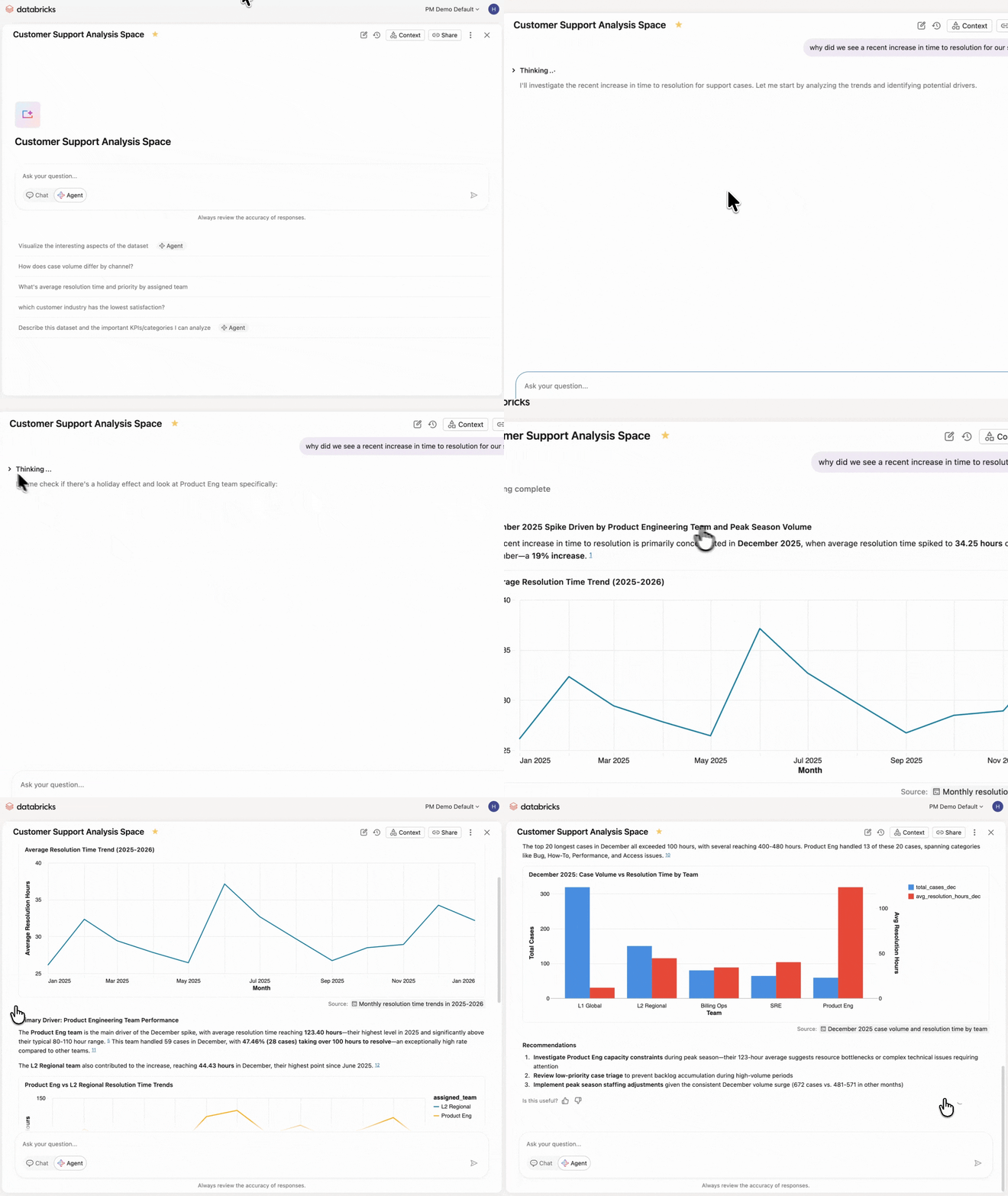
  • Why did our churn rate spike in Q3?
  • How can we optimize our campaign spend?
  • What revenue impact should I anticipate if these two supply lines are interrupted?

How Agent Mode Works

When you ask a question in Agent mode, Genie doesn’t just return a single query. It investigates the problem like a real data analyst: planning an approach, testing hypotheses, and iterating toward an explanation.

For example, imagine a Genie space for customer support. You notice a spike in reopened cases in December 2025 and ask: “What’s contributing to the spike in reopened support cases?”

Agent mode first confirms the spike, then explores possible contributors such as customers, products, categories, or teams. It uses the business context in your Genie space, including Unity Catalog metadata and author-defined semantics, to focus on the most relevant potential contributing factors.
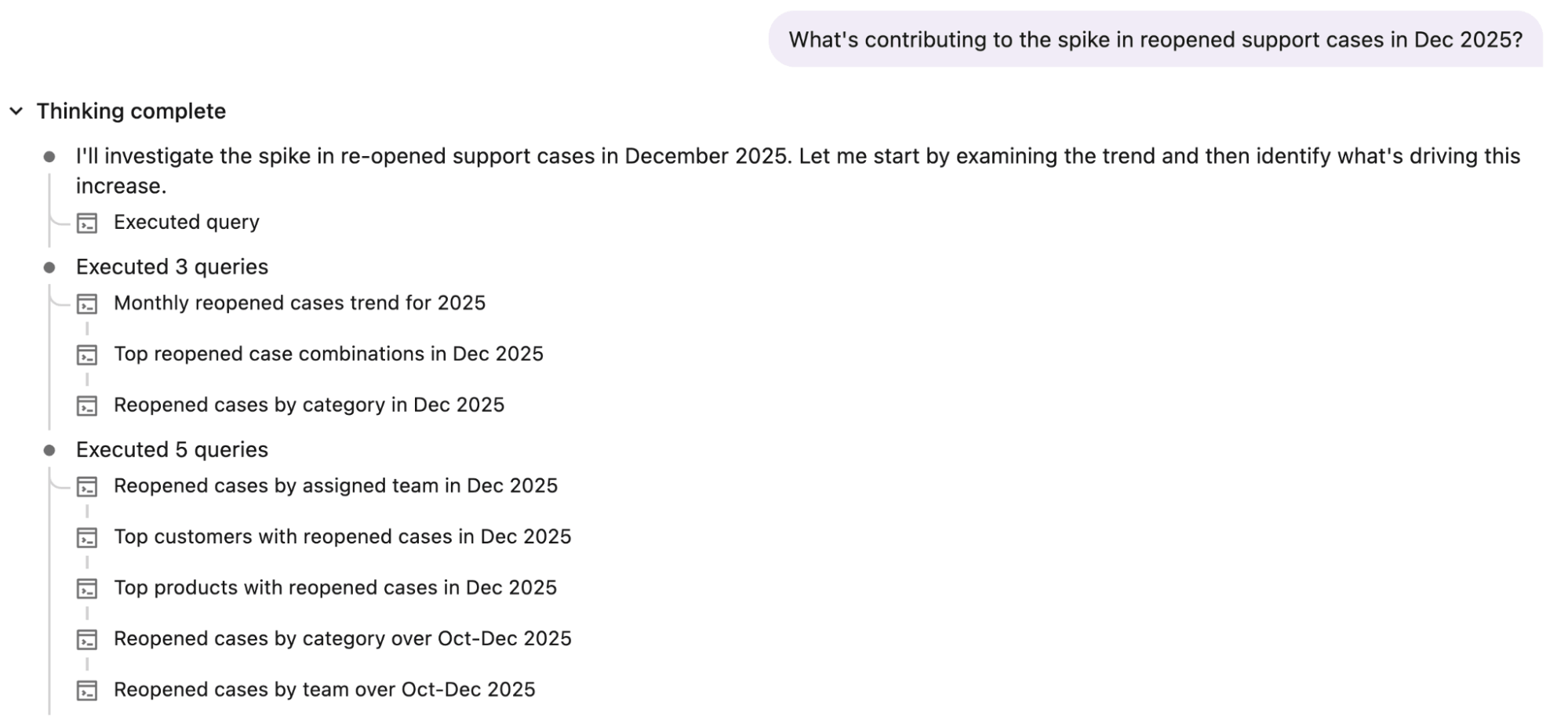
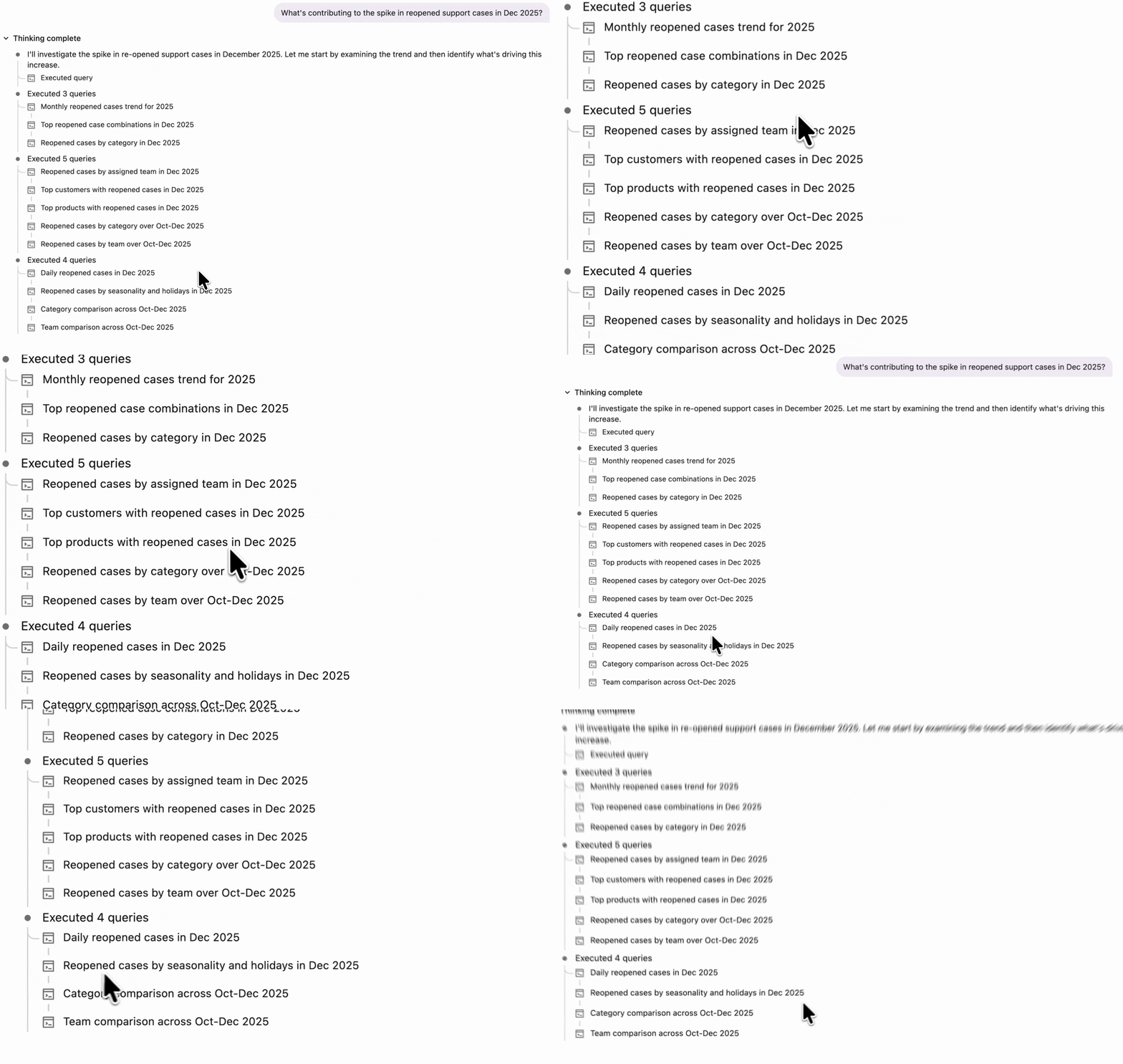
 Genie Agent reasoning trace showing 8 queries executed to analyze the Dec 2025 reopened cases spike.

Agent mode then evaluates these hypotheses by executing multiple queries against the underlying data. The semantics defined in Genie’s knowledge store teach it how to produce accurate queries. We also made Agent mode’s work transparent so users can always verify its accuracy.

During its analysis, Genie continuously reflects on the results of each query and decides what to explore next. In this example, after testing several potential drivers of the spike, the agent decides that it should further investigate if seasonal patterns are contributing to the spike. This iterative cycle of hypothesis generation, querying, and reflection allows Genie to explore data more thoroughly and arrive at a well-supported explanation.
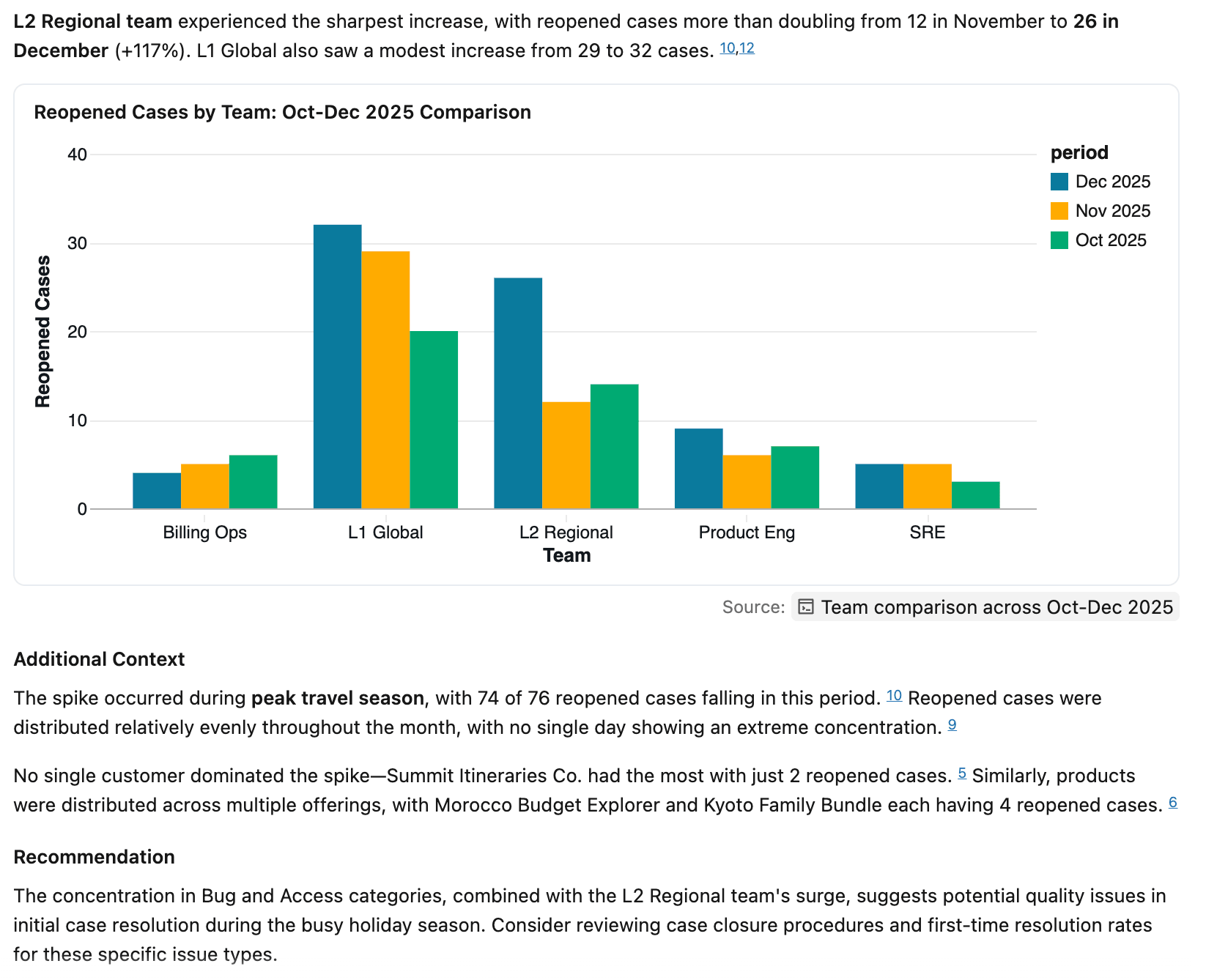
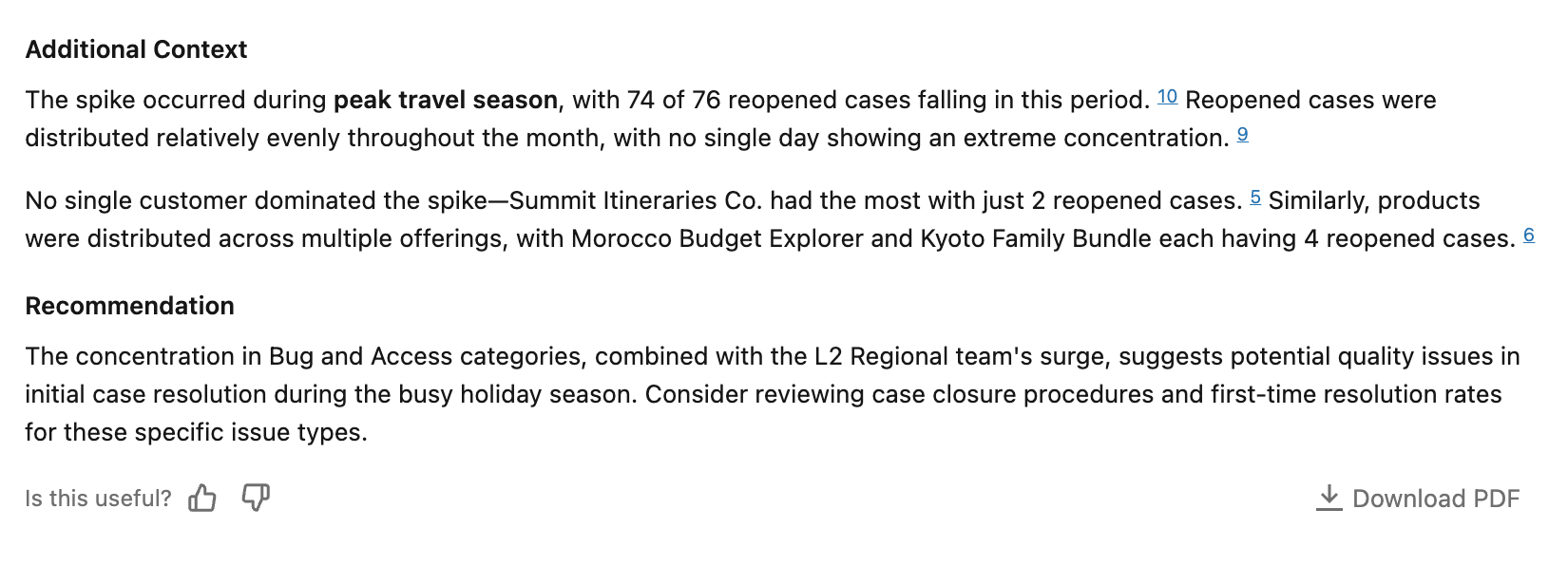
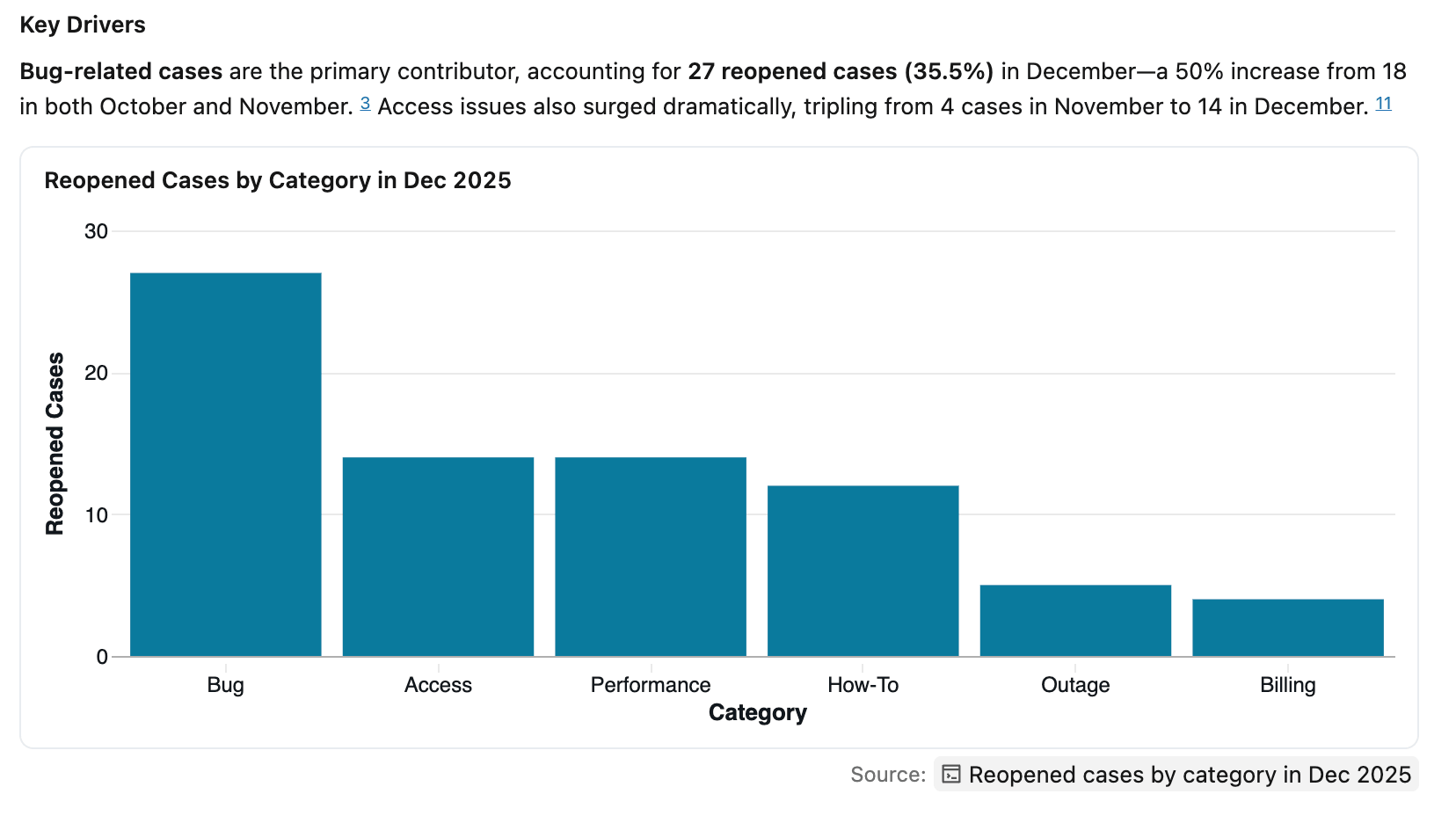
After completing its analysis, Genie generates a report of its findings. Following this example, the report first quantifies the increase in reopened cases and then identifies the primary contributors—namely a rise in bug-related cases and performance from the L2 regional team. To support these conclusions, the report also includes visualizations and references to the underlying SQL for users to review.
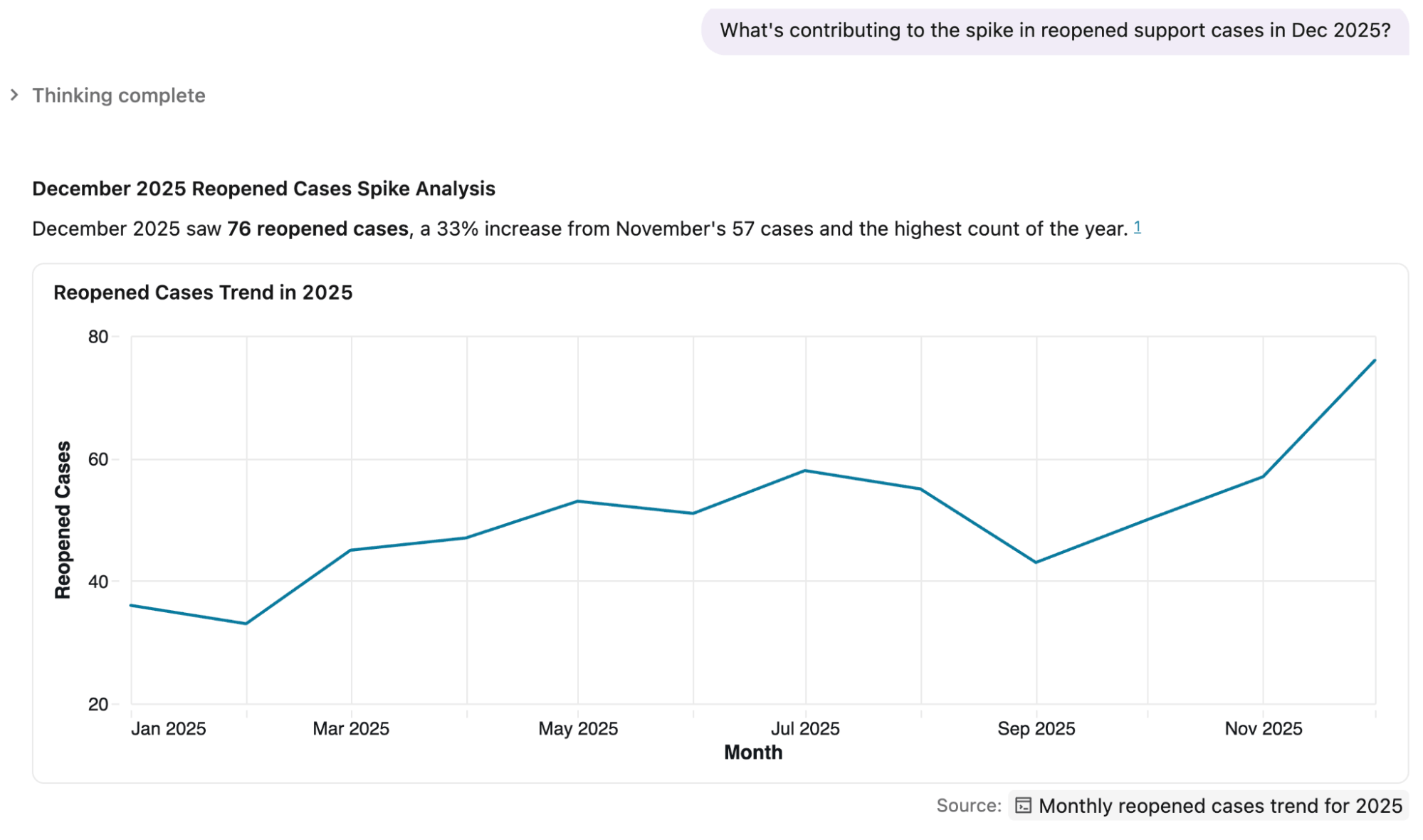
Line chart showing reopened cases trend throughout 2025, peaking at 76 in December.

Bar chart showing reopened support cases by category in Dec 2025, with Bug as the top driver at 27 cases.
Grouped bar chart comparing reopened cases by team across Oct–Dec 2025, with L1 Global and L2 Regional leading.

Genie Agent analysis conclusion with additional context and a recommendation to review case closure procedures.

Depending on the type of question, Genie also provides actionable recommendations on what teams should focus on to improve performance. Users can then share these reports directly in the platform or download them as PDFs to easily distribute insights and collaborate.

Built for Questions of Any Complexity
Agent mode not only unlocks advanced business investigations—it improves accuracy across all question types, from simple analytics to multi-step analysis.

Even for straightforward questions, it takes small validation steps to ensure it understands the data before responding. We’ve also tuned the agent to dynamically scale its reasoning to the complexity of the task—moving quickly for simple prompts, and spending more time planning and evaluating for deeper investigations.

The result is faster answers for everyday questions and more rigorous analysis when tackling complex problems.

Users interacting with Genie inside AI/BI Dashboards can also take advantage of this new experience. When you ask questions to Genie from a Dashboard, it leverages Agent mode by default.

Get Started Today

Workspace admins can now confirm Agent mode is enabled in the Workspace Previews page. Once enabled, simply turn on the Agent toggle in your Genie spaces and ask your business questions.
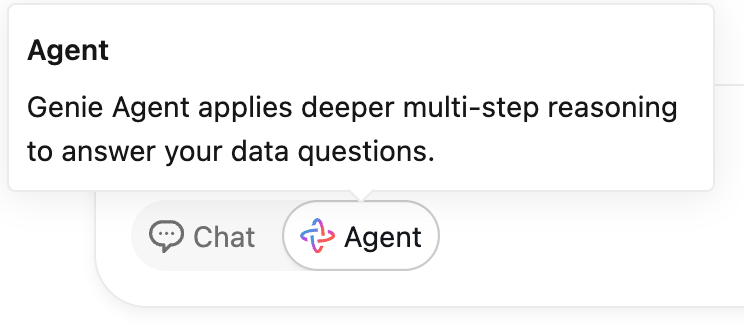
 Databricks Genie interface showing a tooltip explaining the Agent mode for multi-step data reasoning.

Agent mode is now available, with much more to come including API support and unstructured document analysis. Give Agent mode a try today — we can’t wait to hear what you think.