


When we introduced the lakehouse architecture, our vision was to create a single, unified platform for all your data needs by eliminating the divide between data lakes and data warehouses. We proved this was possible with Databricks Lakehouse, bringing diverse workloads in analytics, BI, AI, and ETL together on a single platform using open data, removing duplication and centralizing governance.
Now, we are unifying real-time serving with our core data platform. Today, this is most commonly accomplished by using a separate serving layer or specialized engine. This results in siloed data copies that add complexity, cost, and risk to your data architecture.
Databricks is pleased to announce that we are bringing millisecond performance directly to the lakehouse. We’re introducing Lakehouse//RT, Databricks’ new real-time data warehouse designed for operational analytics, BI and app serving, and observability workloads. Lakehouse//RT is powered by Reyden, a breakthrough new engine for real-time workloads that require immediate responsiveness at high concurrency.

As organizations expand data access across users, applications, dashboards, and agents, demand for real-time responsiveness under high concurrency continues to grow. The traditional answer was to introduce a dedicated serving layer. While fast for reads, this approach requires you to copy data to a new layer, isolating it from the rest of your platform while introducing more complexity across your environment.
Copying your data into a separate serving layer isn't free. It costs you three times, before you've served a single query.
The kicker: And after you've paid all three, the serving layer still can't run all your queries. The moment a query gets complex (e.g. joins, window functions) or the data gets big, it collapses.
Lakehouse//RT is a new real-time warehouse that delivers millisecond performance at massive scale, without data movement. You can support real-time workloads while continuing to use the same open formats, governance model, and central data architecture already powering your analytics and AI.
Preview participants have seen up to 16x better performance vs. real-time serving layers, with response times as low as 10ms on smaller datasets and sub-100ms performance on larger ones. On standard analytical benchmarks, Lakehouse//RT delivers sub-100 millisecond latency at 12,000 queries per second.
But one number on one benchmark is easy to cherry-pick. The real test is whether that speed holds everywhere: on more data, with harder queries, and under a heavier load.
This new approach means that Lakehouse//RT can maintain low latency, even at thousands of queries per second, on both big and small datasets, where other data warehouses or specialized real-time engines can spike in speed or even fail entirely.
Here is what that looks like across three dimensions:
1. Under load: It is easy to deliver low latency with a single query. The challenge comes when a dashboard or application is firing thousands of queries at the same time to the system. You don’t want your end users to open your analytical application and wait seconds or even minutes for it to load. We tested Lakehouse//RT against the leading alternatives on query latency as we push throughput from a handful of queries per second into the thousands. The alternatives all behave the same way. Latency holds for a while, then climbs, and then the engine stops responding altogether. Lakehouse//RT stays flat across the entire range, scaling to thousands of queries per second without sacrificing on query latency.
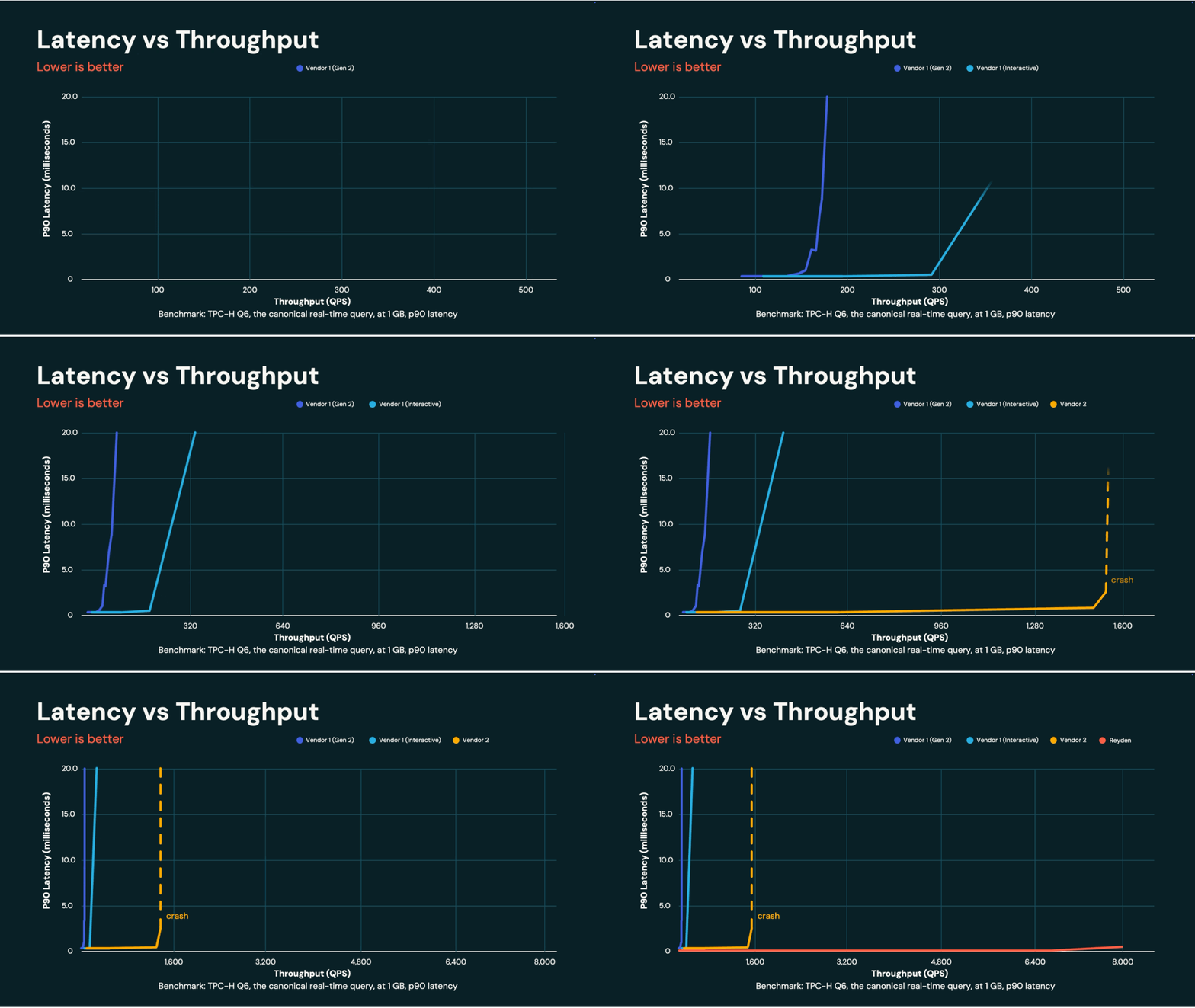
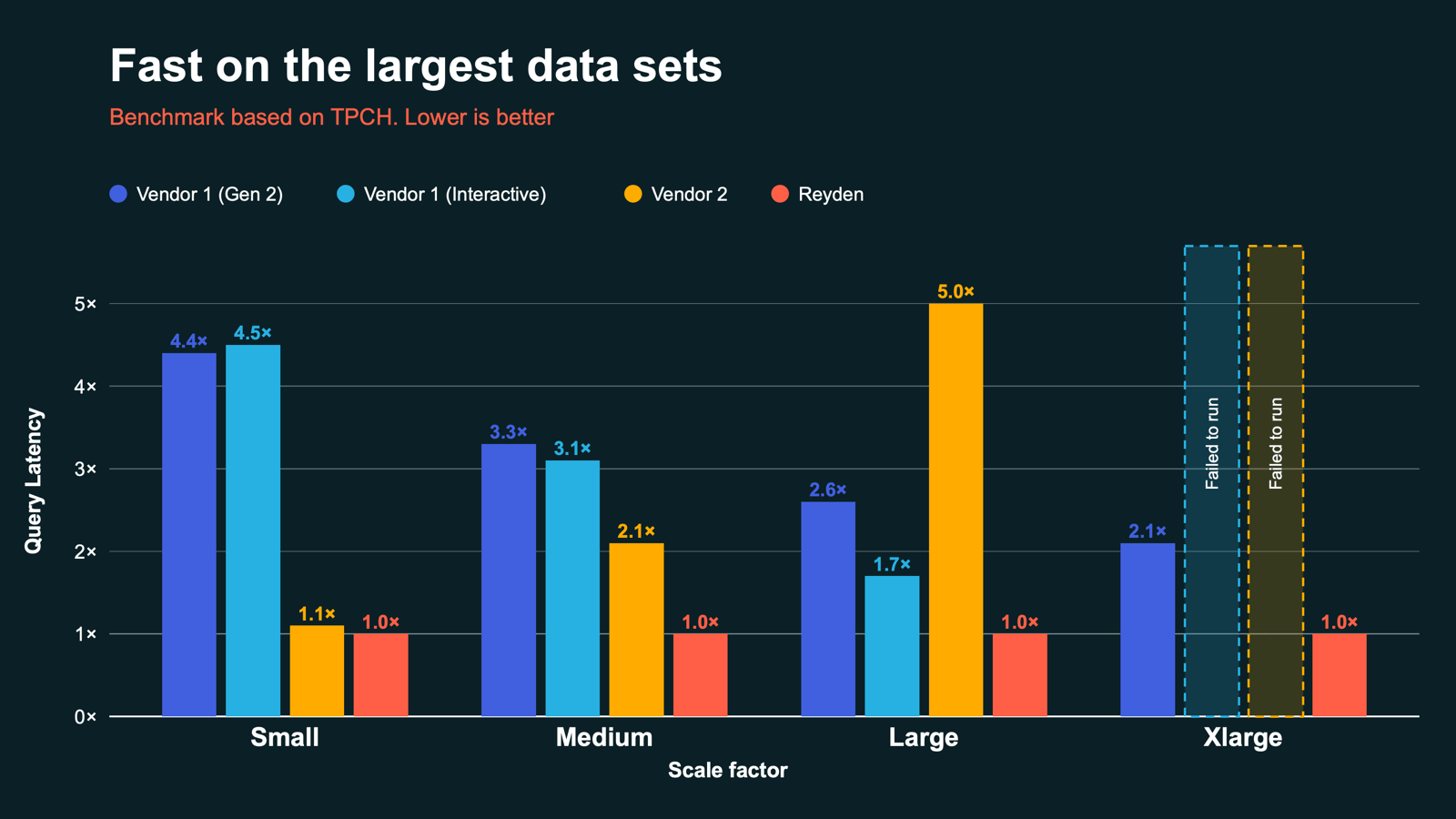
2. At scale: This test is based on TPCH, a standard decision-support benchmark. We ran a suite of queries over a sales schema that combines large table scans, multi-table joins, and aggregations, which is the shape of everyday business reporting. We run it from small datasets up to a terabyte, the path every dataset takes as usage and history accumulate. Lakehouse//RT keeps latency low as the data grows, and the chart shows how performance holds across scale factors. Unfortunately, at large scale factors, 2 of the 3 alternatives we were testing failed to run. Further highlighting the inability of these real-time side stacks to handle any meaningful data sizes.
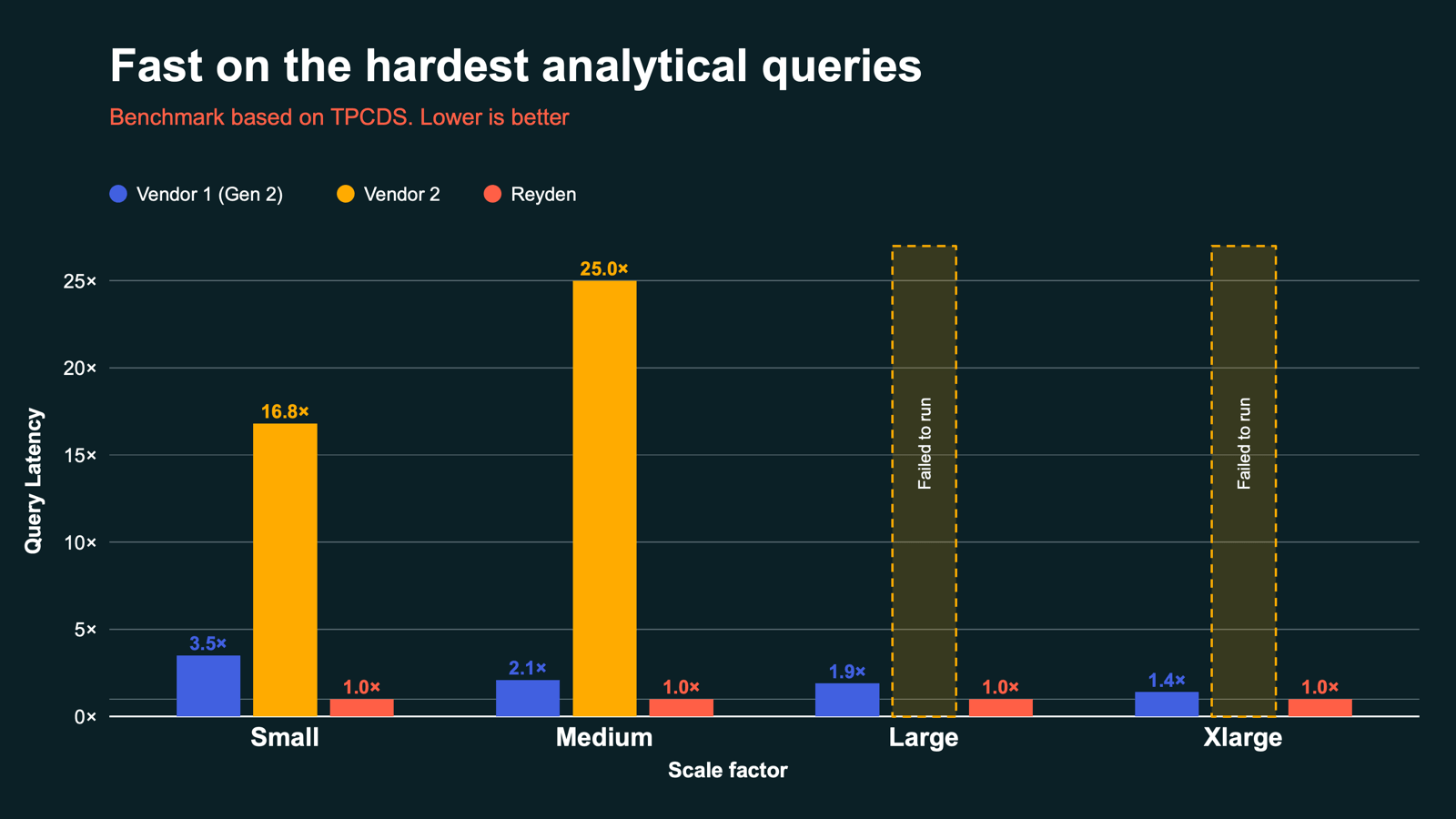
3. On the hardest queries: This test is based on TPCDS, a more demanding decision-support benchmark for data warehouses. We ran a suite of complex queries built from deep multi-table joins, subqueries, and window functions over a realistic warehouse schema, the kind of analytics an analyst writes when the question goes well beyond a simple lookup. Lakehouse//RT keeps latency low even as the queries get harder, and the chart shows the gap only widening, with one alternative running as much as 25 times slower. And once again, at the largest scale, that same alternative failed to finish at all. Further proof that real-time side stacks built for simple lookups cannot handle the complex analytics businesses run every day.
The result is consistent across all three. Fast under load, fast at scale, and fast on the hardest queries, in a single engine, on a single copy of your data. Our preview customers saw similar performance gains with Lakehouse//RT in real-world scenarios from dashboards to real-time analytical applications.
By unifying real-time performance with your central data platform, Lakehouse//RT eliminates architectural trade-offs to deliver three core benefits: real-time answers, streamlined architecture, and consistent governance.
When it’s critical that you get the fastest, freshest insights, Lakehouse//RT delivers. Customers in demanding industries where every millisecond matters, no matter the number of concurrent queries, dramatically lower their time-to-insight with the real-time lakehouse.
Here’s what some of our early preview customers found in performance gains:
"Meta Enterprise runs analytics for our own teams across supply chain, finance, and beyond - where analysts expect answers instantly, even under heavy concurrency on our largest tables. With Lakehouse//RT, our typical query results come back in 10s of milliseconds with data on the lake without a separate system alongside it."
— Srikanth Sakhamuri, Data Engineering Leader at Meta

"SES, a space solutions company, helps governments protect, businesses grow, and people stay connected-no matter where they are. With integrated multi-orbit satellites and our global terrestrial network, we deliver resilient, seamless connectivity. Our operations dashboards run on billions of rows of live telemetry and demand answers in milliseconds at high concurrency.
Lakehouse//RT delivers exactly that directly on our Databricks data - 20 times faster than our previous query times and at a fraction of the cost, as we no longer need to operate a separate serving layer to meet our latency requirements."
— Dennis Rossberg, Senior Data Cloud Architect at SES

"Enverus is the energy industry's AI and data platform, built on 25+ years of proprietary intelligence with 2.7 petabytes of continuously updated data, 350 million+ courthouse records, and $500 billion+ in annual transactions covering the full energy value chain. This means our analytics have to stay interactive, even as analyst and embedded-app traffic scales.
With Lakehouse//RT, queries return in 10s of milliseconds for some queries, and up to 100x faster on others than our specialized real-time engine. That performance means we can collapse our separate analytics stack into a single unified Lakehouse."
— Paul Lamb, Director, Enterprise Analytics at Enverus

Instead of copying and moving data and building extra pipelines, teams can rely on a single, agile platform to get the compute power they need without proprietary tools. This means less complexity and system sprawl.
"Our platform serves hundreds of queries per second for real-time performance data across our entire client base, so consistency and latency directly impact customer experience.
With Lakehouse//RT, we're seeing consistent sub-200 millisecond performance on our core dashboard queries. Being able to achieve that directly on governed lakehouse data dramatically simplifies our pipeline and serving architecture."
— Kayvon Raphael, Senior Director of Engineering at Magnite

"Threat lookup requires consistently low latency, even as usage scales across users and agents. What we're seeing with Lakehouse//RT is millisecond performance on live data with 5x improvement in response time, which creates a path to run those workloads on our lakehouse instead of maintaining a separate serving system."
— Chris Kopek, Head of Data Platforms, Cisco

"At Halcyon, our teams monitor security data across millions of endpoints, correlating disparate signals in order to identify critical threats within seconds. As our customers' security needs grew, so did the load on our systems.
Lakehouse//RT delivered the performance and concurrency we needed. Our critical queries now run about 4x faster, directly on our Lakehouse, without a separate caching system."
— Seagen Levites, Senior Director Quantitative Analysis at Halcyon AI

At the same time, governance remains centralized. Security policies, permissions, access controls, and business logic stay consistently defined and enforced with Unity Catalog. Your teams don’t have to duplicate rules or chase broken governance. You set it up once, and it works everywhere.
"Lakehouse//RT ran more than a third faster on average than our prior warehouse on our healthcare dataset, with 10× faster queries [on some workloads]. That translates directly to quicker information access and more decision time for our customers. We had considered a dedicated real-time system to augment our Lakehouse architecture, but Lakehouse//RT removed that need, giving us that speed natively with consistent governance."
— Mehrshad Setayesh, SVP Engineering (Data, Platform, AI) at PointClickCare

"Bally’s is one of the industry’s largest global gaming and lottery technology groups with millions of transactions a day across ~60TB in Delta Lake under Unity Catalog. Our operations teams need answers in seconds, and to deliver that, we’d been running separate low-latency serving systems alongside the lakehouse. Lakehouse//RT eliminates that trade-off: 7x faster, sub-second performance on the same data, straight from our governed Delta tables. No copies, no extra clusters, no second system to secure.
That simplicity is especially important in a highly regulated industry, where maintaining the highest standards of data governance, security, and privacy is fundamental to how we operate."
— Mark Borg, Senior Vice President of Data at Bally’s

"Equilibrium Energy is reimagining how energy trading is done - AI agents working alongside human traders, on live data pulled from dozens of disparate sources, at the speeds the market actually requires. It's a workload most real-time architectures can't keep up with. Lakehouse//RT delivered up to 3.6x faster median latency than SQL Serverless on our portal queries, fast enough that traders can think with the data instead of waiting on it – running scenarios, exploring alongside AI agents, and making decisions in seconds.
Keeping it all on a single platform – instead of stitching a separate real-time layer onto our stack – lets us move at this speed without sacrificing governance."
— Tarek Rached, Director, Data Platform at Equilibrium Energy

In addition to our Preview customers, some of Databricks' largest global partners are already sharing our vision for Lakehouse//RT. They recognize the incredible potential this brings to the market and are eager to collaborate with us as we pave the way for real-time data warehousing.
"Deloitte's alliance with Databricks continues to build incredible momentum as we help organizations transform their data into strategic, AI-ready assets. The launch of Lakehouse//RT marks a significant leap forward, providing the real-time capabilities needed to fuel advanced analytics and accelerate time-to-value. We are excited to deepen our collaboration with Databricks and bring this latest innovation to our clients to drive measurable, impactful business outcomes."
— Thomas Zipprich, Principal and Global Databricks Alliance Leader, Deloitte Consulting LLP

"As we see accelerating momentum in our partnership with Databricks with our new Business Group Launch, the enterprise demand for real-time data and AI has never been clearer. The launch of Lakehouse//RT delivers the speed and open architecture our clients need to drive intelligent business reinvention. We look forward to continuing our journey with Databricks to unlock new possibilities."
— Jigyasa Singh, Global Databricks Business Group Lead, Accenture

"Sigma now connects directly to Lakehouse//RT, Agent Bricks, Genie Agents and Lakebase, so joint customers can get sub-second query performance at scale, explore billions of rows through a familiar spreadsheet interface, build agents that act on that data and manage the full agent workflow - memory, state and all - without ever leaving the governed environment they already trust.
The hardest part of enterprise AI isn’t building the model. It’s making agents work on real business data, under real permissions, at scale. That’s exactly what Sigma and Databricks solve together."
— Mike Palmer, CEO of Sigma

In addition to performance, simplicity, and governance benefits, Lakehouse//RT also takes the decision burden off your teams:
AUTO sizing. You no longer pick a t-shirt size. Databricks automatically determines the right baseline compute for your workload, so there is no guessing, and no cycle of sizing up when queries slow down or sizing back down to save cost.
Incremental autoscaling. Traditional warehouses handle more concurrency by spinning up whole copies of themselves, 2X, then 3X, then 4X. A small increase in demand can double your bill. Lakehouse//RT scales by adding and removing individual nodes as load changes, so you get exactly the capacity you need and pay for exactly that.
Databricks has long provided the scale and openness required for modern analytics and AI. Organizations no longer need to choose between low-latency performance and an open, unified data architecture. You don’t need a more fragmented stack. You need a more capable data warehouse.
Lakehouse//RT is now available in Beta for select read-only workloads, with more capabilities arriving in the coming months. Talk to your Databricks account team to get started and bring your real-time workloads onto the lakehouse. As an introductory offer, Lakehouse//RT usage is 30% off through January 2027. Once you're in, just pick Lakehouse//RT from the warehouse selector and you're off to the races.
此内容由惯性聚合(RSS阅读器)自动聚合整理,仅供阅读参考。 原文来自 — 版权归原作者所有。