


惯性聚合 高效追踪和阅读你感兴趣的博客、新闻、科技资讯
阅读原文 在惯性聚合中打开

推荐订阅源

Microsoft Azure Blog
C
Cisco Blogs
WordPress大学
WordPress大学
H
Hackread – Cybersecurity News, Data Breaches, AI and More
The Cloudflare Blog
小众软件
小众软件
Recent Commits to openclaw:main
I
Intezer
Cyberwarzone
Cyberwarzone
T
The Blog of Author Tim Ferriss
博客园 - Franky
F
Fortinet All Blogs
C
Cyber Attacks, Cyber Crime and Cyber Security
G
Google Developers Blog
Recent Announcements
I
InfoQ
T
Threat Research - Cisco Blogs
V
V2EX
T
Tenable Blog
H
Help Net Security
Cisco Talos Blog
Cisco Talos Blog
T
Tailwind CSS Blog
cs.CL updates on arXiv.org
The GitHub Blog
The GitHub Blog
P
Privacy & Cybersecurity Law Blog
A
Arctic Wolf
OSCHINA 社区最新新闻
OSCHINA 社区最新新闻
D
DataBreaches.Net
罗磊的独立博客
钛媒体:引领未来商业与生活新知
钛媒体:引领未来商业与生活新知
D
Docker
T
Tor Project blog
Attack and Defense Labs
P
Proofpoint News Feed
H
Heimdal Security Blog
Engineering at Meta
Engineering at Meta
雷峰网
雷峰网
Martin Fowler
Martin Fowler
AWS News Blog
AWS News Blog
IT之家
IT之家
Google DeepMind News
NISL@THU
NISL@THU
Google Online Security Blog
Vercel News
Vercel News
K
KPMG report finds enterprise disconnect between AI and its ROI | CIO
SecWiki News
SecWiki News
GbyAI
GbyAI
P
Proofpoint News Feed
月光博客
月光博客
Schneier on Security

Databricks

How lakebase architecture delivers 5x faster Postgres writes Why Talent Transformation Is the Missing Focus of Enterprise AI Public Health Intelligence Shouldn't Require a Data Scientist Mean Time to Detect Is a Data Access Problem First-party audience data is the ad sales relationship now Rethinking Distributed Systems for Serverless Performance and Reliability The AI Scaling Gap Hiding in Digital Native Companies 10 trillion samples a day: Scaling beyond traditional monitoring infra at Databricks AI success starts with clean data, not just better models How nOps Rebuilt Their Cloud Optimization Platform on Databricks Lakebase, and Why Other ISVs Should Too Peril Predicts: Precision Payouts for a Volatile World The foundation of AI scalability: one team, one platform, one operating model The Federal Data Paradox: Rich in Data, Poor in Access Driving Budapest Forward: How BKK Uses Databricks to Transform City Mobility LLM Vs AI: A Practical Guide to Differences, Use Cases, and Tools Model Risk Governance Is Not the Same as Risk Intelligence Generative AI for Business: A Complete Strategy and Implementation Guide Data Science vs Data Engineering: Choosing Analysis or Infrastructure AI Applications: Tools, Use Cases, and Platforms MLOps vs DevOps: A Practical Guide for Data Scientists and IT Teams Top Data Warehouse Tools For Modern Data Analytics Unlocking SAP Business Context in Databricks with Semantic Metadata Delta Sharing The marketing activation gap has a fix: Databricks and Stitch partner to turn data infrastructure into marketing performance Alert Fatigue Is a Business Risk Backstage with Lakebase Shipping Faster isn’t Learning Faster Why Your OEE Dashboard Is Lying to You The Turbine That Tried to Tell You It Was Failing Predicting Readmissions Isn't Enough. Acting in Time Is. Clinical Trials Run Longer Than They Have To. That's a Patient Problem Network Quality Is a Revenue Problem, Not a Technical One Shelf Availability Starts with Better Demand Visibility When Predicting the Next Hit Requires More Than Intuition Approximate Answers, Exact Decisions: New Sketch Functions for Analytics Companies Winning with AI Built the Data Layer First Rethinking SQL ETL for modern data platforms Stripe data now available on Databricks via Databricks Marketplace Databricks and Stripe Projects: Infrastructure Built for Agents Agents are ready but your architecture probably isn't Interoperability Between Unity Catalog and Google BigQuery via Catalog Federation Built In, Not Bolted On: What AI-Native Actually Means in Cybersecurity Operationalizing AI for public sector fraud prevention From months to minutes: Building real-time clinical data pipelines with natural language Agentic Data Engineering with Genie Code and Lakeflow Securely send first-party conversion signals with Snapchat Conversions API on Databricks Marketplace How leading tech companies are killing the builder’s tax with Lakebase Inside one of the first production deployments of Lakebase: LangGuard's agentic workflow governance engine The next generation of Databricks Genie Model Risk Management in 2026: A Banker’s Guide to the Revised Interagency Guidance OpenAI GPT-5.5 now available on Databricks, fully-governed through Unity AI Gateway Operational databases: How they work and when to use them Databricks partners with OpenAI on GPT-5.5 Announcing the Public Preview of Lakeflow Designer Are LLM agents good at join order optimization? How conversational analytics removes the BI bottleneck How to transform document activation workflows with Genie and Agent Bricks Beyond the spreadsheet: how Databricks is delivering the modern CFO in Financial Services AI App Development: Guide To Building AI-Powered Apps IoT in Manufacturing: Strategy, Components, Use Cases, and Challenges Stop Hand-Coding Change Data Capture Pipelines Multimodal Data Integration: Production Architectures for Healthcare AI Personalization Strategies for Media Companies A Modern AI Risk Management Framework Introducing the Databricks Excel Add-in for Business Users Real-Time Decisioning for AI Agents: Why you Need a Customer Context Layer First A Practical Guide to LLM Fine Tuning AI Data Transformation Guide for Data Engineers and Data Scientists Concurrency Control in DBMS: How Locking, MVCC and Optimistic Strategies Keep Data Consistent Bridging data science and marketing: Databricks unveils Delta Sharing integration for Adobe Experience Platform and agentic marketing workflows Take Control: Customer-Managed Keys for Lakebase Postgres Get hands on with agents, vibe coding and more at Data+ AI Summit Mercedes-Benz Builds a Cross-Cloud Data Mesh with Delta Sharing and Intelligent Replication, Cutting Costs by 66% What Is a Transactional Database? Introducing Genie Agent Mode Governing coding agent sprawl with Unity AI Gateway Governing Coding Agent Sprawl with Unity AI Gateway What is pgvector? Banks Don’t Have an AI Problem – They Have a Data Platform Problem Open Platform, Unified Pipelines: Why dbt on Databricks is Accelerating Why Your Agents Can’t Read Enterprise Documents — and How to Fix It Building with Databricks Document Intelligence and Lakeflow Databricks on Google Cloud: Innovate Faster. Smarter. Together. Introducing the Databricks Connector for Google Sheets: Real-Time, Governed Lakehouse Data in the Sheets Users Love Unity AI Gateway: How to connect agents to external MCPs securely Expanding agent governance with Unity AI Gateway Agentic reasoning in practice: Making sense of structured and unstructured data Agent Bricks: The Governed Enterprise Agent Platform 8 AI and data trends shaping financial services in 2026 Building real-time product search on Databricks Lovable + Databricks: Build Data-Driven Apps at the Speed of Thought Memory scaling for AI agents Powering clinical research innovation: How TriNetX uses Databricks to accelerate drug development Database Branching in Postgres: Git-Style Workflows with Databricks Lakebase How Zalando built a unified data foundation for AI and analytics on Databricks The next era of the open lakehouse: Apache Iceberg™ v3 in Public Preview on Databricks How FSIs eliminate silos between clients, operations, and finance How MakeMyTrip achieved millisecond personalization at scale with Databricks A multi-agent approach to audience intelligence Accelerate business insights with Lakeflow Connect, now with a Free Tier Unlocking Next-Gen Customer Experiences with Data Intelligence for Marketing
AiChemy: Next-generation agent with MCP, skills and custom data for drug discovery
Yen Low, Sean Zhang · 2026-04-03 · via Databricks

Multi-agent systems accelerate cross-disciplinary research

Imagine multi-agent AI systems collaborating like a team of cross-disciplinary experts, autonomously sifting through massive datasets to uncover novel patterns and hypotheses. This is now conveniently achievable with Model Context Protocol (MCP), a new standard for easily integrating diverse data sources and tools. The growing MCP server ecosystem—from knowledge bases to report generators—offers endless capabilities.

What AiChemy does

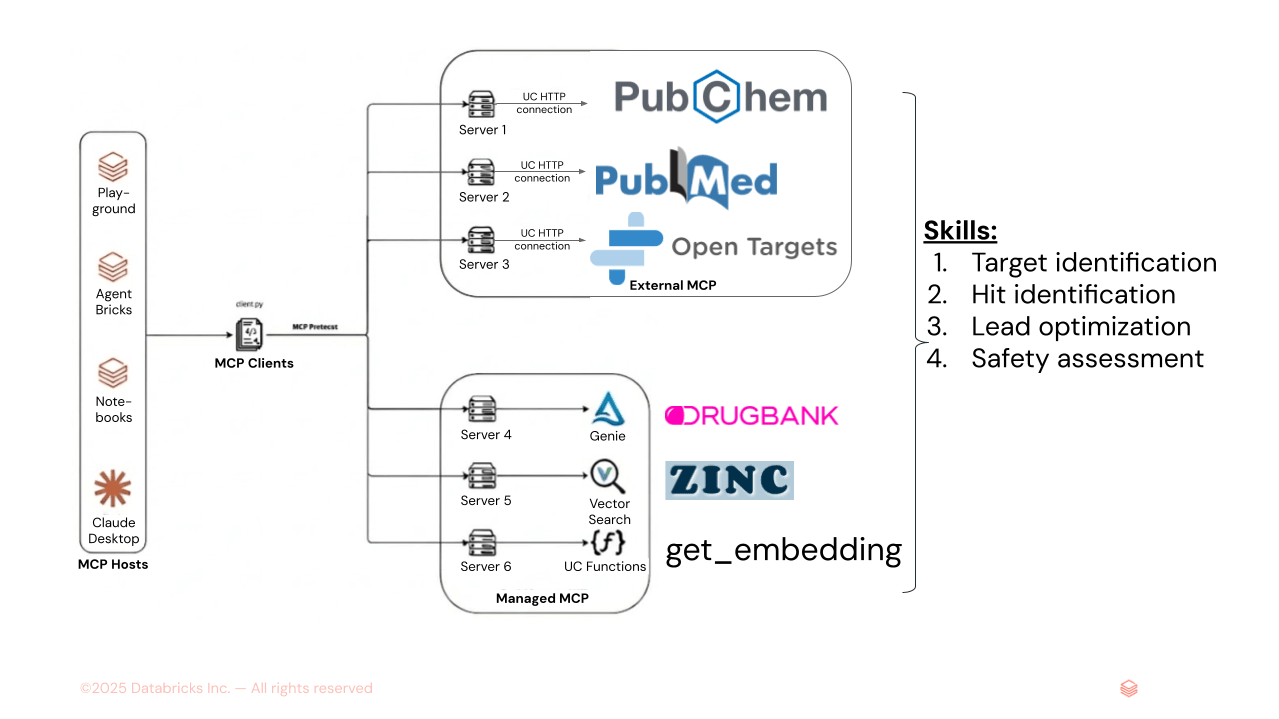
Meet AiChemy, a multi-agent assistant that combines external MCP servers like OpenTargets, PubChem, and PubMed with your own chemical libraries on Databricks such that the combined knowledge bases can be better analyzed and interpreted together. It also has Skills that can be optionally loaded to provide detailed instructions for producing task-specific reports, consistently formatted for research, regulatory, or business needs.
MCP servers PubChem

Figure 1. AiChemy is a multi-agent supervisor comprising external MCP servers PubChem, PubMed, and OpenTargets, and Databricks-managed MCP servers of Genie Space (text-to-SQL for DrugBank structured data) and of AI Search (for unstructured data like ZINC molecular embeddings). Skills can also be loaded to specify task sequence and report formatting and style to ensure consistent output.

Its key capabilities include identifying disease targets and drug candidates, retrieving their detailed chemical, pharmacokinetics properties, and providing safety and toxicity assessments. Crucially, AiChemy backs its findings with supporting evidence traceable to verifiable data sources, making it ideal for research.

Use Case 1: Understand disease mechanisms, find druggable targets and lead generation

The Guided Tasks panel provides necessary prompts and agent Skills to perform the key steps in a drug discovery workflow of disease -> target -> drug -> literature validation.
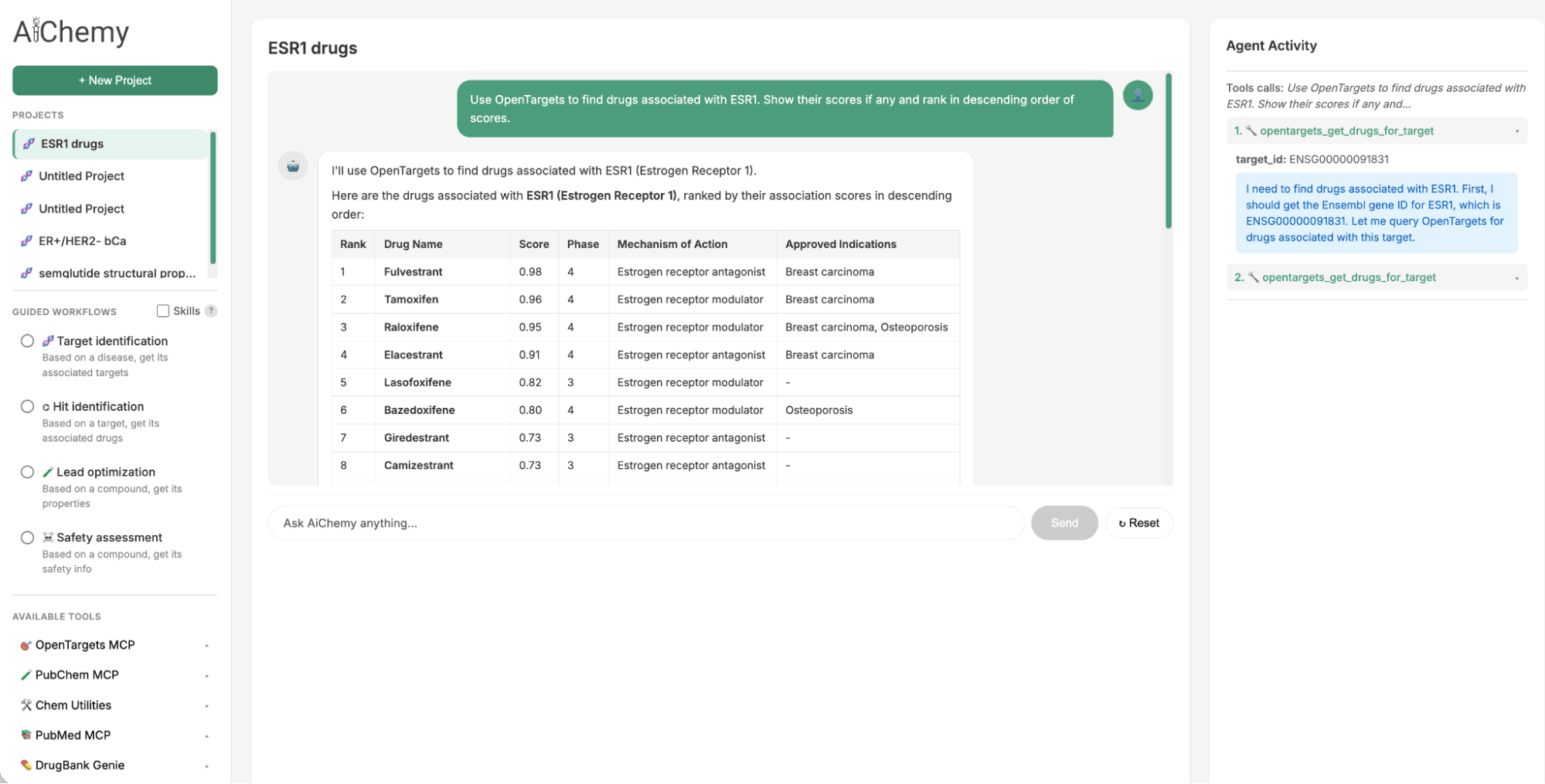
  1. Identify Therapeutic Targets: Starting with a specific disease subtype, such as Estrogen Receptor-positive (ER+)/HER2-negative (HER2-) breast cancer (where ER and HER2 are key protein biomarkers), find associated therapeutic targets (e.g., ESR1).
  2. Find Associated Drugs: Use the identified target (e.g., ESR1) to find potential drug candidates.
  3. Validate with Literature: For a given drug candidate (e.g., camizestrant), check the scientific literature for supporting evidence.

AiChemy

Use Case 2: Lead generation by chemical similarity

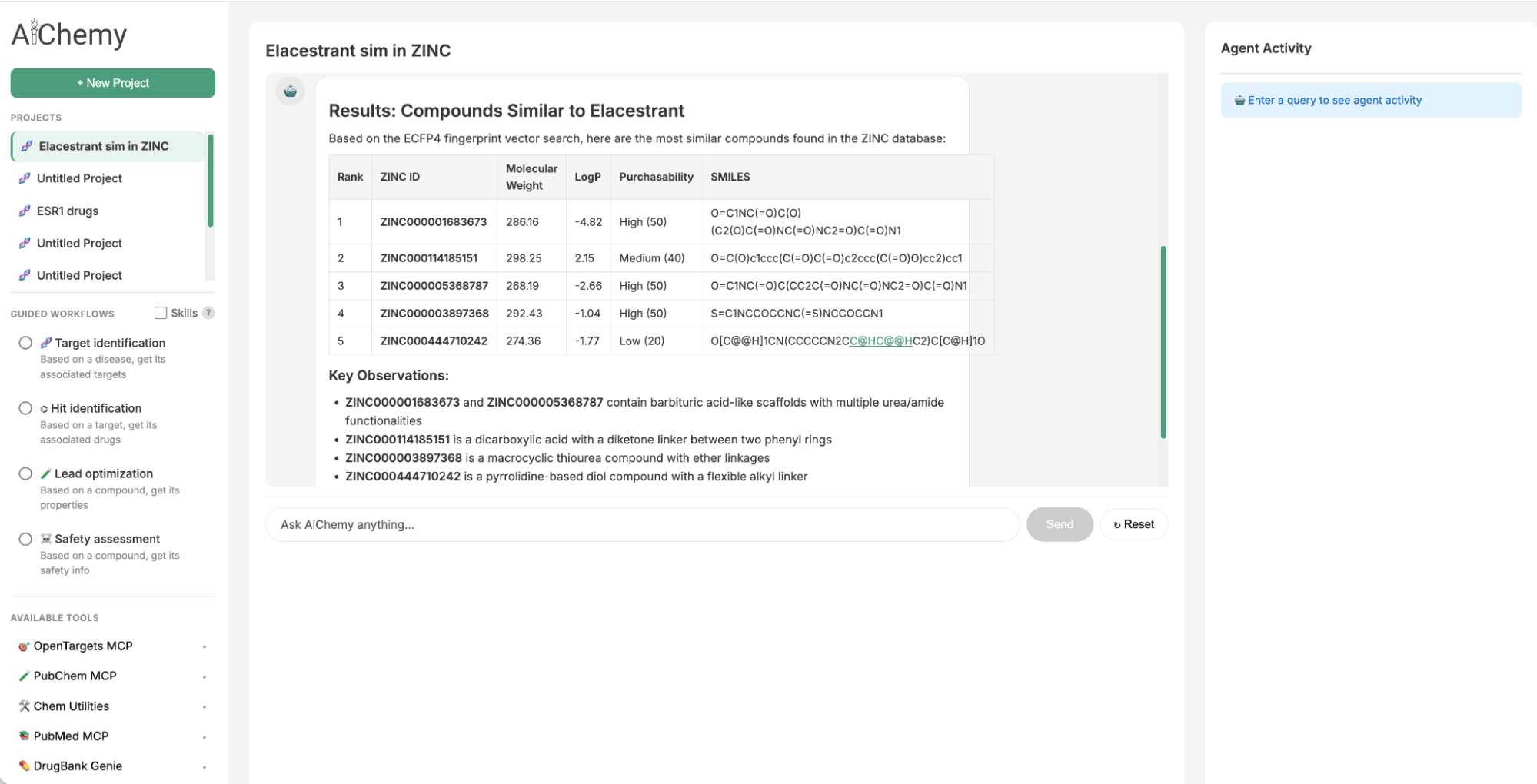
To identify a follow-up to the oral Selective Estrogen Receptor Degrader (SERD) approved in 2023, Elacestrant, we can leverage chemical similarity. We search the large ZINC15 chemical library for drug-like molecules structurally similar to Elacestrant, as Quantitative Structure–Activity Relationship (QSAR) principles suggest they will share similar properties. This is achieved by querying Databricks AI Search, which uses the 1024-bit Extended-Connectivity Fingerprint (ECFP) molecular embedding of Elacestrant (as query vector) to find the most similar embeddings within ZINC's 250,000-molecule index.
ZINC database

Figure 2. AiChemy includes the vector search of the ZINC database of 250,000 commercially available molecules. This enables us to generate lead compounds by chemical similarity. In this screenshot, we asked AiChemy to find in the ZINC vector search compounds most similar to Elacestrant based on the ECFP4 molecular embedding.

Build your own research multi-agent supervisor

We will customize a multi-agent supervisor on Databricks by integrating public MCP servers with proprietary data on Databricks. To achieve this, you have the option of using either no-code Agent Bricks or coding options like Notebooks. The Databricks Playground allows for quick prototyping and iteration of your agents.

Step 1: Prepare the components required for the multi-agent supervisor

The multi-agent system has 5 workers:

  1. OpenTargets: external MCP server of a disease-target-drug knowledge graph
  2. PubMed: external MCP server of biomedical literature
  3. PubChem: external MCP server of chemical compounds
  4. Drug Library (Genie): A chemical library with structured drug properties, made into a Genie space to provide text-to-SQL capabilities.
  5. Chemical Library (AI Search): A proprietary library of unstructured chemical data with molecular fingerprint embeddings, prepared as a vector index to facilitate similarity search by embeddings.

Step 1a: Securely connect to public MCP servers via Unity Catalog (UC) connections in the UI or in a Databricks Notebook (e.g. 4_connect_ext_mcp_opentarget.py).

Step 1b: Ensure your structured table(s) (e.g. DrugBank) is transformed into a Genie space with text-to-SQL functionality using the UI. See 1_load_drugbank and descriptors.py

Step 1c: Ensure your unstructured chemical library is created as a vector index in the UI or in a Notebook to enable similarity search. See 2_create VS zinc15.py

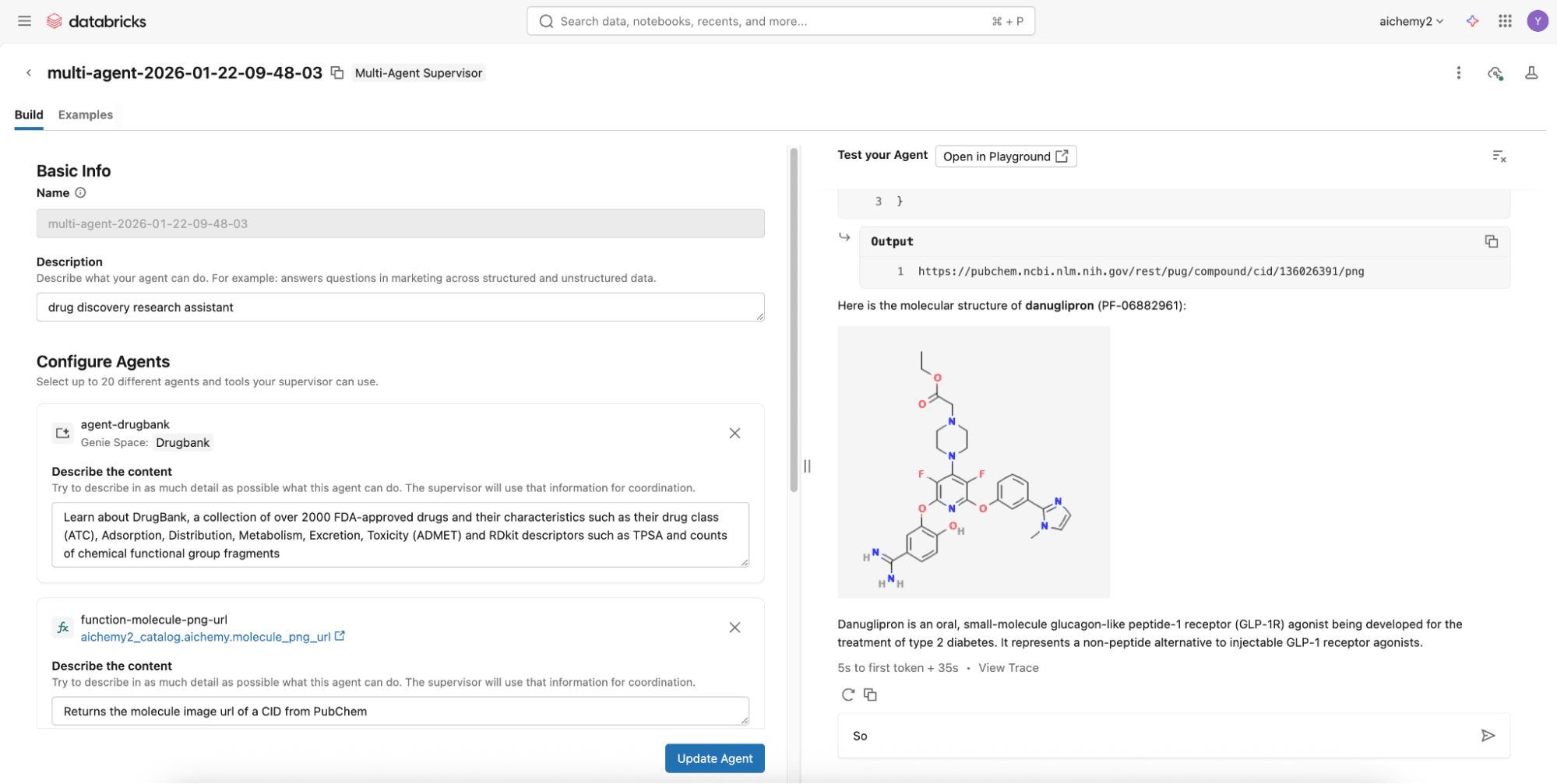
Step 2 (Easy Option): Build the multi-agent supervisor using no-code Supervisor Agent in 2 mins

To assemble them, try the no-code Agent Bricks that builds a supervisor agent with the above components via the UI and deploys it to a REST API endpoint, all in a few minutes.
AgentBricks

Step 2 (Advanced Option): Build the multi-agent supervisor using Databricks Notebooks

For more advanced capabilities like agentic memory and Skills, develop a Langgraph supervisor on Databricks Notebooks to integrate with Lakebase, Databricks Serverless Postgres database. Check out this code repository where you can simply define the multi-agent components (see Step 1) in the config.yml.

Once config.yml is defined, you can deploy the multi-agent supervisor as a MLflow AgentServer (FastAPI wrapper) with a React web user interface (UI). Deploy them both to Databricks Apps via the UI or Databricks CLI. Set the appropriate permissions for users to use the Databricks App and for the app’s service principal to access the underlying resources (e.g. experiment for logging traces, secret scope if any).

Step 3: Evaluate and monitor your agent

Every invocation to the agent is automatically logged and traced to a Databricks MLflow experiment using OpenTelemetry standards. This enables easy evaluation of the responses offline or online to improve the agent over time. Additionally, your deployed multi-agent uses the LLM behind AI Gateway so you can enjoy the benefits of centralized governance, built-in safeguards, and full observability for production readiness.
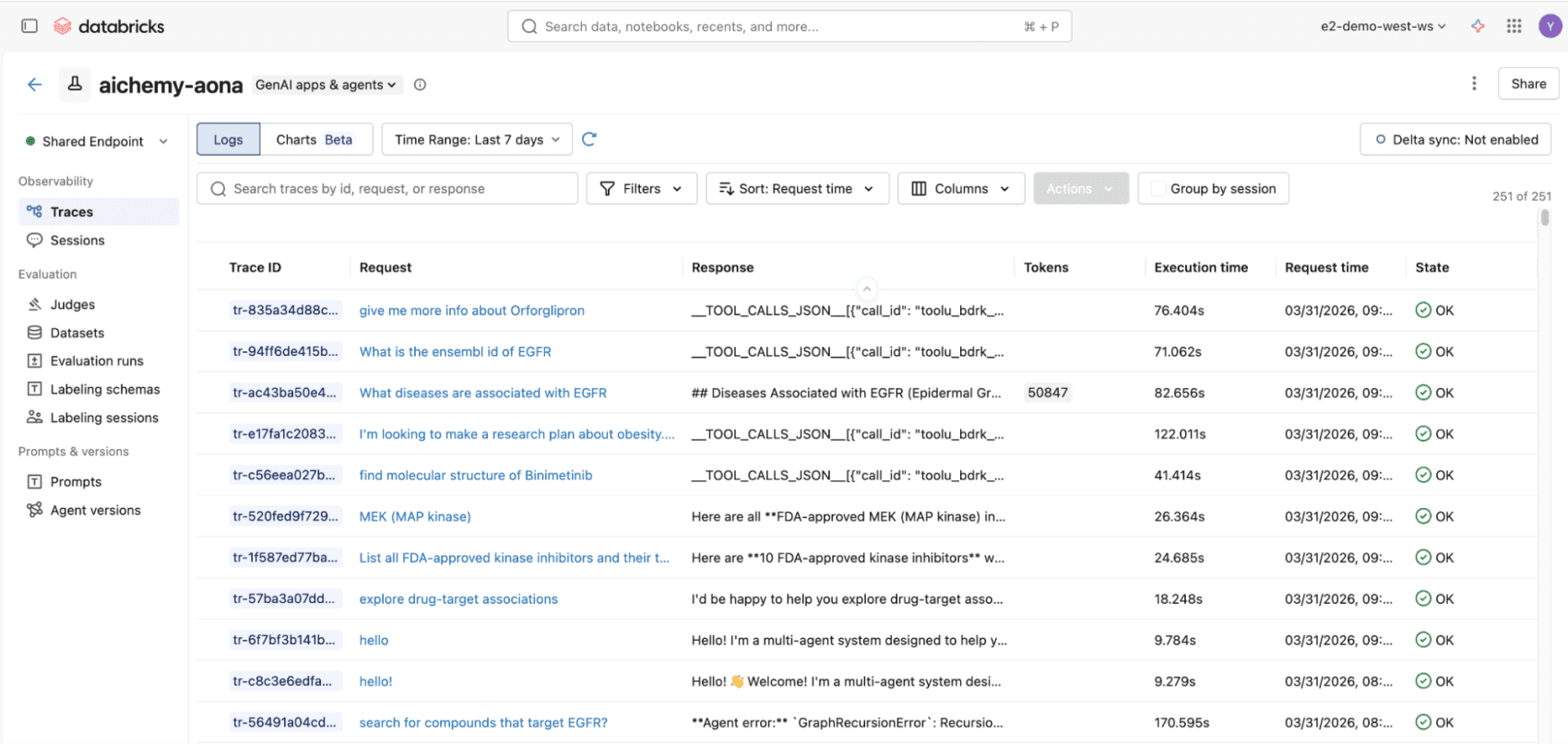
MLflow traces

Figure 3. All invocations to the multiagent whether via React UI or REST API will be logged to MLflow traces, compliant with OpenTelemetry standards, for end-to-end observability.
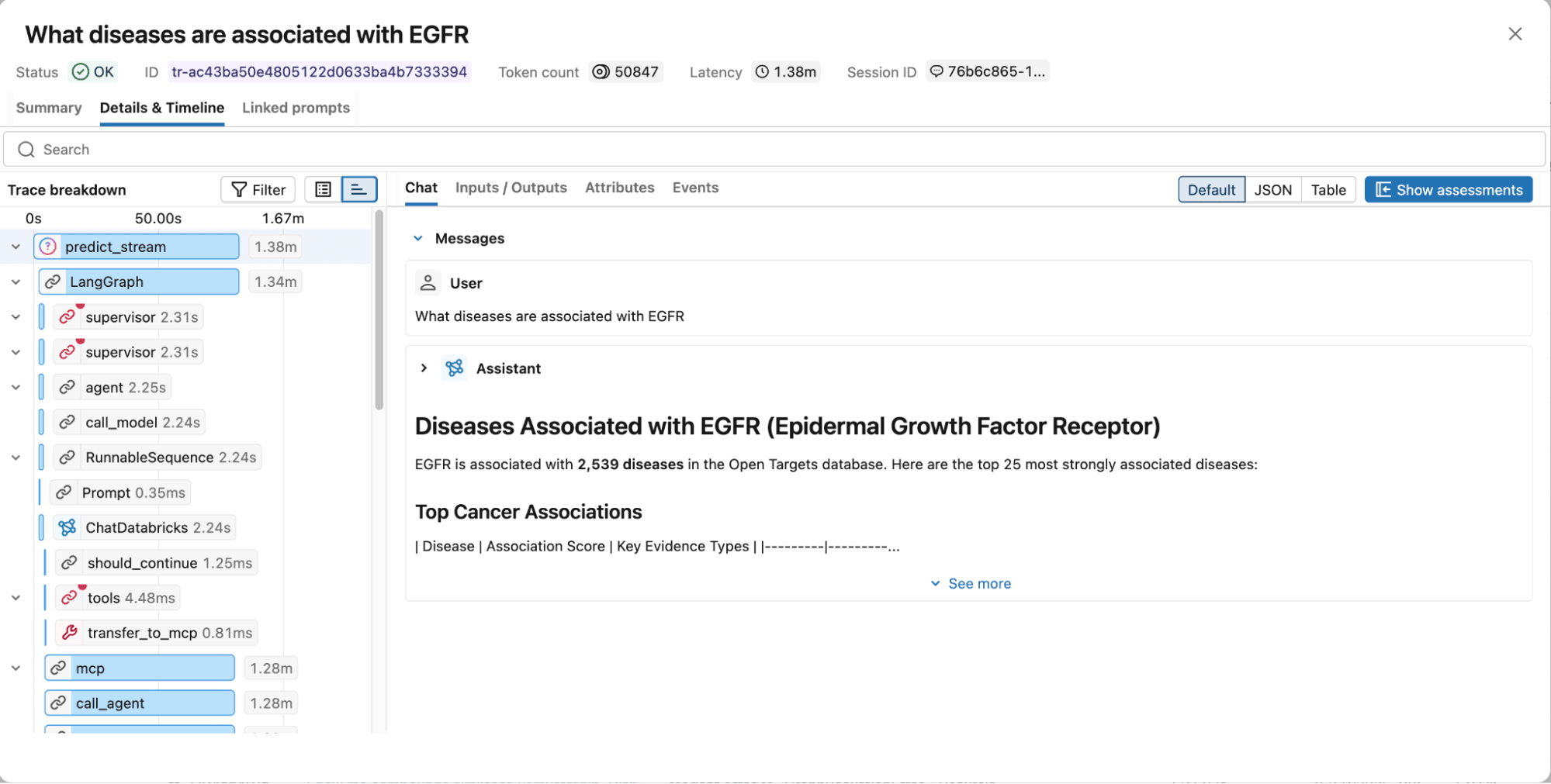
MLflow traces full execution graph

Figure 4. MLflow traces capture the full execution graph, including reasoning steps, tool calls, retrieved documents, latency, and token usage for easy debugging and optimization.

Next Steps

We invite you to explore the AiChemy web app and Github repository. Start building your custom multi-agent system with the intuitive, no-code Agent Bricks framework on Databricks so you can stop sifting and start discovering!
Github repository