


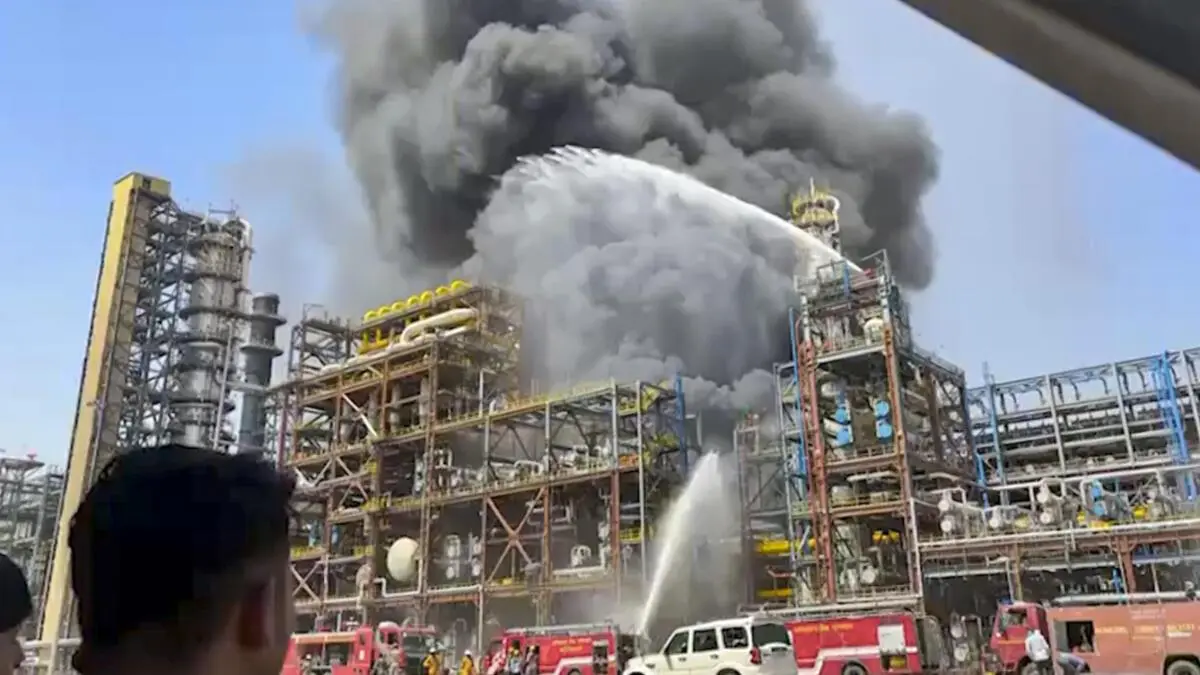
‘Leakage of hydrocarbons through one of the valves and/or flanges in the heat exchanger circuit caused the fire’
The Oil Ministry has set up a four-member team to investigate the fire incident in the crude distillation unit (CDU) section of the HPCL Rajasthan Refinery (HRRL) refinery in Barmer, Rajasthan. However, all the units are structurally safe and unaffected.
The team, which is led by the former Managing Director of the Mangalore Refinery and Petrochemicals (MRPL) M Venkatesh, has reached the refinery and has commenced the investigation.
Sujata Sharma, Joint Secretary in the Ministry of Petroleum & Natural Gas (MoPNG), said on Tuesday that the team has reached Barmer and have started the investigation: “Delays, if any, in the commissioning timelines will only be known after the investigation is concluded.”
Prime Minister Narendra Modi was scheduled to inaugurate the refinery on April 21. However, the inauguration has been postponed and a new date will be decided later.
State-run Hindustan Petroleum Corporation (HPCL) holds 74 per cent stake in HRRL, while Rajasthan government holds 26 per cent in the complex, which has a 9 million tonnes per annum (mtpa) crude refining capacity, including 2.4 mtpa of petrochemicals. The total project cost is around ₹72,900 crore.
HPCL on Tuesday said that the unfortunate fire incident occurred on April 20 in the CDU section of the refinery. Prima facie, it appears that leakage of hydrocarbons through one of the valves and/or flanges in the heat exchanger circuit caused the fire.
“The fire was localised in the heat exchangers stack. The CDU, vacuum distillation unit (VDU) and all other units of the CDU section were quickly isolated. All Units are structurally safe and unaffected. No other section of the refinery has suffered any impact,” it assured.
An investigation has been initiated to ascertain the cause of the incident and to undertake necessary remedial measures. The financial and operational impact, if any, is being assessed, and prima facie, is not expected to be material, the oil marketing company said.
Sumit Ritolia, Kpler’s Lead Research Analyst for Refining & Modeling explained that It is important to recognise that commissioning large, complex refineries is a phased process, and these incidents do happen. Moving from CDU startup to stable production of refined products typically takes a few months, with full ramp-up taking significantly longer.
“From a supply standpoint, the Rajasthan refinery fire incident does not alter India’s near-term product availability. The refinery was not yet contributing to the product pool, and any meaningful output had only been expected from Q3 2026 onwards,” he added.
Published on April 21, 2026
此内容由惯性聚合(RSS阅读器)自动聚合整理,仅供阅读参考。 原文来自 — 版权归原作者所有。