





Business news |
By Brian Tristam Williams
The smartphone memory shortage is now expected to wipe 12.9% off global handset shipments in 2026, taking the market down to 1.12 billion units, according to IDC’s latest market outlook. That would mean roughly 160 million fewer smartphones shipped year-on-year, snapping the recovery seen across 2024 and 2025 and dragging the market to its lowest annual volume in more than a decade.
IDC says the pain will fall hardest on vendors concentrated at the bottom end of Android, where rising DRAM and NAND costs leave little room to absorb price rises. The firm expects average selling prices to rise 14% to a record US$523 in 2026, while the sub-US$100 segment, worth about 171 million devices, becomes effectively uneconomical even after pricing stabilises. In practice, that points to portfolio pruning, more aggressive premiumisation and likely further consolidation as smaller brands struggle to secure supply on workable terms.
This is not just a short, ugly quarter. IDC expects supply pressure to persist through 2026 and into mid-2027, with prices unlikely to return to 2025 levels within its forecast horizon.
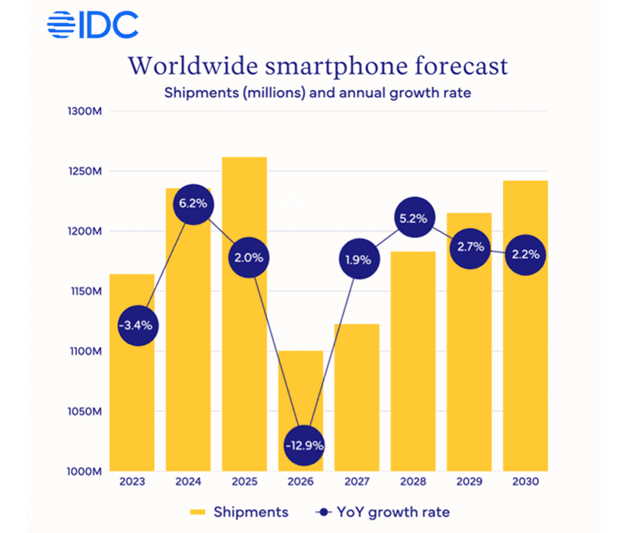
IDC projects global smartphone shipments will fall sharply in 2026 before returning to modest growth in the following years. Source: IDC
The underlying problem is structural: AI infrastructure build-outs are competing with consumer devices for the same DRAM and NAND capacity, while suppliers continue to favour higher-margin server and HBM products. Reuters reported that IDC sees Apple and Samsung as better placed to ride that out than lower-end Android makers.
Regionally, IDC expects the steepest decline in Middle East and Africa, down 20.6% year-on-year, followed by Asia Pacific excluding Japan and China at 13.1%, and China at 10.5%. That regional mix matters because markets with a heavier concentration of low-cost handsets are the most exposed when memory becomes a larger share of the bill of materials. As previously reported by eeNews Europe when SK hynix warned the squeeze could last up to 2030, the pressure is no longer confined to AI servers and premium components. IDC still sees a modest 2% recovery in 2027 and a stronger 5.2% rebound in 2028, but the message is fairly blunt: the market may recover in volume, yet the old ultra-cheap handset model is not coming back in any meaningful way.
 If you enjoyed this article, you will like the following ones: don't miss them by subscribing to :
此内容由惯性聚合(RSS阅读器)自动聚合整理,仅供阅读参考。 原文来自 — 版权归原作者所有。