

惯性聚合 高效追踪和阅读你感兴趣的博客、新闻、科技资讯
阅读原文 在惯性聚合中打开

推荐订阅源

Google DeepMind News
U
Unit 42
Cyber Security Advisories - MS-ISAC
J
Java Code Geeks
D
DataBreaches.Net
B
Blog RSS Feed
D
Docker
L
LangChain Blog
aimingoo的专栏
aimingoo的专栏
F
Fortinet All Blogs
Y
Y Combinator Blog
A
About on SuperTechFans
V
V2EX
罗磊的独立博客
WordPress大学
WordPress大学
宝玉的分享
宝玉的分享
MongoDB | Blog
MongoDB | Blog
博客园 - 【当耐特】
Last Week in AI
Last Week in AI
S
SegmentFault 最新的问题
月光博客
月光博客
Vercel News
Vercel News
H
Hackread – Cybersecurity News, Data Breaches, AI and More
阮一峰的网络日志
阮一峰的网络日志

... eeNews Europe

Molex Teramount deal targets co-packaged optics NVIDIA and ServiceNow extend AI governance from desktops to data centres Faraday Future launches Physical AI robotics institute with BIBS SiTime targets AI data centers with sub-nanosecond timing chip System Check: Should engineers learn analog? Decoupled by Design: How Gateworks and NXP are rethinking edge AI architecture NVIDIA and Corning partner on AI photonics expansion GCT taps satellite partner to speed 5G rollout Sodankylä supersite to support ESA Earth observation SiTime posts 88% revenue growth on AI infrastructure demand Infrared LEDs support in-cabin sensing for vehicle safety Anthropic compute deal taps SpaceXAI Colossus 1 Quantum Brilliance CEO Mark Luo on deployable quantum systems and the future of diamond-based computing SEMI Summit spotlights Europe’s chiplet and packaging push AI data center infrastructure drives Pennsylvania energy expansion NXP CoreRide gains Vector software support for SDV platforms Elektor Lab Talk covers Red Pitaya and reconfigurable test gear SEMI names Julie Rogers to lead ESD Alliance ASML CEO backs joint call for Europe tech competitiveness push FlexIC RFID inlays bring NFC to paper packaging ROHM targets smart rings with ultra-compact NFC wireless power chipset China silicon wafers push boosts Eswin capacity ESD Alliance outlook spotlights agentic AI in chip design AI robotics sales growth rises as Faraday Future expands into education Microchip expands dsPIC33A controllers for AI data center power sensiBel MEMS microphone heads to Silex production SEMI: Global silicon wafer shipments jump 13% on AI demand AI drives photonics innovation Advantech adds Intel Core Series 3 to edge AI systems NI CHESS enables software-driven RF channel emulation into aerospace testing
ROHM advances SiC MOSFETs for high-temperature power systems
2026-04-24 · via ... eeNews Europe

ROHM advances SiC MOSFETs for high-temperature power systems

Technology News |

By Alina Neacsu


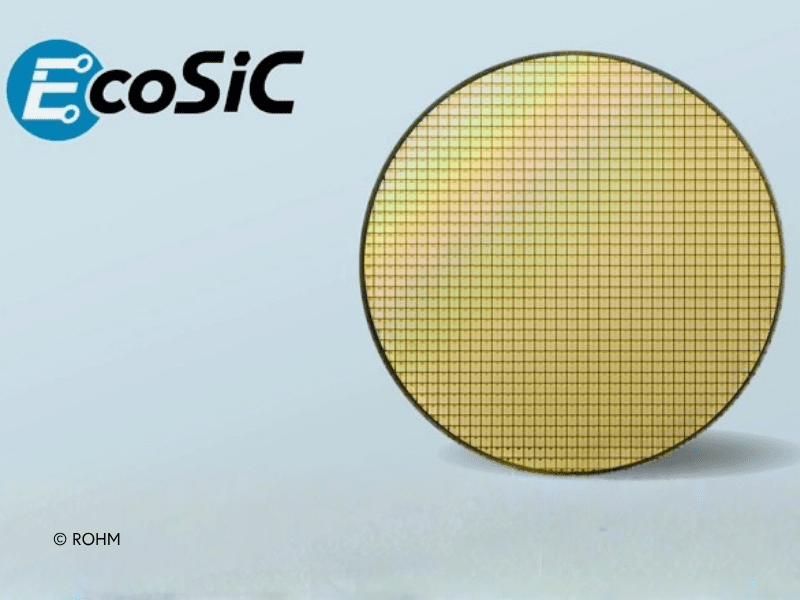
ROHM has introduced its 5th-generation silicon carbide devices, aimed at cutting conduction losses in demanding power conversion systems. The company says the latest SiC MOSFETs reduce on-resistance at high temperatures by around 30% compared with its previous generation, under the same breakdown voltage and chip size conditions.

For eeNews Europe readers, the development is relevant because thermal performance remains a practical constraint in both electric drivetrains and high-density industrial power systems. It also reflects how the design of SiC MOSFETs is shifting from early adoption toward broader use in automotive, data centre and energy infrastructure.

Lower losses at higher temperatures

The latest addition to ROHM’s EcoSiC line is positioned for applications where efficiency and heat handling are closely linked, including traction inverters in electric vehicles, onboard chargers, DC-DC converters, and industrial power supplies. ROHM is also pointing to AI servers, data centres, photovoltaic inverters, energy storage systems and UPS platforms as target markets.

The main change is a reduction of 30% in on-resistance during high-temperature operation at a junction temperature of 175°C. In practice, that could help designers limit conduction losses in systems that run hot or operate under sustained high load. In automotive powertrains, that may support smaller or potentially higher-output inverter stages. In industrial installations, it could help improve efficiency in power conversion blocks where thermal margins are tight.

SiC moves further into the mainstream

ROHM says it began supporting the bare-die business for the 5th generation SiC MOSFETs in 2025 and completed development in March 2026. Samples of discrete devices and modules using the technology are scheduled from July 2026.

The next step will be portfolio expansion. ROHM says it plans to add more breakdown voltage and package options while continuing to build out design tools and application support. That matters because wider SiC adoption depends not only on device performance, but also on packaging, qualification and the ease of integrating parts into complete power systems.

If you enjoyed this article, you will like the following ones: don't miss them by subscribing to :

   eeNews on Google News


Linked Articles