





News |
By Asma Adhimi
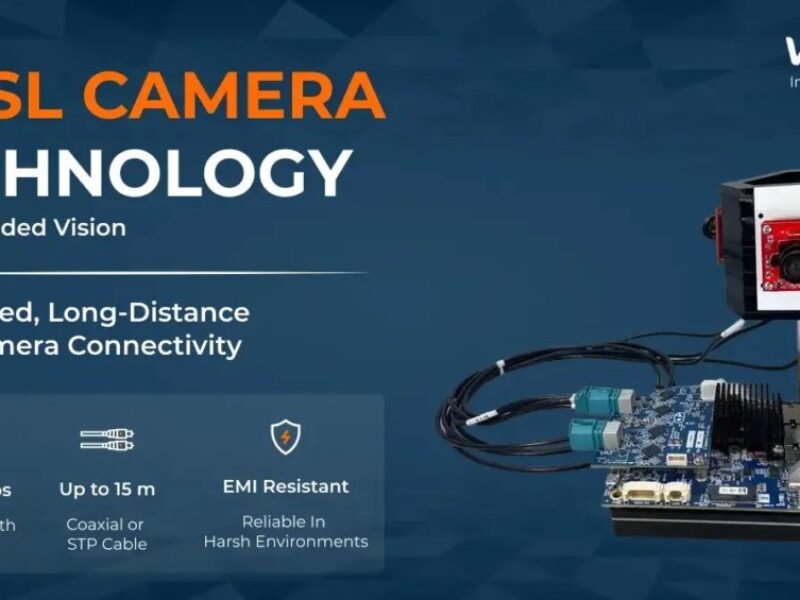
Vadzo Imaging has published a new technical guide explaining how GMSL (Gigabit Multimedia Serial Link) camera technology works and why it is increasingly used in embedded vision systems that require long-distance, high-bandwidth image transmission. The guide targets engineers designing systems where cameras must operate far from processors without compromising image integrity or latency.
For eeNews Europe readers working in automotive, robotics, industrial automation, and medical electronics, the topic is particularly relevant as embedded vision systems become more distributed and data-heavy. Understanding how to move uncompressed video reliably across longer cable runs is a growing challenge in system architecture.
According to Vadzo Imaging, many engineers still choose camera interfaces primarily based on bandwidth, often overlooking other constraints such as cable length, electromagnetic interference (EMI), and latency requirements. Traditional interfaces each have limitations: MIPI CSI-2 works well in compact designs and USB typically performs best over distances under a meter.
GMSL was designed specifically for applications where the camera must sit several meters away from the processing unit. These situations occur frequently in vehicles, robotic systems, factory equipment, and medical devices. In these environments, reliable transmission of uncompressed video data over long cables becomes a critical system design factor.
The guide focuses on the SerDes (serializer/deserializer) architecture that underpins GMSL camera systems. On the camera side, a serializer converts parallel pixel data from the image sensor into a high-speed serial stream, reducing the number of wires required and enabling the signal to travel further without degradation. At the processor end, a deserializer reconstructs the data stream and applies error correction during transmission.
The resulting latency can be extremely low. In GMSL1 systems, typical end-to-end latency is under one microsecond, making the technology suitable for applications such as advanced driver-assistance systems (ADAS) and high-speed industrial inspection.
Another section of the guide explores practical design considerations around cabling and connectors. Vadzo highlights the importance of selecting the correct cable type depending on the operating environment.
Coaxial cable provides strong EMI protection, and automotive systems widely use it where cameras operate near motors, ignition systems, and high-voltage power lines. Shielded twisted-pair (STP) cables offer a lighter and more flexible option in environments with moderate EMI exposure, such as medical equipment housings.
Connector termination is also a critical factor. Automotive deployments commonly use FAKRA or HSD connectors, and improper termination can cause signal reflections at high data rates. Even when the correct cable is selected, poor connector termination can still degrade image quality in production systems.
The guide also compares the three generations of the technology. GMSL1 supports data rates up to 3.125 Gbps, sufficient for 1080p60 uncompressed video. GMSL2 increases bandwidth to 6 Gbps and adds improved error correction and bidirectional data transmission over cable lengths of up to 15 meters.
The latest generation, GMSL3, pushes forward-channel bandwidth to 12 Gbps and enables aggregation of multiple 4K video streams over a single cable. This capability is increasingly relevant in autonomous vehicle perception systems and complex industrial machine vision installations, where reducing cable harness complexity can improve both reliability and cost.
Vadzo Imaging says the guide also outlines deployment scenarios across automotive ADAS, robotics, industrial automation, medical imaging, agriculture machinery, and multi-camera broadcasting setups. The company’s own GMSL camera portfolio supports both GMSL2 and GMSL3 interfaces and includes features such as Power over Coax, bidirectional control, and configurations designed for high-EMI environments.
 If you enjoyed this article, you will like the following ones: don't miss them by subscribing to :
此内容由惯性聚合(RSS阅读器)自动聚合整理,仅供阅读参考。 原文来自 — 版权归原作者所有。