





News |
By Brian Tristam Williams
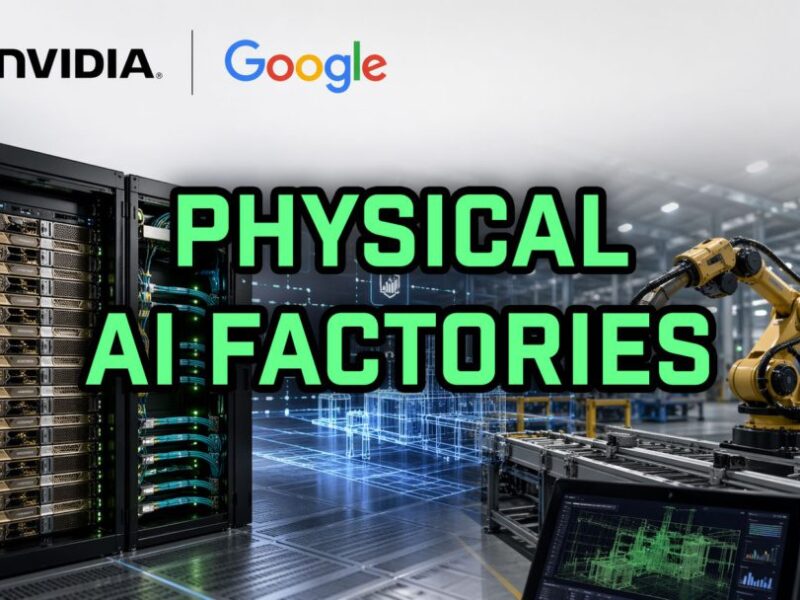
NVIDIA and Google Cloud have expanded their long-running partnership with a set of announcements at Google Cloud Next 2026 that tie new GPU infrastructure, confidential computing and Google’s reworked enterprise agent stack into a broader push towards physical AI factories. The move comes as Google sharpens its enterprise AI pitch around autonomous agents rather than generic chat tools, bringing Vertex AI and related services together under the Gemini Enterprise banner.
At the infrastructure level, Google said it will be among the first cloud providers to offer A5X bare-metal instances based on NVIDIA Vera Rubin NVL72 systems when the platform becomes available later in 2026. NVIDIA said the design can scale to 80,000 Rubin GPUs in a single-site cluster and 960,000 across a multisite cluster, positioning Google Cloud for very large training and inference environments rather than conventional enterprise AI pilots.
That matters less as a headline number than as a signal of where the partners think demand is going: away from isolated model hosting and towards tightly coupled infrastructure for agents, simulation, robotics and digital twins. As previously reported by eeNews Europe when NVIDIA deepened its industrial software alliances, the same stack is increasingly being aimed at engineering and manufacturing workflows rather than only data-centre chatbots.
Beyond raw compute, the partners are widening the deployment model. NVIDIA said Google is previewing Gemini on Google Distributed Cloud running on NVIDIA Blackwell and Blackwell Ultra GPUs, aimed at customers that need frontier models closer to sensitive data. Google also said Confidential G4 VMs with NVIDIA RTX PRO 6000 Blackwell Server Edition GPUs are now in global preview, adding hardware-backed protections for regulated or multi-tenant AI workloads.
The software side is just as important. Google used Next to introduce Gemini Enterprise Agent Platform as a consolidated environment for building, governing and scaling agents, while NVIDIA said Nemotron 3 Super models and NeMo-based training tools are being tied into that stack. The result is a more complete route from model development to production deployment for industrial users running robotics simulation, digital twins, vision systems and workflow automation.
For now, the announcement is mostly about platform alignment rather than immediate end-user products. But it shows where both companies are trying to position themselves: Google Cloud as the operating layer for enterprise agents, and NVIDIA as the infrastructure and model toolkit underneath the next wave of physical AI factories.
 If you enjoyed this article, you will like the following ones: don't miss them by subscribing to :
此内容由惯性聚合(RSS阅读器)自动聚合整理,仅供阅读参考。 原文来自 — 版权归原作者所有。