
惯性聚合 高效追踪和阅读你感兴趣的博客、新闻、科技资讯
阅读原文 在惯性聚合中打开

推荐订阅源

H
Help Net Security
月光博客
月光博客
IT之家
IT之家
B
Blog RSS Feed
T
Tailwind CSS Blog
The GitHub Blog
The GitHub Blog
博客园 - 三生石上(FineUI控件)
MyScale Blog
MyScale Blog
J
Java Code Geeks
Stack Overflow Blog
Stack Overflow Blog
奇客Solidot–传递最新科技情报
奇客Solidot–传递最新科技情报
Cyber Security Advisories - MS-ISAC
博客园 - Franky
博客园 - 叶小钗
阮一峰的网络日志
阮一峰的网络日志
freeCodeCamp Programming Tutorials: Python, JavaScript, Git & More
U
Unit 42
博客园_首页
B
Blog
V
V2EX
腾讯CDC
Vercel News
Vercel News
量子位
Microsoft Security Blog

... eeNews Europe

Molex Teramount deal targets co-packaged optics NVIDIA and ServiceNow extend AI governance from desktops to data centres Faraday Future launches Physical AI robotics institute with BIBS SiTime targets AI data centers with sub-nanosecond timing chip System Check: Should engineers learn analog? Decoupled by Design: How Gateworks and NXP are rethinking edge AI architecture NVIDIA and Corning partner on AI photonics expansion GCT taps satellite partner to speed 5G rollout Sodankylä supersite to support ESA Earth observation SiTime posts 88% revenue growth on AI infrastructure demand Infrared LEDs support in-cabin sensing for vehicle safety Anthropic compute deal taps SpaceXAI Colossus 1 Quantum Brilliance CEO Mark Luo on deployable quantum systems and the future of diamond-based computing SEMI Summit spotlights Europe’s chiplet and packaging push AI data center infrastructure drives Pennsylvania energy expansion NXP CoreRide gains Vector software support for SDV platforms Elektor Lab Talk covers Red Pitaya and reconfigurable test gear SEMI names Julie Rogers to lead ESD Alliance ASML CEO backs joint call for Europe tech competitiveness push FlexIC RFID inlays bring NFC to paper packaging ROHM targets smart rings with ultra-compact NFC wireless power chipset China silicon wafers push boosts Eswin capacity ESD Alliance outlook spotlights agentic AI in chip design AI robotics sales growth rises as Faraday Future expands into education Microchip expands dsPIC33A controllers for AI data center power sensiBel MEMS microphone heads to Silex production SEMI: Global silicon wafer shipments jump 13% on AI demand AI drives photonics innovation Advantech adds Intel Core Series 3 to edge AI systems NI CHESS enables software-driven RF channel emulation into aerospace testing
System Check: are engineering certificates worth it?
2026-04-10 · via ... eeNews Europe

System Check: are engineering certificates worth it?

News |

By eeNews Europe


System check! The journalists and engineers at eeNews Europe and Elektor want to know: How do you feel about certificates in electronics and engineering? Have you ever paid for training that led to a certification? Please share your opinion with us.
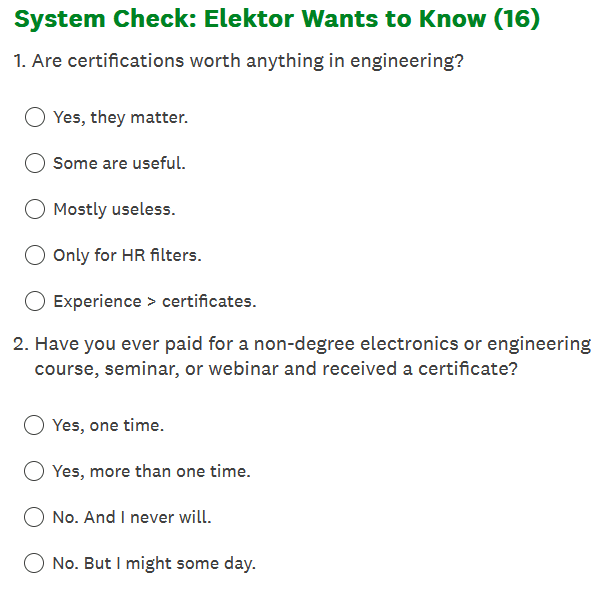
System Check: Your Opinion on Engineering Certificates

Click to submit your answers!

Past results

Curious about the results from last week’s System Check on the topic of KiCad? Here is what we learned.

System Check KiCad results

Results from System Check: KiCad (2026)

What does this tell us? KiCad has clearly emerged as the leading schematic capture and PCB design tool within Elektor’s global community. With about two-thirds of respondents using it, KiCad surpasses both commercial tools and mixed-tool workflows. This level of adoption suggests that open-source solutions have matured to the point where they meet the needs of engineers, makers, and students alike. While cost likely plays a role, the widespread use also signals strong trust in KiCad’s capabilities. At the same time, the continued use of paid tools (around 20%) and hybrid approaches shows that established platforms still hold value, especially in specialized or legacy-driven contexts.

In terms of perception, KiCad also holds its own against commercial competitors. Most respondents say they prefer KiCad over paid options, reinforcing the idea that its usability, features, and community support are delivering real value. That said, the data isn’t one-sided. A meaningful minority still views paid tools as better, and some see little difference between the options. This suggests that while KiCad is highly competitive, certain advanced features, workflows, or enterprise-level integrations in commercial tools may still offer advantages in specific scenarios.

Overall, open-source EDA tools are no longer just alternatives. They are increasingly becoming the default choice for a significant portion of the electronics community.

If you enjoyed this article, you will like the following ones: don't miss them by subscribing to :

   eeNews on Google News


Linked Articles