


State Bank of India (SBI) sees significant opportunities in expanding digital onboarding, transaction banking, and strengthening its wealth management franchise for building a granular, stable, and low-cost deposit base.
“Strengthening our liability franchise and deepening customer engagement will remain an important strategic focus area. We see significant opportunities in expanding digital onboarding, transaction banking, SME ecosystems, and relationship-led banking solutions,” Chairman Challa Sreenivasulu Setty said in his message to the shareholders.
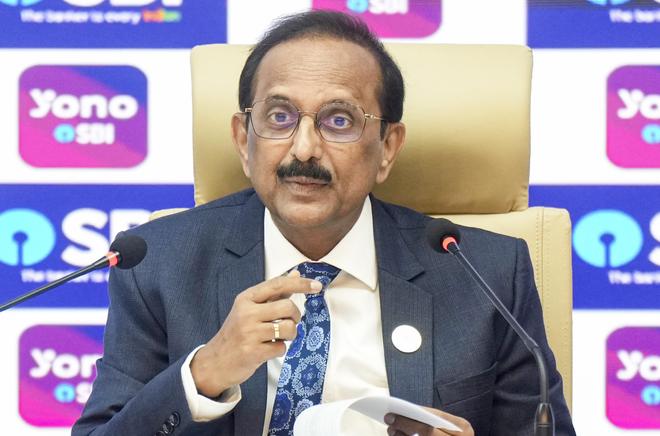
State Bank of India (SBI) Chairman Challa Sreenivasulu Setty | Photo Credit: SHASHANK PARADE
India’s largest bank also sees significant opportunities in strengthening its wealth management franchise, expanding relationship-led advisory services, and leveraging technology-enabled engagement models to deepen customer relationships across segments, per Setty’s message in the latest Annual Report.
The SBI Chief emphasised that going forward, SBI’s strategic priorities will remain firmly centred around strengthening the “Digital First, Customer First” approach.
“We will continue investing in technology, data analytics, artificial intelligence, cybersecurity, and digital infrastructure to create a more intelligent, agile, and responsive banking ecosystem.
“The next phase of our transformation will focus on delivering deeply personalised, seamless, and intuitive banking experiences across all customer segments and channels,” he said.
At the same time, physical banking will continue to remain an important pillar of SBI’s relationship-led model.
“Our endeavour will be to integrate the strength of our branch network with the speed and convenience of digital platforms, thereby creating a truly omni-channel banking experience for our customers.
“We will continue simplifying processes, improving turnaround times, and enhancing service quality through continuous innovation and operational excellence,” he said.
Setty noted that initiatives under Project SARAL, which was launched on 31st July, 2025, with a focus on process simplification, automation, centralisation and selective outsourcing of critical, high-impact retail operations, will continue to drive transformation through process re-engineering, standardisation, digital integration, and greater use of automation and Artificial Intelligence.
Key initiatives undertaken Project SARAL include Universal Branch Access, aimed at dismantling the traditional “home branch” mindset and enabling seamless banking access across branches; implementation of Single KYC across products to simplify customer onboarding and servicing; and automation of back-office processes such as inward clearing through the use of Generative AI, per the annual report.
These initiatives are expected to significantly improve operational efficiency and enhance overall customer experience, the report added.
Setty said risk management and governance will remain foundational to SBI’s growth strategy. Even as the Bank pursues new opportunities, its approach will continue to be guided by financial discipline, balanced growth, strong compliance standards, and prudent capital management.
He underscored that diversified portfolio, strong balance sheet, and robust capital position provide resilience and flexibility to navigate evolving macroeconomic conditions.
SBI Chief observed that as India progresses towards the vision of Viksit Bharat, the banking sector will play a transformative role in mobilising capital, enabling entrepreneurship, supporting infrastructure creation, and accelerating financial inclusion.
“As the country’s largest bank, we recognise both the opportunity and responsibility that comes with this role and remain committed to supporting India’s growth aspirations,” he said.
SBI Chief said the Bank’s vision is to build a future-ready institution that combines technological leadership with human trust and business growth with social responsibility.
The annual report noted that “While we do not expect significant pressure on asset quality in FY 2027, a protracted conflict in West Asia and a strong El-Nino may affect the sector’s risk profile in the current financial year.”
Published on May 27, 2026
此内容由惯性聚合(RSS阅读器)自动聚合整理,仅供阅读参考。 原文来自 — 版权归原作者所有。