







DK Shiva Kumar (left) and Siddaramaiah. Earlier in the day, the two leaders shared breakfast and exchanged warm hugs, visuals crafted to signal a smooth handover rather than a bitter succession battle.
It was only a week ago that, when asked about a possible leadership transition, then Deputy Chief Minister D.K. Shivakumar smiled and said, “Only time, and muhurta will tell.” Finally, the muhurta seems to have smiled on him.
The meeting with the Congress high command on May 27 turned out to be the moment Shivakumar had long waited for. By May 28, Thursday , Shivakumar and Karnataka Chief Minister Siddaramaiah jointly announced that the latter had tendered his resignation, ending months of speculation over Karnataka’s closely watched power equation.
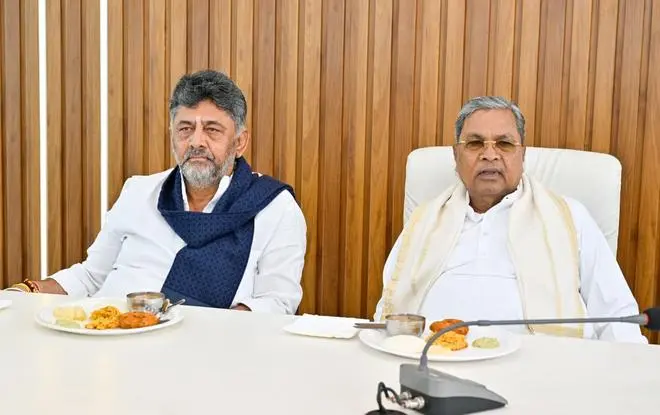
Earlier in the day, the two leaders shared breakfast and exchanged warm hugs, visuals crafted to signal a smooth handover rather than a bitter succession battle.
Born Doddalahalli Kempegowda Shivakumar on May 15, 1962, in Kanakapura to a well-to-do family, the Vokkaliga strongman first entered politics as a student activist in the 1980s. Though he lost his debut Assembly election to heavyweight H.D. Deve Gowda in 1985, Shivakumar bounced back quickly, registering the first of what would become eight consecutive Assembly victories at the age of 27 from the erstwhile Sathanur constituency.
Known within Congress circles as “Kanakapura Bande,” the rock of Kanakapura, DK Shivakumar has long played the role of the party’s troubleshooter and organisational strongman in Karnataka. From safeguarding Congress MLAs during political crises to stitching together alliances and navigating high-stakes negotiations, Shivakumar built a reputation as the man the party turned to in moments of instability.
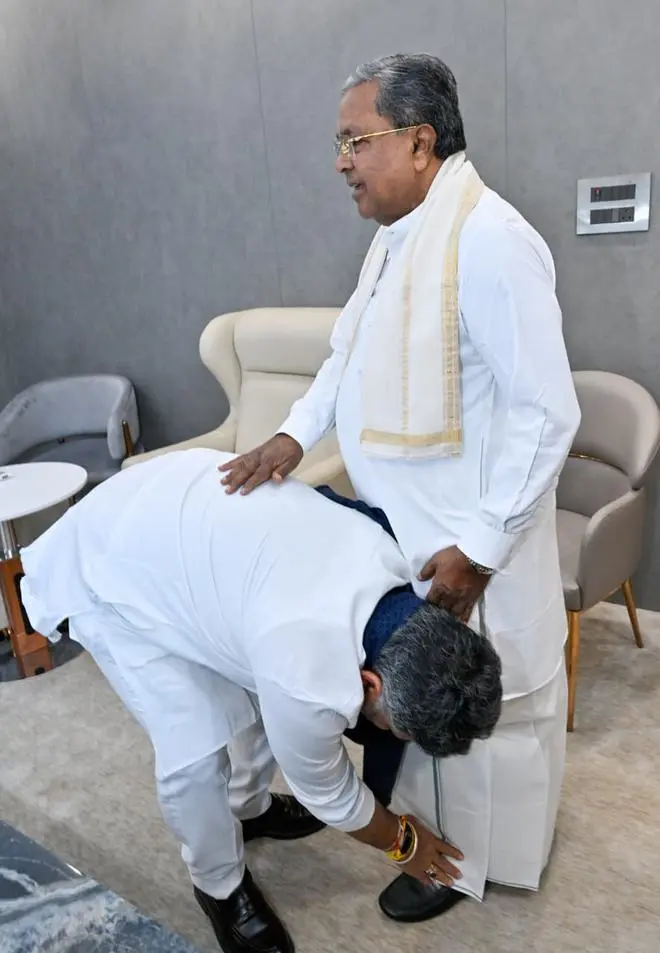
Beyond the towering cut-outs, victory slogans and power negotiations, Karnataka’s politics has often been shaped by deeply personal stories of faith, ambition, heartbreak and survival. For all their contrasting styles, both D.K. Shivakumar and Siddaramaiah built their careers on moments that revealed the men behind their political personas. And as the state witnesses another carefully negotiated transition, those anecdotes once again return to the spotlight.
For those close to Shivakumar, Friday’s announcement was not just political timing; it was celestial timing. The incoming Chief Minister, known for his deep belief in astrology and religious rituals, is learnt to have sought three separate auspicious dates from astrologers before the transition was finalised. Among those he is known to trust is astrologer Dwarkanath, who has reportedly predicted for years that Shivakumar would one day occupy the Chief Minister’s chair. Shivakumar’s faith has long been intertwined with his politics. Before elections, he is known to take religious vows, and even today, regular visits to Ajjayya temple remain part of his routine.
Long before he became Karnataka’s tallest mass leader, Siddaramaiah’s political journey began with defeat. In 1980, he unsuccessfully contested the Lok Sabha elections from Mysore. His first electoral victory came later as an independent candidate, before he joined Ramakrishna Hegde’s “Young Turks” in the Janata Party. From there, Siddaramaiah steadily built a reputation as an administrator and strategist, eventually emerging as one of the state’s most dominant political figures.
Siddaramaiah’s career has also survived moments when many believed it was over.
The first came in 2005, when he was expelled from the Janata Dal (Secular). In 2006, contesting from Varuna, he turned the battle into a prestige fight against H.D. Deve Gowda’s camp and emerged stronger.
The second scare came years later in Chamundeshwari, when a sitting Chief Minister suffered the shock of defeat to G.T. Deve Gowda. Anticipating trouble, Siddaramaiah had simultaneously contested from Badami, a move many saw as political insurance. He eventually won from Badami against BJP leader B. Sriramulu and stayed politically afloat.
Behind Siddaramaiah’s public image lies a deeply personal tragedy. His elder son, Rakesh Siddaramaiah, who was widely seen as his political heir and actively managed constituency affairs, passed away in 2016. The loss deeply affected the Congress leader and altered the family’s political trajectory. His younger son, Dr. Yathindra Siddaramaiah, a medical professional by training, later entered politics to carry forward the family legacy.
The Chief Ministership he almost had
For Siddaramaiah, the wait for the top post had nearly ended much earlier. In 2004, after the Assembly elections threw up a fractured verdict, Siddaramaiah was widely seen as a frontrunner for the Chief Minister’s post. But H.D. Deve Gowda was reportedly reluctant to back him, and the post eventually went to Dharam Singh. Many in Karnataka politics still see that episode as the moment the Siddaramaiah-Deve Gowda relationship irreversibly soured.
Even as rivals attempted to box him into a caste identity, Siddaramaiah consistently projected himself beyond being merely a Kuruba leader. Instead, he carefully crafted the AHINDA coalition — minorities, backward classes and Dalits — transforming it into one of Karnataka’s most influential political social blocs. The strategy became the backbone of his political rise and Congress’ electoral calculations in the State.
Yet, Siddaramaiah’s second innings as Chief Minister were not without controversy. The MUDA site allotment controversy cast a shadow over his government, denting the carefully built image of a leader who often positioned himself as pro-poor and clean. Though sites linked to the controversy were surrendered and the matter entered legal scrutiny, the political taint lingered and gave the Opposition fresh ammunition.
Few politicians in Karnataka can match Siddaramaiah’s record with the state budget.
Across stints as Finance Minister and Chief Minister, he has presented 16 state budgets — the highest by any Karnataka Chief Minister, cementing his reputation as one of the state’s most hands-on administrators.
Even the Governor’s office found itself under political scrutiny during the transition.
Governor Thaawarchand Gehlot’s sudden absence from Bengaluru due to a relative’s illness triggered murmurs in political circles, with some analysts questioning the timing amid intense leadership discussions. Though officially unrelated, the development added another layer of intrigue to Karnataka’s already dramatic political week.ed the timing of the governor’s absence.
Published on May 28, 2026
此内容由惯性聚合(RSS阅读器)自动聚合整理,仅供阅读参考。 原文来自 — 版权归原作者所有。