



Ahead of the next GST Council meeting, industry leaders are pushing for a significant policy shift: allowing input tax credit (ITC) refunds on input services under the inverted duty structure (IDS). Currently, manufacturers can often only claim refunds on raw materials (inputs), leaving tax paid on services (like legal, consulting, or logistics) trapped as a cost.
Experts feel that absence of such a mechanism creates structural disadvantage for manufacturers.
Basic problems
IDS refers to a system where tax on inputs is higher while that on output is lower. This results in two basic problems. First, it could result in accumulated ITC and blocked working capital. Though there is provision of refund, it is is available only for input goods and not for input services. Second, IDS pushes the production cost making affecting competitiveness of domestic manufacturer and thus makes imported goods cheaper.
In a representation to Central Board of Indirect Taxes (CBIC), the Bengal Chamber of Commerce & Industry (BCCI) said: “While the rate reduction in GST 2.0 has helped trade and industry too by supporting the output supply part, yet for manufacturers it has deepened the inverted duty structure and hence increased the cost.” It may be noted that with effect from September 22, GST rates were restructured with two basic rate slab (5 per cent and 18 per cent) along with 40 per cent rate slab for demerit and high-end goods.
Key issues
The chamber especially highlighted problem of FMCG (fast moving consumer goods) manufactures. As a part of rate revision, GST on many such goods lowered to 5 per cent from 18 per cent. “As a consequence of this downward revision, the rate of tax applicable to outward supplies were reduced by 13 per cent; however, the rate of tax applicable for input services remained as 18 per cent,” it said. This deepened the IDS on account of input services to a large extent.
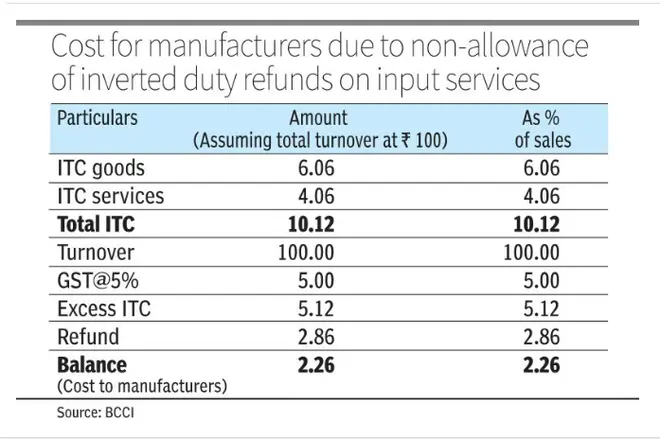
Further, due to the legal provisions under section 54 of CGST/ SGST Act and Rule 89 and as confirmed by the courts also, inverted duty refunds are not eligible on input services. This leaves the ITC earned on input services as a wasteful asset in the balance sheet and a resultant cost to the manufacturers. “This also goes against the very object of GST to eliminate ‘cascading impact of tax,” the chamber said while making the plea for appropriate recommendations for the amendment of the statutory provisions for correcting this anomaly.
According to Rahul Shekhar, Parter at Nangia Global, in practice, manufacturers incur substantial input services costs such as information technology, rentals, advertising, royalty/ technical fees on acquisition of technology, management cost if it is a subsidiary of global MNC etc, which form an integral part of their overall cost structure. The exclusion of input services from the refund mechanism results in the accumulation of unutilised ITC, thereby blocking working capital and increasing the cost of operations. “This creates a structural disadvantage for manufacturers operating under an inverted duty regime, ultimately affecting liquidity and business efficiency,” he said.
Published on April 17, 2026