



惯性聚合 高效追踪和阅读你感兴趣的博客、新闻、科技资讯
阅读原文 在惯性聚合中打开

推荐订阅源

钛媒体:引领未来商业与生活新知
钛媒体:引领未来商业与生活新知
云风的 BLOG
云风的 BLOG
IT之家
IT之家
C
Check Point Blog
T
The Blog of Author Tim Ferriss
S
SegmentFault 最新的问题
人人都是产品经理
人人都是产品经理
H
Hackread – Cybersecurity News, Data Breaches, AI and More
美团技术团队
M
MIT News - Artificial intelligence
Jina AI
Jina AI
Blog — PlanetScale
Blog — PlanetScale
freeCodeCamp Programming Tutorials: Python, JavaScript, Git & More
Microsoft Security Blog
G
Google Developers Blog
F
Fortinet All Blogs
V
Visual Studio Blog
奇客Solidot–传递最新科技情报
奇客Solidot–传递最新科技情报
T
Tailwind CSS Blog
Hugging Face - Blog
Hugging Face - Blog
MyScale Blog
MyScale Blog
爱范儿
爱范儿
The Cloudflare Blog
博客园 - 三生石上(FineUI控件)

Business News Today: Latest Business News, Finance News

Markets’ dilemma: Trust the bark or wag of oil prices The sector call illusion Bandu’s Blockbusters For April 12, 2026 Mastering Derivatives: Does Lag Impact Effectiveness Of OI? Who Am I? April 12, 2026 Index Outlook: Rising From Dire Straits US Market Outlook: Gaining Strength Bullion Cues: Gold And Silver Futures Face Barrier F&O Tracker: Tentative Shift In Trend F&O Strategy: Buy L&T Put Maruti Suzuki to launch 4 EVs by 2031 India Inc flags surge in cost of packaging raw material, seeks relief measures India-flagged LPG tanker Jag Vikram crosses Strait of Hormuz after US-Iran ceasefire Muted pricing power, rising costs to curb benefits of demand in cement sector: HDFC Securities Iran's new supreme leader Mojtaba Khamenei has severe and disfiguring wounds, sources say No road tax, registration fees for electric vehicles priced up to ₹30 lakh till March 2030: Delhi’s draft EV policy Central Railway to run four special local trains for Ambedkar Jayanti West Asia tensions push up costs for India; further impact hinges on stability: Report ED initiates fresh raids against former Bengal minister Chatterjee in teacher recruitment scam Election Commission reverses Mittal’s DVAC posting, appoints him DGP, TN Armed Police Israel and Lebanon are expected to hold talks. Here’s what to know US, Iran set for peace talks but doubts emerge over Lebanon, sanctions Cotton Association revises output estimates for 2025-26 up at 324 lakh bales of 170 kg each Orbicular gets USFDA’s tentative nod for generic Semaglutide Injection in partnership with Apotex Malls, high-streets in NCR clock 45% rise in leasing of retail spaces in Jan-Mar: C&W FIIs pull ₹28,375 crore in five sessions; domestic buyers cushion fall as indices post best week in months Nifty and Bank Nifty Prediction for the week 13 Apr’26 to 17 Apr’26 by BL GURU Proposed Trump arch in Washington DC includes winged figure, eagles, lions and gold inscriptions 'Ladakh' replaces 'Jammu and Kashmir' in Aadhaar records for UT residents Misri ends US trip with focus on civil nuclear cooperation and LPG exports
India’s fertilizer production drops as Iran war disrupts ...
2026-04-29 · via Business News Today: Latest Business News, Finance News
Domestic fertilizer production between March 1 and April 26 stood at 59.01 lakh tonnes (lt) this year, significantly lower than 76.09 lt produced during March-April, last year

Domestic fertilizer production between March 1 and April 26 stood at 59.01 lakh tonnes (lt) this year, significantly lower than 76.09 lt produced during March-April, last year | Photo Credit: -

Fertilizer production in the first two months following the Iran war has fallen sharply compared with the same period last year, fuelling anxiety among farmers who are already lining up at retail outlets weeks before the start of kharif sowing.

Official data show that domestic fertilizer production between March 1 and April 26 stood at 59.01 lakh tonnes (lt) this year, significantly lower than 76.09 lt produced during March-April, last year.

Even after adding an estimated 4-5 lt output for the remaining days of April, total production for March-April is expected to reach only about 64 lt, nearly 12 lt lower year-on-year.
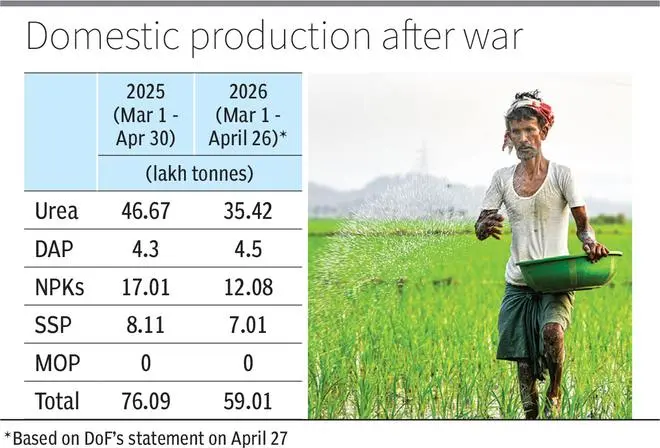
The decline has been most pronounced in urea, the key nitrogenous fertilizer used widely during kharif. Urea production dropped to 35.42 lt this year from 46.67 lt in March-April last year, a fall of over 24 per cent. Industry sources attribute the decline mainly to disruption in liquefied natural gas (LNG) supplies, the primary feedstock for urea manufacturing, after the Iran war.

The production shortfall is already being felt on the ground. Farmers in several regions have begun queuing up at fertilizer outlets earlier than usual to secure supplies before sowing begins, pushing up sales compared to last year. Urea sales touched 8.53 lt in April 1-17 this year, up from 7.71 lt in the comparable period last year, while sales of DAP, complex fertilizers and SSP have also risen noticeably.

Govt Version

The government, however, has sought to reassure farmers and State administrations, maintaining that fertilizer availability remains “strong, stable and well-managed.”

According to the Department of Fertilizers, total fertilizer stocks stood at 190.21 lt as of April 27, equivalent to about 49 per cent of the estimated kharif 2026 demand of 390.54 lt, significantly higher than the 33 per cent stock level at the same time last year.

Officials said there are currently no major issues in the availability of key raw materials for producing urea and phosphatic fertilizers. They also noted that LNG supply to urea plants has improved to about 97 per cent of requirement after dropping to 50-60 per cent immediately following the war.

The government further emphasised that retail prices of major fertilizers remain unchanged despite a sharp spike in global prices, with urea continuing to be sold at ₹266.5 per 45-kg bag, DAP at ₹1,350 per 50-kg bag, and TSP at ₹1,300 per 50-kg bag.

However, with production lagging behind last year’s levels and farmers stocking up early, industry officials say the coming weeks before peak kharif sowing will be critical in determining whether the government’s confidence translates into smooth on-ground availability.

Published on April 28, 2026