






There is a particular kind of humility you develop when you spend years building technology platforms for agriculture. The farm does not care about your roadmap – soil microbiomes disregard sprint cycles and plants, operate on extraordinarily sophisticated biological web evolved over millions of years.
The 20th-century Green Revolution saved lives through extraordinary productivity gains, based primarily on input intensification: more fertilizer, pesticides and irrigation. However, this model has reached its physical limits, creating a systemic efficiency crisis.
Today, Nutrient Use Efficiency (NUE) is deeply suboptimal (e.g., India’s severe 10:9:4 NPK ratio), contributing to soil degradation, yield plateaus despite escalating costs, and an inability to cope with compounding climate stresses like heat and drought. This widening gap between input costs and yield response is a structural signal that the input-intensification paradigm has failed, marking the birthplace of agriculture’s next architectural shift.
Building better products (fungicides, fertilizers) is key, but product-centric thinking is slow and poorly adapted to agriculture’s diversity. A platform is fundamentally different: it is a capability infrastructure that enables continuous discovery, modular recombination, and compounding learning. Unlike a product pipeline, where development is a long, linear process optimized for specific conditions, a platform makes discovery continuous.
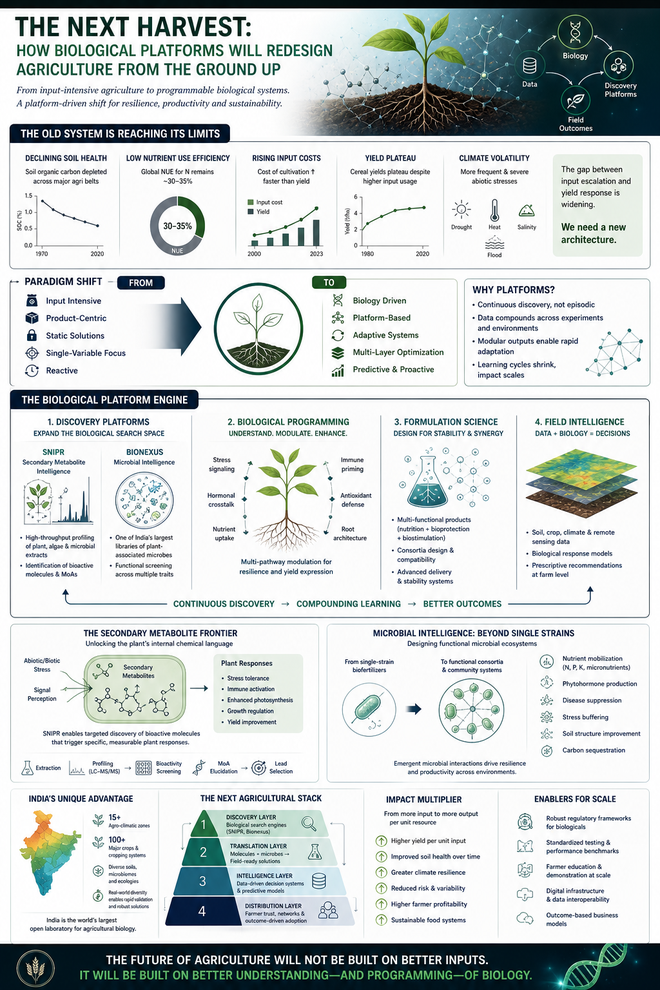
Each experiment feeds a shared data layer, allowing for molecules and microbial strains to be screened across an expanding matrix of conditions and targets. While platforms yield products, the platforms themselves—the compounding strategic asset—are the true innovation.
Secondary metabolites, a vast chemical library of compounds beyond the core growth machinery are the plant cell’s command language, evolved to manage its interface with the world. They signal stress, recruit beneficial microbes and initiate crucial immune and growth-regulating responses, encoding the chemical legacy of evolutionary adaptation.
Conventional agronomy has systematically overlooked secondary metabolites, focusing on what plants need to grow rather than the molecular conversations they are already having.
This new approach shifts from adding inputs to modulating biology. By profiling secondary metabolites signatures, scientists can identify bioactive compounds that, when applied, shift plant behaviour in agronomically meaningful ways.
This means, instead of plant being able to take up only 30 per cent of applied nitrogen, we activate the plant’s own nitrogen-acquisition pathways to now take up 50 per cent of the applied nitrogen; and instead of having to reply on fungicides, insecticides alone to protect the plants, you prime the plant’s systemic resistance to withstand diseases and pests. And in case of climate resilience, where chemicals are of little help, biomolecules pave path for drought, salinity or heat tolerance through physiology modulation
The implications are significant, particularly commercially, because the molecular discovery space is vast and platform advantages compound over time.
The story with microbes is structurally similar. Agricultural microbiology has existed for decades — rhizobia inoculants for legumes date to the nineteenth century — but the dominant product model has been single-strain biofertilizers applied to soils with the expectation that they will colonize, persist, and perform.
The field performance record of single-strain products is, to be charitable, inconsistent. Establishment in a complex soil microbiome is not guaranteed. Persistence under variable conditions is poor. The functional contribution of a single strain to a living soil system — which contains billions of microorganisms per gram — is often marginal and difficult to attribute.
What is becoming clear, as metagenomics and functional microbiome science mature, is that microbial function in agriculture is emergent. It arises from communities, not individuals. A soil that supports healthy plant growth does so through a web of microbial interactions — nutrient cycling, disease suppression, hormone signalling, stress buffering — that cannot be replicated by adding a single commercially available strain.
Consortia design — assembling microbial teams that are functionally complementary, ecologically compatible, and context-appropriate — is the output mode of this platform. It is enormously more complex than single-strain product development. It is also enormously more effective
The strategic takeaway is clear - Winners in the next decade will not be those who sell more inputs, but those who control discovery, understand biology at scale, and translate it into reliable farmer outcomes.
For India, this presents a unique opportunity. Its diversity—once seen as a constraint—can become the foundation for building globally relevant, climate-resilient agricultural solutions. But realizing this potential requires alignment across science, regulation, and market access.
Ultimately, the next agricultural upgrade is not about replacing chemistry with biology—it is about integrating intelligence into the system.
And those who can build, scale, and continuously learn from these biological platforms will define the future of farming—not just in India, but globally.
The author is Co- Founder and Chief Technology Officer, BioPrime® AgriSolutions Pvt. Ltd.
Published on May 16, 2026
此内容由惯性聚合(RSS阅读器)自动聚合整理,仅供阅读参考。 原文来自 — 版权归原作者所有。