









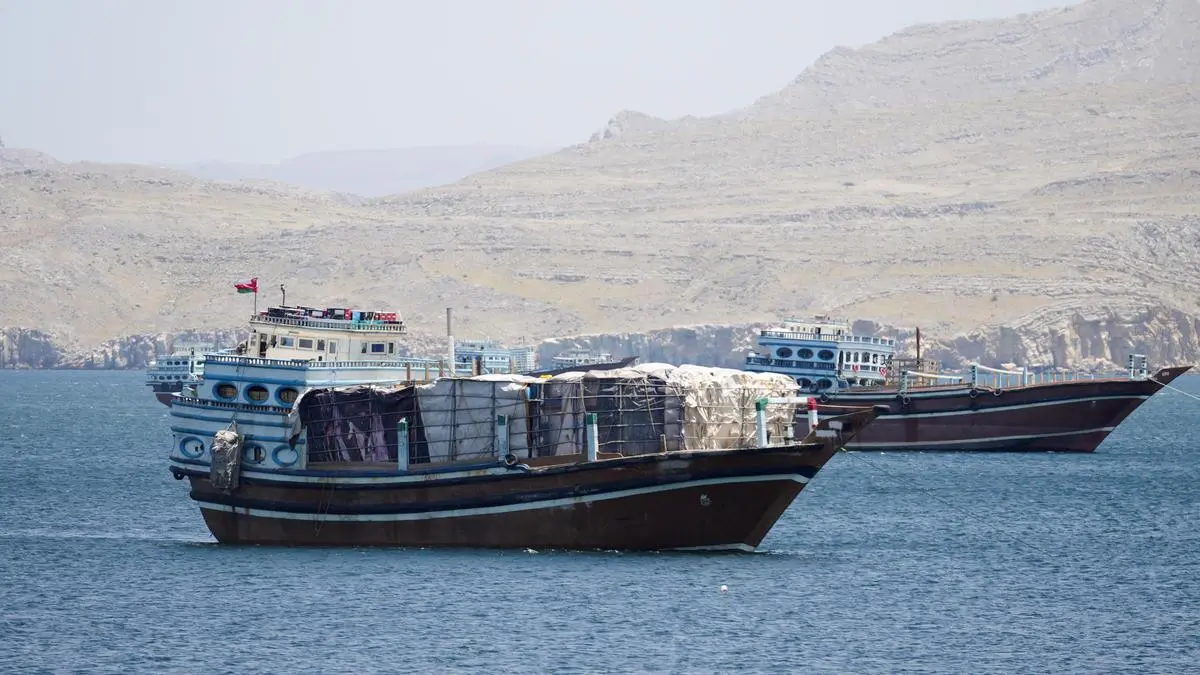
The blockade of the Strait of Hormuz is casuing enromous economic pain the world over | Photo Credit: STRINGER
In the tumultuous global economic and political context of the past year, it is hardly surprising that the focus of the IMF in the first chapter of its flagship report World Economic Outlook for April 2026 should focus on geopolitical risks, and recognise their impact on economies across the world. It therefore proposes that countries must prioritise ”policies that are robust to alternative states of the world” so as to “enhance resilience and foster agility and adaptability”.
Yet the proposed strategies for doing this remain much the same as they would have been before: “preserving price and financial stability, safeguarding fiscal sustainability, and implementing structural reforms without further delay”. (IMF WEO April 2026, page xvi). These are the usual bromides that have appeared in successive IMF documents over far too many decades, which are somehow impervious to the very differing economic realities of countries over time and in different geopolitical and economic contexts.
As such, these banal and even misleading suggestions are unlikely to be of much help to policy makers in lower income countries who are trying to grapple with a perfect storm of adverse shocks in an already fragile environment.
Part of the problem is that — even while recognising that all risk analysis in these crazy times is difficult — the IMF’s analysis is disproportionately based on the approach and perceptions of investors based in the North Atlantic. Consider Figure 1, which is based on data from worlduncertaintyindex.com and policyuncertainty.com. These uncertainty measures are news- and media-outlets-based indices that quantify media attention to global news related to overall uncertainty, economic policy uncertainty, and trade policy uncertainty. These are probably reliant on largely western media and specifically more on finance- and business-related news portals, which essentially orient to the concerns of capital markets.

What is interesting is not the dramatic increase in the uncertainty indices in September-October 2025, but the almost equally dramatic decline thereafter. This may have reflected the view of financial markets, especially in the US (which appear to have absorbed the TACO doctrine that “Trump always chickens out”). But to suggest that most low and middle income countries (other than China) were equally facing reduced uncertainty would be very far off the mark, as most of them continued to face the combined threats of trade disruption, pressure from the US to alter many domestic policies along with trade policy concessions, and capital market volatility.
The regional calculations of risk described in Figure 2 could be similarly misleading. It is noted that these figures come from a country-specific geopolitical risk index of Caldara and Iacoviello (2026), a news-based measure of adverse geopolitical events that covers 10 major newspapers in Canada, the United Kingdom, and the United States. Once again, it is safe to assume that these measures are oriented to the interests of financial investors in those countries, rather than people who actually live in the countries of the various regions.

Note that these are index numbers representing the increase in perceived risk compared to the 1990s. On an absolute measure, such risks are still perceived to be significantly lower in Europe despite the recent increase, while they remain significantly higher in the developing regions.
To be fair, it is not that the IMF does not recognise the possibility of other more diverse and even more problematic risks. “Downside risks dominate, even after the realization of a risk event — namely, an escalation of geopolitical tensions — frequently underscored in previous WEO reports. Geopolitical tensions could worsen even more than they already have — turning the situation into the largest energy crisis in modern times — or domestic political strains could erupt. Political stress factors can get entangled with shifts in trade and other international policies. Independently of geopolitical developments, trade-related disputes could flare up.” (IMF WEP April 2026 page XV)
However, the limitations of such risk analysis are clearly brought out by the experience of the past two months. The unjustified US-Israel war on Iran has had obviously disastrous effects on the people of Iran, but the regime’s remarkable ability for survival and success in asymmetric warfare have meant that the other worst effects have fallen on people in lower income countries, especially in Asian oil importing countries that relied disproportionately on oil and gas coming through the now-closed Hormuz Strait.
The risks inherent in that possibility of closure are now painfully realised, but they were not factored in before. Nor are other possibly chokepoints for the global economy being considered, even after this experience. For example, the Gulf economies rely hugely not only on the ability to export oil through that narrow strait, but also on incomes from tourism, foreign residents (corporations and individuals) attracted by tax haven status, and serving as logistics and communications hubs. As this in turn is dependent on constant and high-quality connectivity, which is almost completely delivered by a dense network of undersea cables.
The recent publication by the Iranian news agency Tasnim, of maps of undersea internet cables, the locations of servers providing cloud infrastructure and landing stations in the UAE, Qatar, Bahrain, Kuwait and Saudi Arabia may have served as a polite warning that these are also vulnerable in the ongoing conflict. These cables do not require massive military hardware to disrupt: a simple snip of a few cables would do more than disrupt the entire economy that is increasingly dependent on such connectivity. Repairing these, if and when they are broken (such as Alcatel Submarine Networks being unable to send their flagship cable vessel, the Ile De Batz, into the Gulf to repair a broken cable lying on the seabed) is currently next to impossible because those repair vessels cannot gain entry.
These risks are also not noted in the IMF’s report. But they immediately affect insurance markets, which now price these into all future transactions. So whether or not the IMF chooses to recognise these risks that have translated into fearsome reality, anyone trying to engage in economic activity in this region — large or small enterprises, formal or informal workers — already have to face them, and hits the livelihood and remittances of millions of migrant workers from South Asia and elsewhere.
The worst — and most obvious — omission may well be deliberate. The shameful subservience of multilateral institutions supposedly answerable to the entire world, to the climate-denying whims of the current US administration means that the report notably makes no mention of climate risks. Yet these are now significantly greater than before for most lower income countries. They are even greater because of the unjustified wars unleashed by the US and Israel, which create not just deaths, destruction and trade blockages, but also add to global warming and immense ecological damage that may be impossible to reverse.
Published on April 28, 2026
此内容由惯性聚合(RSS阅读器)自动聚合整理,仅供阅读参考。 原文来自 — 版权归原作者所有。