






After a prolonged multi-year rally, the market has seen a meaningful correction over the past few months. Several quality stocks across sectors have corrected and fundamentally sound businesses have seen their valuations cool off. For investors looking to use the correction to build exposure gradually through SIPs, value investing can be an effective route. A value-oriented fund can take advantage of temporary pessimism, buy quality businesses at lower valuations and potentially deliver better risk-adjusted returns over a market cycle.
Among the funds in this space, HSBC Value Fund stands out. The fund, which has 5 stars in our bl. portfolio Star Track MF Ratings, has delivered strong long-term returns while remaining faithful to its value-investing mandate. It has consistently outperformed its benchmark and most peers, without taking excessive portfolio risks.
Launched in January 2010, HSBC Value Fund has a track record of more than 15 years and is managed by Venugopal Manghat. What makes the scheme stand out is not merely its recent returns, but the consistency of its outperformance across timeframes and market cycles.
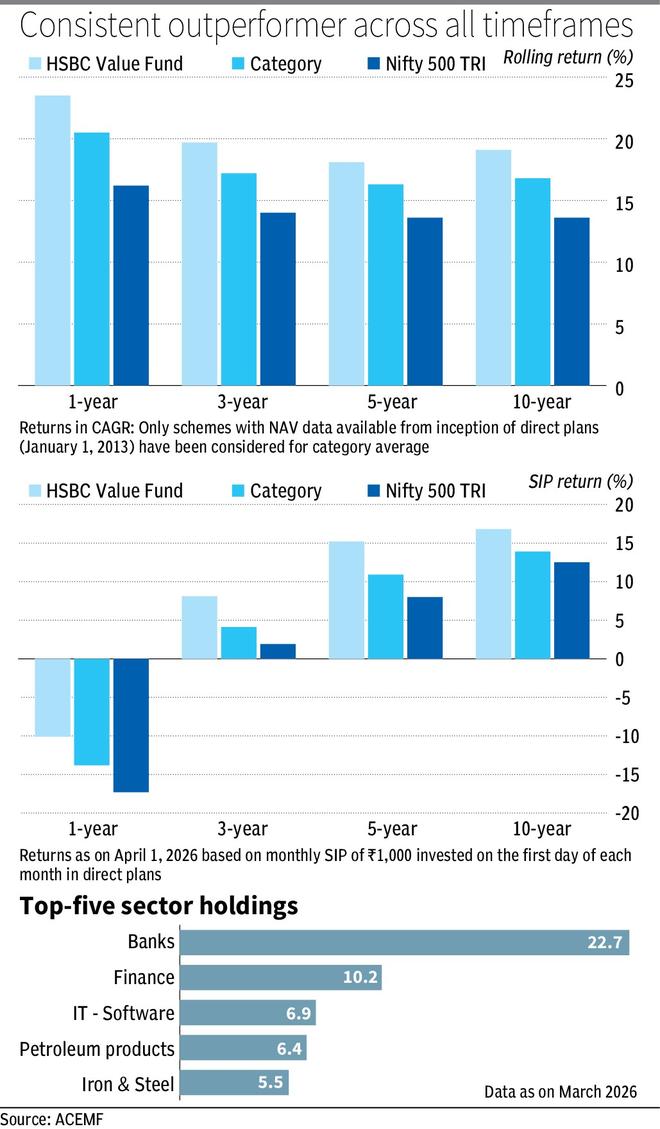
On rolling returns, the fund has comfortably outperformed both the value-fund category average and the Nifty 500 TRI. Over one, three, five and 10 years, the fund has delivered annualised returns of 23.5 per cent, 19.7 per cent, 18.1 per cent and 19.1 per cent, respectively. Against the Nifty 500 TRI, this translates into outperformance of 7.3 percentage points over one year, 5.7 points over three years, 4.5 points over five years and 5.5 points over 10 years. This indicates that the fund has not merely benefited from market beta.
The scheme has been equally impressive for SIP investors. A monthly SIP over 10 years has generated returns of 16.8 per cent, compared with 12.5 per cent from the Nifty 500 TRI and 13.9 per cent for the value-fund category average. Even over five years, the fund’s SIP return of 15.2 per cent is far ahead of the benchmark’s 8 per cent and category’s 10.9 per cent.
This ability to deliver in both lumpsum and SIP formats is important in the current market. Investors entering after a correction rarely invest everything at once. A fund that has historically rewarded staggered investing deserves greater weight.
Equally important, the fund has not achieved these returns by taking extreme risks. The portfolio has historically fallen less than the benchmark during weak markets, while participating strongly in rallies. In the difficult FY26 market, for instance, the fund still managed a positive return of 4 per cent and was the second-best performer among nearly two dozen peers, even as the Nifty 50 ended the year with a decline.
Many value funds drift away from their mandate during strong bull markets and end up chasing momentum-led sectors. HSBC Value Fund has largely avoided that trap.
The fund has stayed true to its value approach by focussing on businesses that combine reasonable valuations, sound balance sheets and long-term growth potential. The portfolio is built through bottom-up stock selection rather than sector calls.
Large-caps dominate the portfolio, but the fund also maintains meaningful exposure to mid- and small-cap stocks. Typically, 45-55 per cent of the portfolio is invested in mid- and small-caps, giving the fund the ability to benefit when broader market opportunities emerge (upside capture ratio of 118 per cent). At the same time, the presence of large-caps helps keep overall portfolio risk in check (downside capture ratio of 97 per cent).
The fund is also well-diversified. It typically holds more than 70 stocks, with even the largest positions accounting for less than 4.5 per cent of the portfolio. This reduces dependence on any one stock or sector.
Banks remain the largest allocation, accounting for nearly 23 per cent of the portfolio. Finance, IT software, petroleum products and industrial stocks also feature prominently. Some pockets of these sectors have either underperformed the market or seen valuation compression despite reasonable business fundamentals.
Among the fund’s top holdings are SBI, NTPC, Karur Vysya Bank, Reliance Industries, HDFC Bank and Shriram Finance. Some of These are businesses with relatively inexpensive valuations compared to their own history or the broader market, but with the potential to benefit when sentiment improves.
The current environment is particularly favourable for SIP investing into a value fund. Market corrections tend to create a wider universe of attractively priced stocks. A staggered investment approach through SIPs allows investors to take advantage of this volatility without worrying about the exact market bottom. In that context, HSBC Value Fund’s portfolio remains reasonably valued too, with a price-to-book of 4.1 times, placing it in the cheaper half of the value-fund category.
HSBC Value Fund is well-suited to such an approach. The fund usually remains fully invested and does not hold excessive cash unlike some peers. This ensures that its investors are able to participate when markets recover on a sustained basis. With a weighted average direct-plan expense ratio of 0.74 per cent (source: ACEMF), it is also among less expensive value-oriented funds, ranking in roughly the lowest one-third of the category by cost alone.
At the same time, the fund’s diversified portfolio and lower downside capture make it relatively better placed than many aggressive mid- and small-cap funds if markets remain weak for some more time.
Investors should, however, approach the scheme with a long-term horizon of at least five years. Value investing can go through phases of temporary underperformance. But over longer periods, patient investors are often rewarded as undervalued stocks revert to fair value.
Published on April 11, 2026
此内容由惯性聚合(RSS阅读器)自动聚合整理,仅供阅读参考。 原文来自 — 版权归原作者所有。