







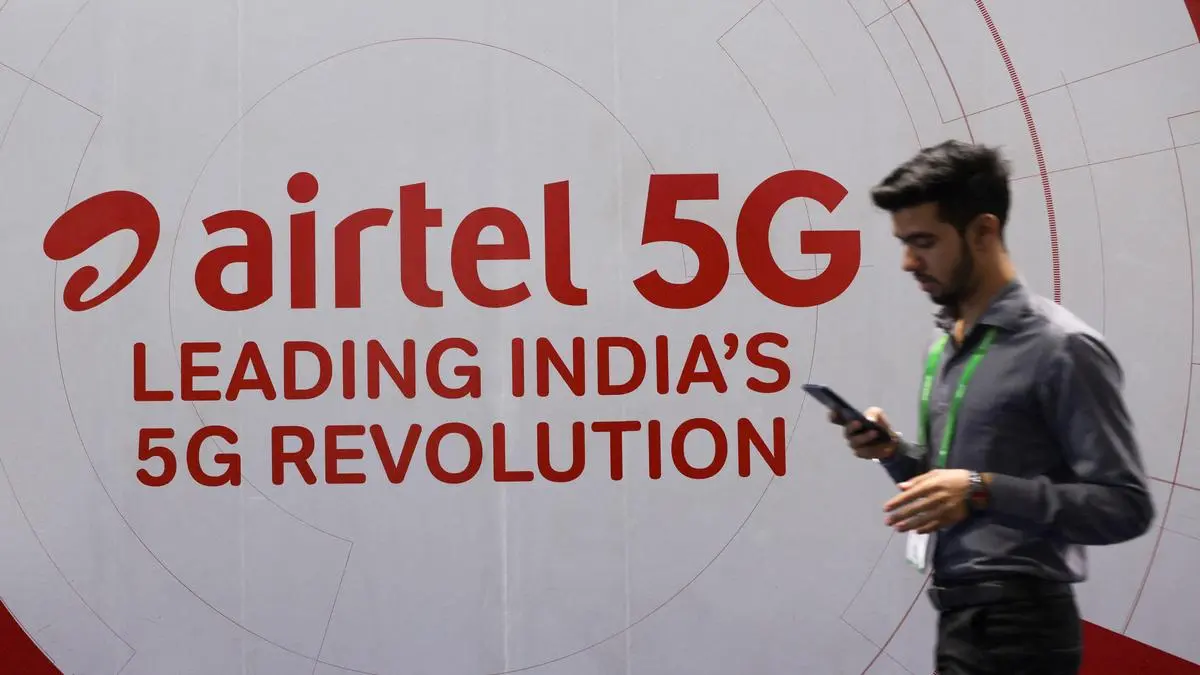
A Parliamentary panel headed by Nishikant Dubey has asked the Department of Telecommunications and Telecom Regulatory Authority of India to study the impact of 5G network slicing services in countries such as Singapore and the UK amid concerns over net neutrality and equal internet access. | Photo Credit: ANUSHREE FADNAVIS
Amid a growing debate triggered by the launch of Airtel Priority post-paid plan, a Parliamentary panel on Tuesday asked the Department of Telecommunications (DoT) and the Telecom Regulatory Authority of India (TRAI) to study the impact of 5G network slicing services in countries such as Singapore and the UK, while also examining whether the interests of India’s largely prepaid mobile subscriber base are adequately protected.
The Standing Committee on Communications and Information Technology, headed by BJP MP Nishikant Dubey, also decided to call major digital and social media companies, including Meta, X, Google and Amazon, for discussions on net neutrality and preferential access practices. The meeting was convened to review “Quality of Service (QoS) Standards and Consumer Protection in Telecom Sector,” with a specific focus on net neutrality.
The deliberations assume significance following the recent launch of Airtel Priority Postpaid, India’s first commercially announced 5G network slicing-based consumer offering. In a communication to users, Airtel said the technology had already been deployed in several Western markets and would allow the company to provide enhanced network capabilities exclusively to its Priority postpaid customers.
The move, however, has sparked concerns over whether telecom operators may begin offering differentiated quality of service to select categories of subscribers, potentially undermining the principle of equal internet access. According to a person familiar with the discussions, the committee sought detailed submissions from DoT and TRAI on how similar services have affected net neutrality frameworks globally.
“The Committee asked DoT and TRAI to present a study on the impact of 5G slicing in countries such as Singapore and the UK, among others. It also discussed what implications this could have for net neutrality, which is based on the principle of equality,” the person said.
Members of the panel also reportedly flagged concerns over the impact on prepaid subscribers, who account for nearly 90 per cent of India’s mobile user base. “Nearly 90 per cent users are having prepaid mobile connections. How can their rights be bypassed? DoT and TRAI have been asked to give a detailed response,” the person added.
5G network slicing enables telecom operators to partition a single physical network into multiple virtual networks, each optimised for specific performance requirements such as speed, latency or reliability. While one slice may support high-speed consumer broadband, others can be tailored for applications such as autonomous vehicles, remote healthcare or large-scale IoT connectivity.
After the meeting, Nishikant Dubey said the committee was examining whether telecom operators and digital platforms were creating preferential access structures for specific categories of users, including postpaid subscribers and paying customers on online platforms.
“We have to look after 140 crore people. All of them should get equal rights. Right of Equality,” Dubey said, while clarifying that the committee had not yet reached any conclusions and that discussions would continue in the coming weeks.
Published on May 26, 2026
此内容由惯性聚合(RSS阅读器)自动聚合整理,仅供阅读参考。 原文来自 — 版权归原作者所有。