







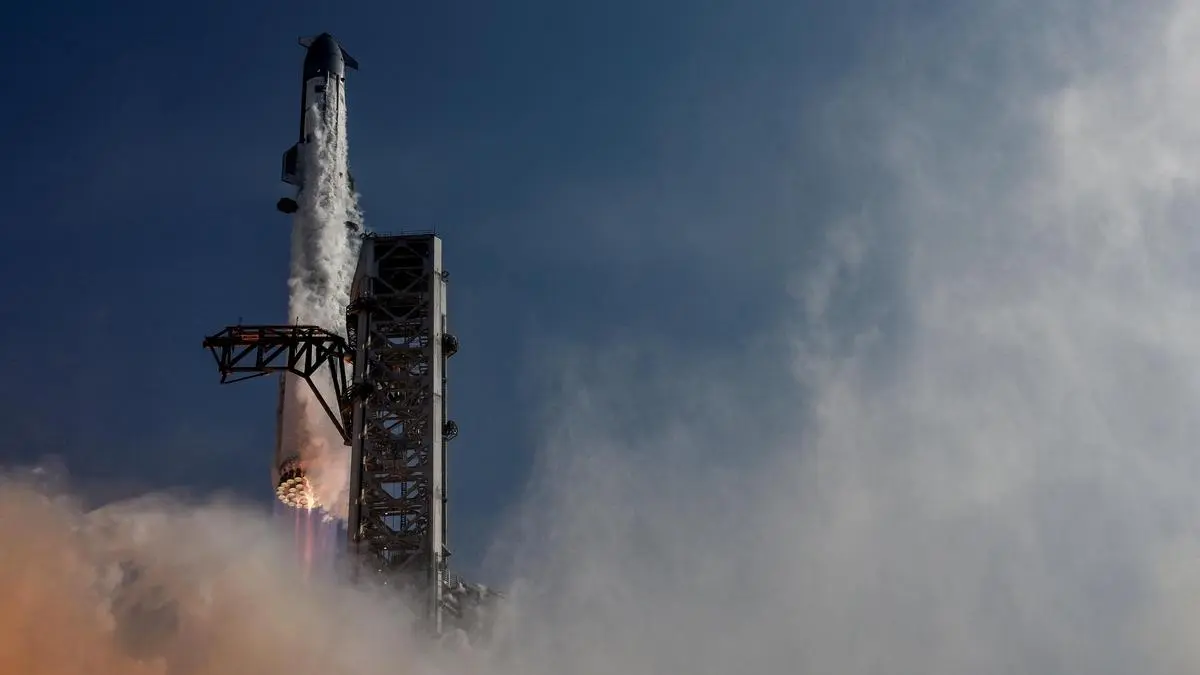
The SpaceX Starship and Super Heavy Booster lifts off on its 12th test flight from the SpaceX launch complex in Starbase, Texas, U.S., May 22, 2026. REUTERS/Steve Nesius | Photo Credit: STEVE NESIUS
SpaceX revealed eye-popping numbers in its IPO prospectus, including a $26.5 trillion potential market for an empire spanning artificial intelligence and telecommunications.
But another, comparatively low, number also stood out. SpaceX’s launch business only brought in roughly $4.1 billion of revenue last year. And ultimately, it lost money.
It’s a stark reality when considering the fact that launch is what made SpaceX the juggernaut that it is today. With its Falcon family, SpaceX pioneered the commercial viability of reusing rockets in a way similar to how airlines use jets, bringing down costs and forcing industry incumbents to rethink their business models.
Now, SpaceX holds a near-monopoly on the heavy-lift launch market and is by far the most crucial rocket provider for the US government — and much of the world. Chief Executive Officer Elon Musk is gearing up to launch the company’s prototype Starship rocket on a test flight as soon as Friday evening.
But what’s clear from SpaceX’s prospectus is that the revenue from its Starlink satellite broadband unit and the potential of its newly acquired AI business are now taking center stage.
“You definitely can’t underwrite this company as a launch company,” Chad Anderson, an early SpaceX investor and CEO of investment firm Space Capital, said. “Launch is a competitive advantage that enables the big money makers.”
What the budget numbers don’t show, however, is how vital that small piece is to Musk’s ambitions.
SpaceX’s Starship is the key that will unlock plans for future orbital AI data centers and expanding Starlink. That’s what makes the upcoming debut of the latest Starship, called V3, so crucial; the stakes are high for SpaceX to show the vehicle could work.
But on top of that, the impressive resume SpaceX established with its Falcon fleet and the rocket’s value to the marketplace are inextricably linked to the company’s success. And that past work will be a large part of the reason that future investors decide to jump into the company now.
“When we look at new investments, we not only look for companies that are innovating and can dominate existing markets; we get even more excited by companies generating new markets,” Shahin Farshchi, a partner at Lux Capital, said. “And what SpaceX achieved early in its life was to vastly expand the launch business.”
Still, SpaceX’s launch revenue pales in comparison to sales from Starlink. SpaceX’s connectivity segment generated $11.4 billion in revenue in 2025, up from the $7.6 billion in the previous year. And its subscriber base has been growing annually, Wednesday’s prospectus filing showed.
The biggest reason SpaceX has been able to put roughly 10,000 satellites in low-Earth orbit is its Falcon 9 fleet. In fact, SpaceX is its own biggest customer, with Starlink missions making up nearly 75 percent of all 165 Falcon 9 trips in 2025.
“We are our largest demand for launchers now,” SpaceX President Gwynne Shotwell told Time Magazine in March. “Starlink basically created this incredible demand for Falcon 9.”
Though Falcon 9 primarily supports Starlink missions, the vehicle is one of the only available options for commercial satellite operators to get large payloads to orbit, and is a key provider for both NASA and the Pentagon.
But despite scooping up most of the launch market, SpaceX is still limited in how much money it can make from that sector. Its foray into Starlink, and soon, orbital AI data centers, highlights a growing trend that has emerged among its rivals over the years: you have to branch out.
“Launch alone does not make a business,” Anderson said, adding that, “Launch is crucial. You need to secure your access to space. But also you need to have something to do when you’re there.”
Other companies like Rocket Lab Corp. and Firefly Aerospace Inc. have begun expanding beyond their primary business into satellite manufacturing, software, lunar landers and space communications.
SpaceX rival Blue Origin LLC has its hand in numerous space businesses, from launch to satellite systems and lunar landers. Even Vast Space LLC, which is working to build space stations, recently announced plans to start building satellites for customers.
But SpaceX’s key advantage over its competitors has always been that it has a working, reliable rocket with significant capability that can launch in a timescale of months, not years. And when it comes to competing with other hyperscalers in the AI market like Meta and Alphabet’s Google, SpaceX has the capacity and expertise that they don’t have.
Even Amazon.com Inc. needed to buy rocket launches from SpaceX to loft its satellites.
“Is launch not a good business because SpaceX is not making a huge amount of money on it? Well, the alternative is something like Amazon, which has spent over $11 billion dollars on launch alone, and even with that expenditure, they still can’t get their satellites on orbit,” said Chris Quilty, president of advisory firm Quilty Space.
There is one big wrinkle moving forward, though. SpaceX will eventually shift from Falcon to the more massive and complex Starship.
Designed to be fully reusable, Starship is proving to be much harder to develop and may not be ready to carry satellites in the near future. In fact, the massive capital expenditure on Starship, which amounted to $3 billion in 2025, is likely to blame for the net loss of SpaceX’s launch business.
“Starship is a key factor in the company’s future performance,” Anderson said. “The possibility of its delay or failure is the company’s top risk factor.”
More stories like this are available on bloomberg.com
Published on May 23, 2026
此内容由惯性聚合(RSS阅读器)自动聚合整理,仅供阅读参考。 原文来自 — 版权归原作者所有。